Hand-signed by the artist, with title, date, and edition number inscribed in ink on an archival label affixed to the reverse side of the mounted photograph.
We are kept on the near side of the ferns, at the height where their serrated fronds break into wet light, each blade beaded with dew that catches the yellow-green like small lenses. Beyond them the picture cools and clouds; a woman sits behind glass streaked with condensation, her face given to us only from the parted lips down, her arms folded, a ginkgo leaf suspended near her cheek. The garden is a threshold, and we have been placed among the growing things rather than beside her.
What organizes the frame is the argument between two kinds of clarity. The nearest fronds are exact, almost botanical, their toothed edges and hanging droplets rendered with a patience that borders on devotion. The figure is the opposite: softened, half-erased, a body dissolving into the leaves that overlap her chest and arm. To see her we must give up the ferns; to hold the ferns we lose her. The photograph makes that exchange its subject, and refuses to resolve it.
Harvey, who works from her garden in coastal Maine and has built books like Blue Violet and You an Orchestra a Bomb from exactly this register of color and weather, treats the domestic world as a place where feeling becomes visible. Here the greens do the emotional work, saturated to the edge of the synthetic yet earned by the dew. Printed as an archival pigment print, the surface holds every gradation of that green, from the lit blade in front to the drowned figure behind, so that the eye keeps traveling and never quite arrives.
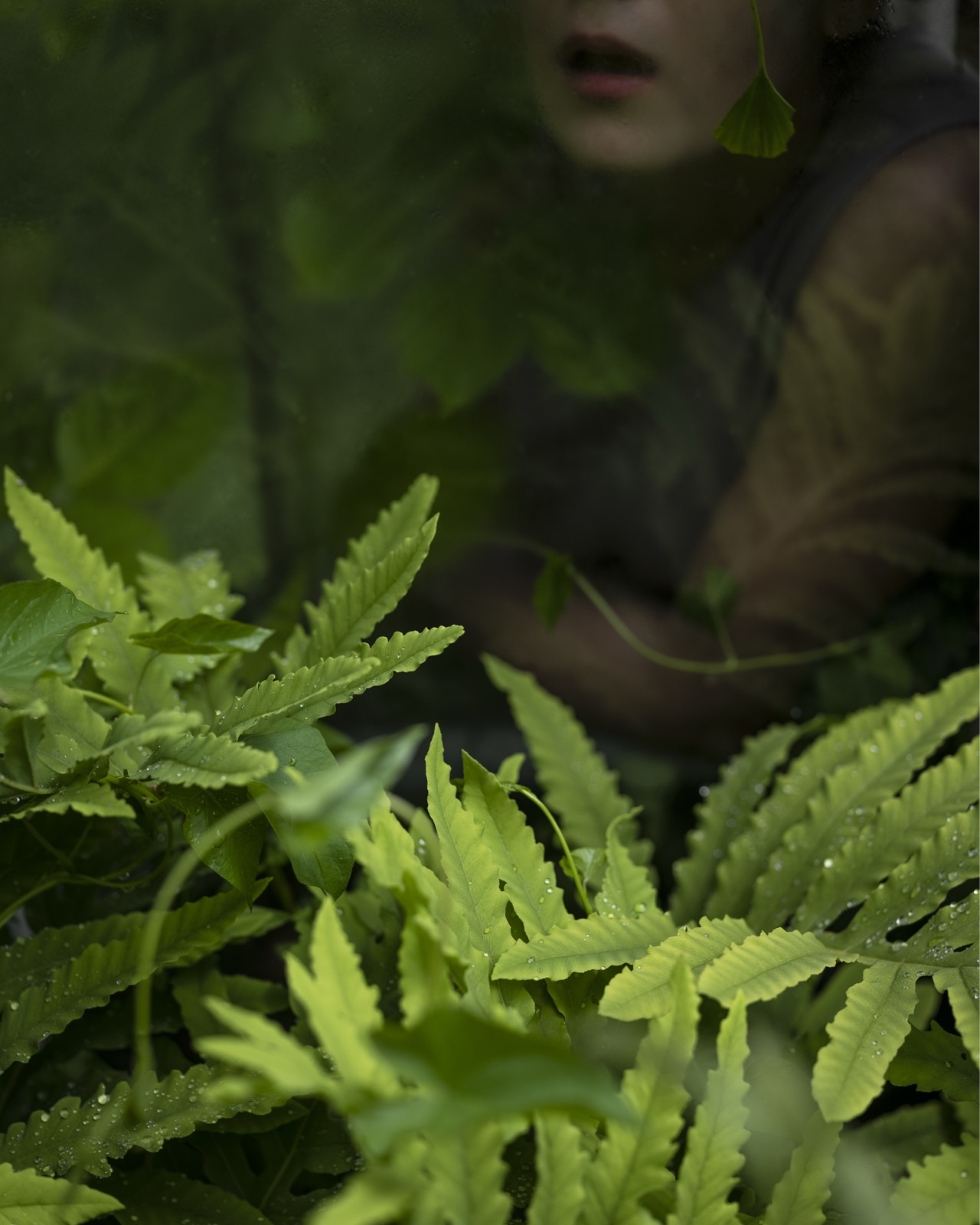

We are kept on the near side of the ferns, at the height where their serrated fronds break into wet light, each blade beaded with dew that catches the yellow-green like small lenses. Beyond them the picture cools and clouds; a woman sits behind glass streaked with condensation, her face given to us only from the parted lips down, her arms folded, a ginkgo leaf suspended near her cheek. The garden is a threshold, and we have been placed among the growing things rather than beside her.
What organizes the frame is the argument between two kinds of clarity. The nearest fronds are exact, almost botanical, their toothed edges and hanging droplets rendered with a patience that borders on devotion. The figure is the opposite: softened, half-erased, a body dissolving into the leaves that overlap her chest and arm. To see her we must give up the ferns; to hold the ferns we lose her. The photograph makes that exchange its subject, and refuses to resolve it.
Harvey, who works from her garden in coastal Maine and has built books like Blue Violet and You an Orchestra a Bomb from exactly this register of color and weather, treats the domestic world as a place where feeling becomes visible. Here the greens do the emotional work, saturated to the edge of the synthetic yet earned by the dew. Printed as an archival pigment print, the surface holds every gradation of that green, from the lit blade in front to the drowned figure behind, so that the eye keeps traveling and never quite arrives.