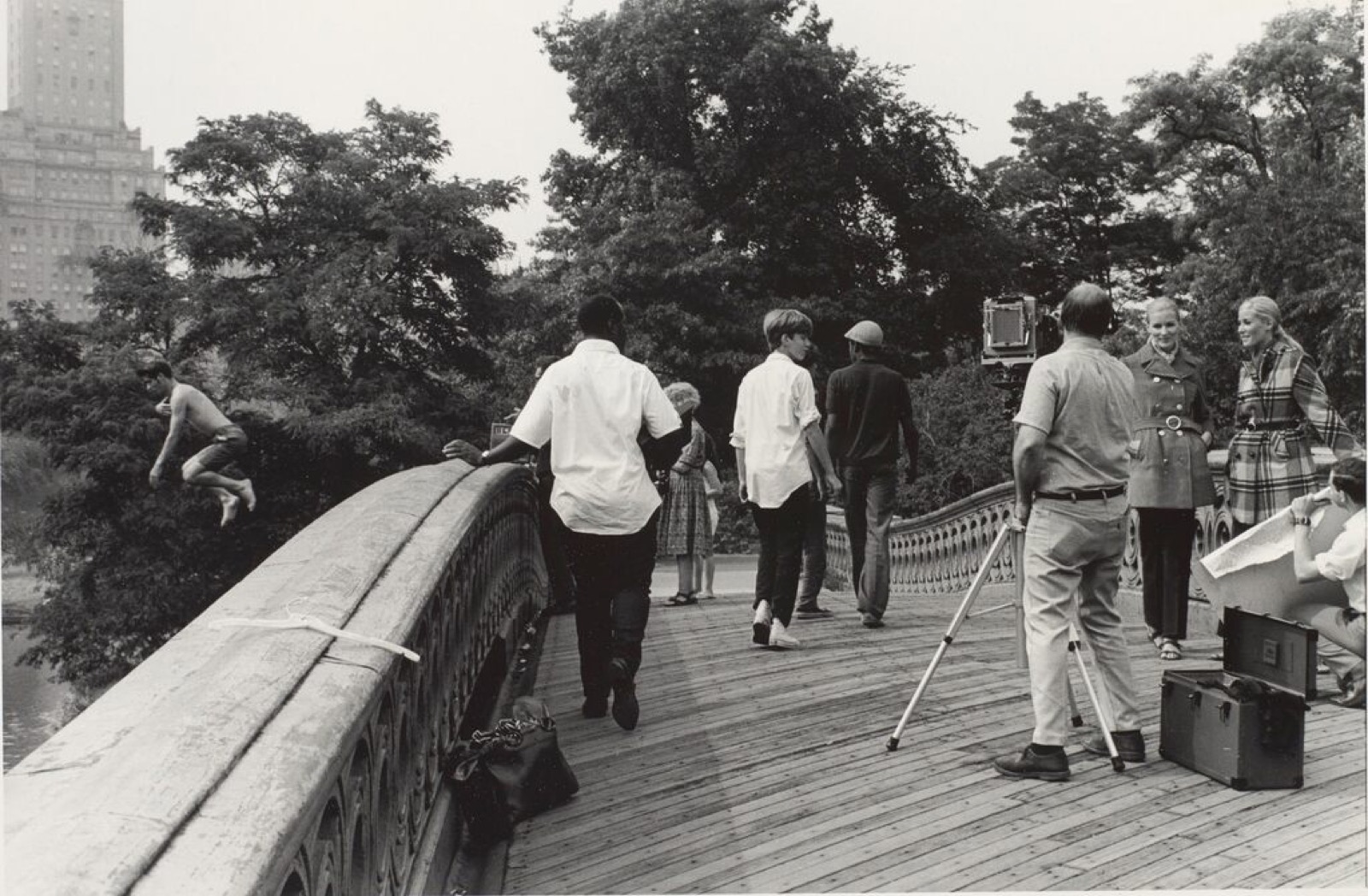
Worn planks run the length of the bridge over the Central Park lake, and a cast-iron balustrade curves off toward the bank where the summer trees close the view. At the far left a barefoot boy has hooked one leg over the coping and hangs above the water, shirtless, mid-vault, a private leap no one has turned to watch. The deck is busy with strangers on separate errands, and beyond them the towers of Central Park West rise pale into a bleached sky.
What the bridge really carries is a fashion shoot. A tall view camera stands on its tripod; a photographer in a light shirt bends to it, back to us, aiming at two models on the right, one belted, one in a plaid coat, while an assistant kneels among silver equipment cases and a folded white sheet. Their apparatus faces one way and will record only what it is paid to see. The boy at the rail falls outside that frame, and the moment’s ethics lie in the gap.
Meyerowitz set himself aslant to both economies, close enough to hold commerce and play in a single exposure. These are his street years, worked in the spirit of Robert Frank, before the view camera and the luminous colour that would make his name beside Shore and Eggleston. Printed later as an archival pigment print, the picture keeps the summer haze and the grain of that afternoon uncorrected. His work is held at the Modern, the Met and the Boston MFA, and it rewards anyone who lets the whole bridge speak.
Worn planks run the length of the bridge over the Central Park lake, and a cast-iron balustrade curves off toward the bank where the summer trees close the view. At the far left a barefoot boy has hooked one leg over the coping and hangs above the water, shirtless, mid-vault, a private leap no one has turned to watch. The deck is busy with strangers on separate errands, and beyond them the towers of Central Park West rise pale into a bleached sky.
What the bridge really carries is a fashion shoot. A tall view camera stands on its tripod; a photographer in a light shirt bends to it, back to us, aiming at two models on the right, one belted, one in a plaid coat, while an assistant kneels among silver equipment cases and a folded white sheet. Their apparatus faces one way and will record only what it is paid to see. The boy at the rail falls outside that frame, and the moment’s ethics lie in the gap.
Meyerowitz set himself aslant to both economies, close enough to hold commerce and play in a single exposure. These are his street years, worked in the spirit of Robert Frank, before the view camera and the luminous colour that would make his name beside Shore and Eggleston. Printed later as an archival pigment print, the picture keeps the summer haze and the grain of that afternoon uncorrected. His work is held at the Modern, the Met and the Boston MFA, and it rewards anyone who lets the whole bridge speak.