Photography has a gift for pairing what history meant to keep apart. Here a lunar space suit, white and hose-laced, stands sealed in a museum window under a label reading LUNAR SPACE SUIT, its gold visor lowered over a face that isn’t there. A step to the right, on the granite base of the building, an old man in a bowler hat has settled himself, waistcoat buttoned, two-tone shoes crossed at the ankle, a relic of an earlier New York parked beside the relic of the future.
The claim the picture tests is whether these two figures belong to the same city, and it decides that they do. Both are upright, both are on display; the suit is a body without a man, the man a body the suit’s era has already dated. Meyerowitz lets the flat museum glass and the mottled stone wall carry the argument, dividing the frame down the doorway so that space age and bowler age hold equal ground. The photograph makes the joke and the elegy at once.
By 1970 he was among the photographers proving the street could carry ideas as large as any studio, working still in black and white, in the descriptive spirit of Robert Frank, before the view camera and the colour of Cape Light. This frame belongs to that sociable New York eye. Issued now as an archival pigment print made later, it holds its silver detail, the grain of the granite, the seams of the suit. His pictures are held at the Modern, the Met and the Boston MFA.
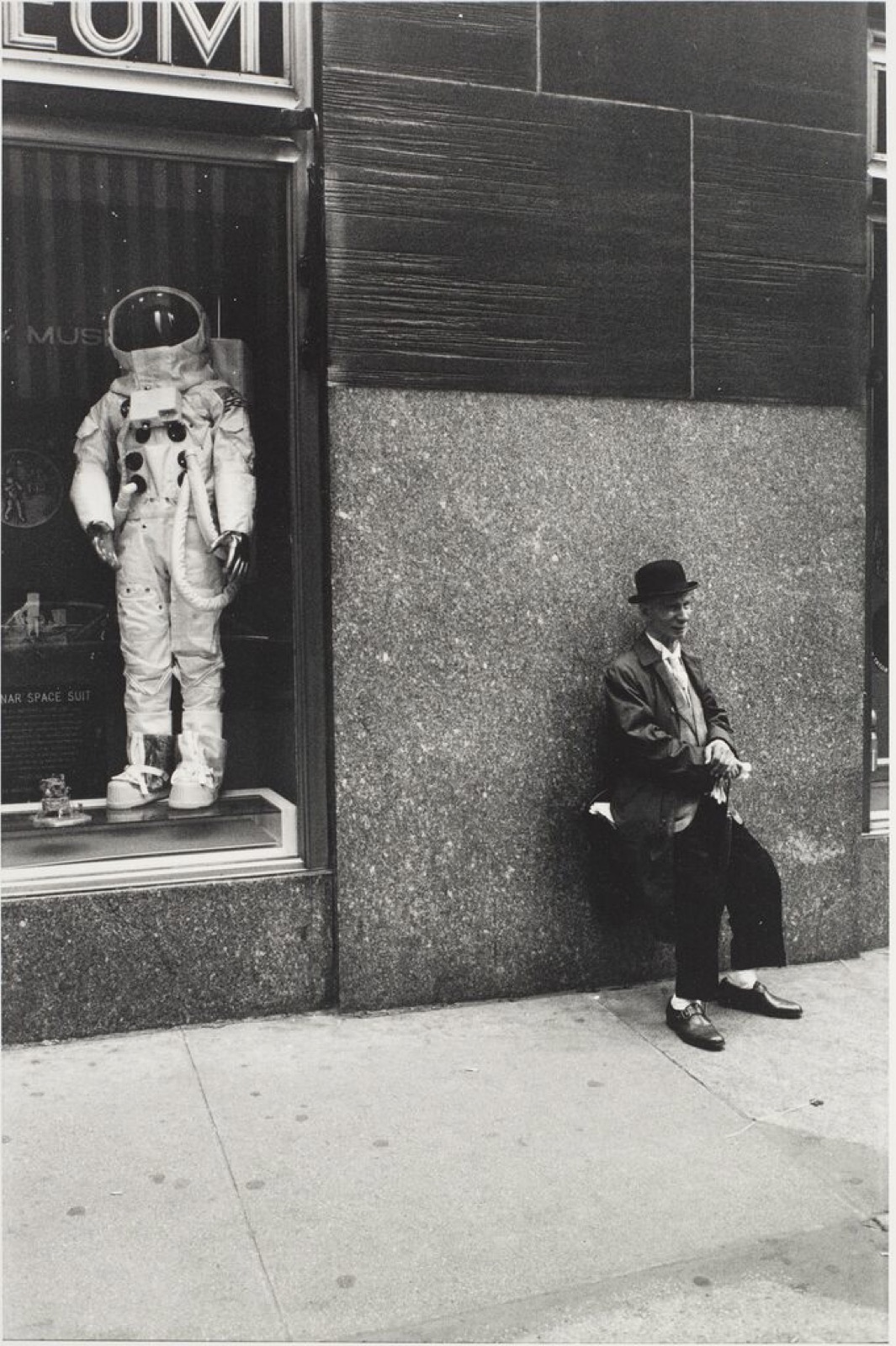

Photography has a gift for pairing what history meant to keep apart. Here a lunar space suit, white and hose-laced, stands sealed in a museum window under a label reading LUNAR SPACE SUIT, its gold visor lowered over a face that isn’t there. A step to the right, on the granite base of the building, an old man in a bowler hat has settled himself, waistcoat buttoned, two-tone shoes crossed at the ankle, a relic of an earlier New York parked beside the relic of the future.
The claim the picture tests is whether these two figures belong to the same city, and it decides that they do. Both are upright, both are on display; the suit is a body without a man, the man a body the suit’s era has already dated. Meyerowitz lets the flat museum glass and the mottled stone wall carry the argument, dividing the frame down the doorway so that space age and bowler age hold equal ground. The photograph makes the joke and the elegy at once.
By 1970 he was among the photographers proving the street could carry ideas as large as any studio, working still in black and white, in the descriptive spirit of Robert Frank, before the view camera and the colour of Cape Light. This frame belongs to that sociable New York eye. Issued now as an archival pigment print made later, it holds its silver detail, the grain of the granite, the seams of the suit. His pictures are held at the Modern, the Met and the Boston MFA.