A house photographed at dusk is always a house someone has just left, or is about to. Here the proof is small and ordinary: a single ground-floor window lit warm behind a half-drawn curtain while every other pane stays cold and reflective, the dim sky pressing in around a brick tower of a house too narrow for its three storeys. The light says occupied; everything else says exposed.
To photograph a building this way is to make an argument about loneliness without naming it. The house stands by itself on a graded lot, flanked by two cars that do not match — an old dark sedan tilted in the dirt to the left, a white one parked on bare asphalt to the right — as if the structure had outlived whatever neighborhood once squared it. Telephone wires fan out overhead toward houses we cannot see, a web of connection to an absent world. The snow has half-melted into the road in dirty, deliberate patches, and a storm grate sits in the foreground like a small black mouth. Nothing is staged, and yet nothing is accidental.
The image belongs to the long open project the artist titles only by number, the suburban-nocturne sequence gathered in *House Hunting*, where the lit window is the recurring evidence of a life kept just out of reach. What such a picture withholds is the interior; what it offers is our own suspicion that the warmth behind that curtain is the only thing holding the cold structure up. The camera does not enter. It waits at the curb, where we wait too, and that waiting is the whole of what it knows.
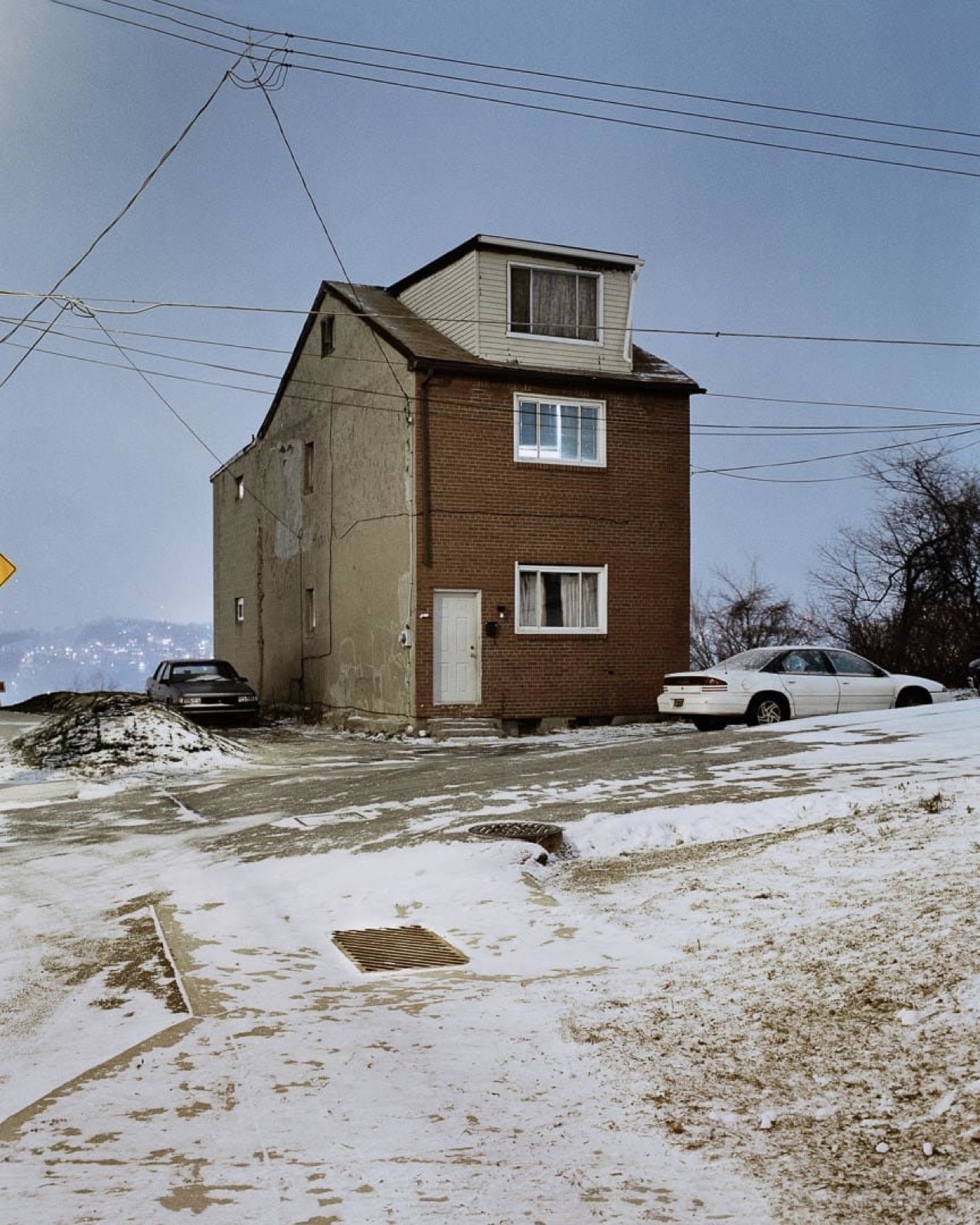

A house photographed at dusk is always a house someone has just left, or is about to. Here the proof is small and ordinary: a single ground-floor window lit warm behind a half-drawn curtain while every other pane stays cold and reflective, the dim sky pressing in around a brick tower of a house too narrow for its three storeys. The light says occupied; everything else says exposed.
To photograph a building this way is to make an argument about loneliness without naming it. The house stands by itself on a graded lot, flanked by two cars that do not match — an old dark sedan tilted in the dirt to the left, a white one parked on bare asphalt to the right — as if the structure had outlived whatever neighborhood once squared it. Telephone wires fan out overhead toward houses we cannot see, a web of connection to an absent world. The snow has half-melted into the road in dirty, deliberate patches, and a storm grate sits in the foreground like a small black mouth. Nothing is staged, and yet nothing is accidental.
The image belongs to the long open project the artist titles only by number, the suburban-nocturne sequence gathered in *House Hunting*, where the lit window is the recurring evidence of a life kept just out of reach. What such a picture withholds is the interior; what it offers is our own suspicion that the warmth behind that curtain is the only thing holding the cold structure up. The camera does not enter. It waits at the curb, where we wait too, and that waiting is the whole of what it knows.