There's a One Way sign bolted to a post in the middle of this picture, pointing left, and the first thing I want to know is: one way to where? Nobody's driving anywhere. It's the kind of municipal instruction that survives long after anyone's left to obey it, and here it sits, mid-frame, deadpan, the only thing in the photograph still claiming to give directions. Everything else has gone quiet. The house has that pale, slightly swollen look clapboard gets at night, two volumes shoved together at an awkward seam, and over one upstairs window someone has tacked a sheet of plastic that the streetlight has turned into a dull silver patch — winterizing, or just not getting round to the glass yet. You can't tell. That's the whole game.
What gets me is the light leaking from the downstairs rooms. Not dramatic, just on. Somebody is home, or was, or left it burning, and the camera has waited in the cold yard with its patched fencing and its bare branches scribbled across the siding until the blue of the sky went that impossible, saturated cobalt you only get in a long exposure when the eye has long since stopped seeing it. The branches do half the composing, laying their shadow-net over the wall.
This is Todd Hido at the heart of House Hunting, the series that made his name and put him into the SFMOMA and Whitney collections — driving suburban dark, photographing from the road into houses he never enters. The strange thing is how little it judges. You keep waiting for the menace and it never quite arrives; what arrives instead is something closer to tenderness, the recognition that someone, somewhere behind that lit window, is also just getting through the evening. One way. As if there were ever another.
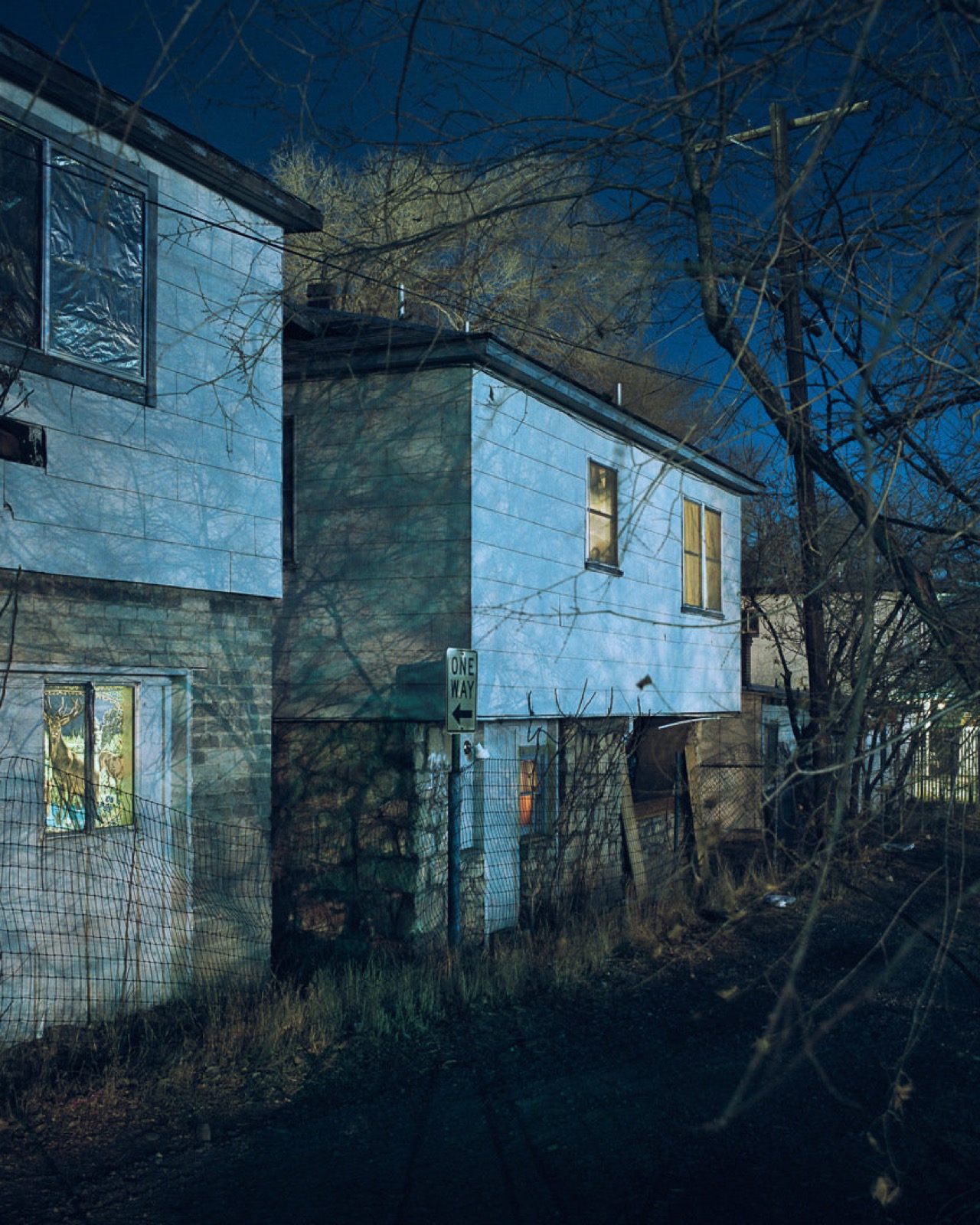

There's a One Way sign bolted to a post in the middle of this picture, pointing left, and the first thing I want to know is: one way to where? Nobody's driving anywhere. It's the kind of municipal instruction that survives long after anyone's left to obey it, and here it sits, mid-frame, deadpan, the only thing in the photograph still claiming to give directions. Everything else has gone quiet. The house has that pale, slightly swollen look clapboard gets at night, two volumes shoved together at an awkward seam, and over one upstairs window someone has tacked a sheet of plastic that the streetlight has turned into a dull silver patch — winterizing, or just not getting round to the glass yet. You can't tell. That's the whole game.
What gets me is the light leaking from the downstairs rooms. Not dramatic, just on. Somebody is home, or was, or left it burning, and the camera has waited in the cold yard with its patched fencing and its bare branches scribbled across the siding until the blue of the sky went that impossible, saturated cobalt you only get in a long exposure when the eye has long since stopped seeing it. The branches do half the composing, laying their shadow-net over the wall.
This is Todd Hido at the heart of House Hunting, the series that made his name and put him into the SFMOMA and Whitney collections — driving suburban dark, photographing from the road into houses he never enters. The strange thing is how little it judges. You keep waiting for the menace and it never quite arrives; what arrives instead is something closer to tenderness, the recognition that someone, somewhere behind that lit window, is also just getting through the evening. One way. As if there were ever another.