The blue-grey weather is not this picture’s setting; it is the material the picture is made from. Rain and mist have been allowed to settle between lens and world, most likely on the glass of a car window, and every form pays a toll: the lone bare tree softens to a nerve-ending silhouette, the dirt road loses its edges as it climbs the rise, snow lies in the ruts like static. Photographers once waited out days like this one. Here the day itself does the developing.
Photography usually flatters us with proximity: look how close, how crisp, how present. This image argues the opposite case. It testifies to distance, to the fact that most of what we see from a moving car we see poorly, briefly, through weather and glass and thought. The tree holds the composition the way a comma holds a sentence, a pause where the road bends and memory takes over from observation. If it resembles a watercolor, that is not a betrayal of photography but a reminder of how much of seeing is already blur.
The photographer, born in Ohio and based in the San Francisco Bay Area, has made the view from the driver’s seat one of the signal genres of contemporary American photography, alongside his glowing houses at night. He gives his pictures numbers, not anecdotes; museums including SFMOMA, the Getty and the Whitney hold his prints. In this archival pigment print the long gradations survive, slate blue into dove grey, and the blur keeps its place between the eye and the world, which is where he found it.
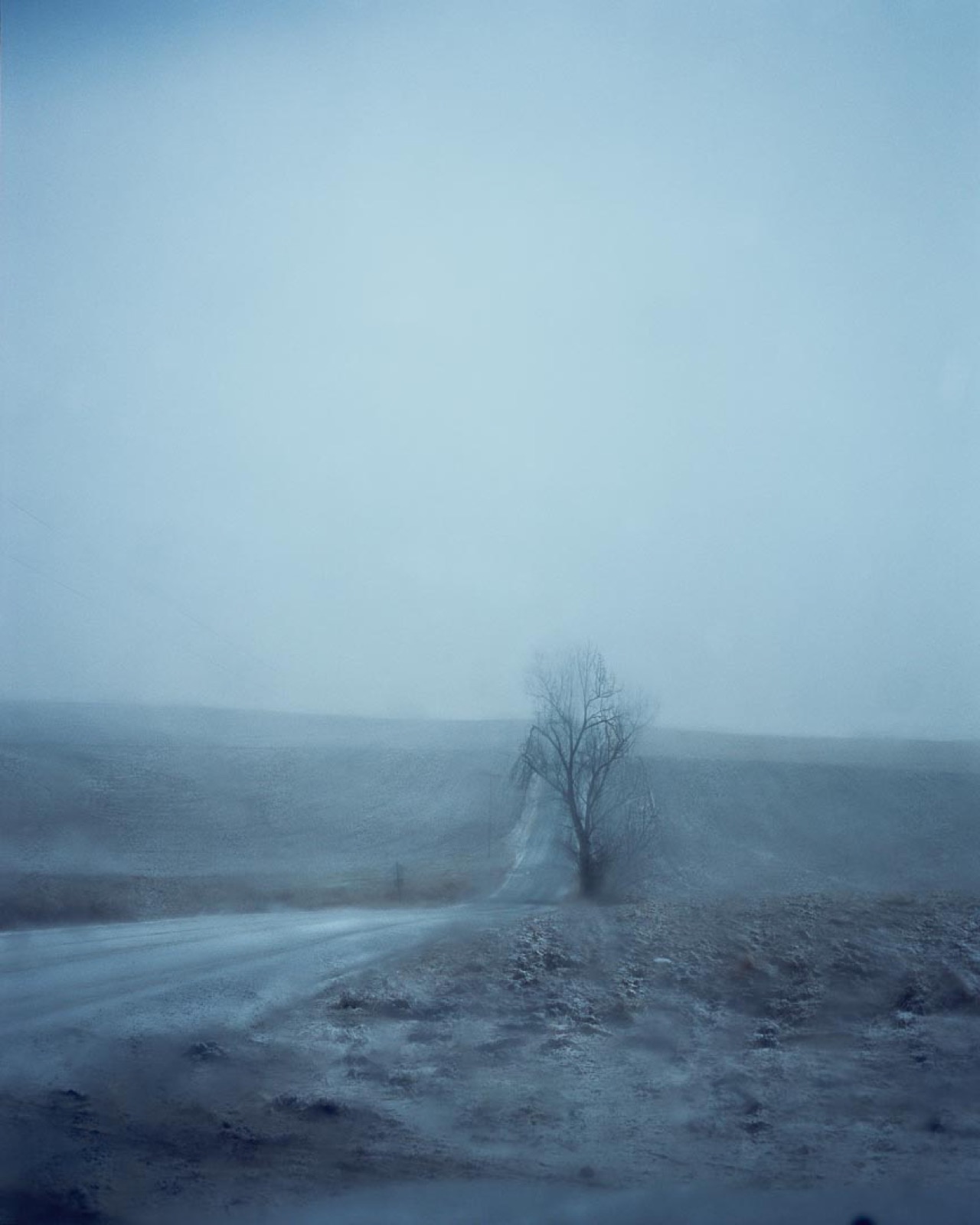
The blue-grey weather is not this picture’s setting; it is the material the picture is made from. Rain and mist have been allowed to settle between lens and world, most likely on the glass of a car window, and every form pays a toll: the lone bare tree softens to a nerve-ending silhouette, the dirt road loses its edges as it climbs the rise, snow lies in the ruts like static. Photographers once waited out days like this one. Here the day itself does the developing.
Photography usually flatters us with proximity: look how close, how crisp, how present. This image argues the opposite case. It testifies to distance, to the fact that most of what we see from a moving car we see poorly, briefly, through weather and glass and thought. The tree holds the composition the way a comma holds a sentence, a pause where the road bends and memory takes over from observation. If it resembles a watercolor, that is not a betrayal of photography but a reminder of how much of seeing is already blur.
The photographer, born in Ohio and based in the San Francisco Bay Area, has made the view from the driver’s seat one of the signal genres of contemporary American photography, alongside his glowing houses at night. He gives his pictures numbers, not anecdotes; museums including SFMOMA, the Getty and the Whitney hold his prints. In this archival pigment print the long gradations survive, slate blue into dove grey, and the blur keeps its place between the eye and the world, which is where he found it.