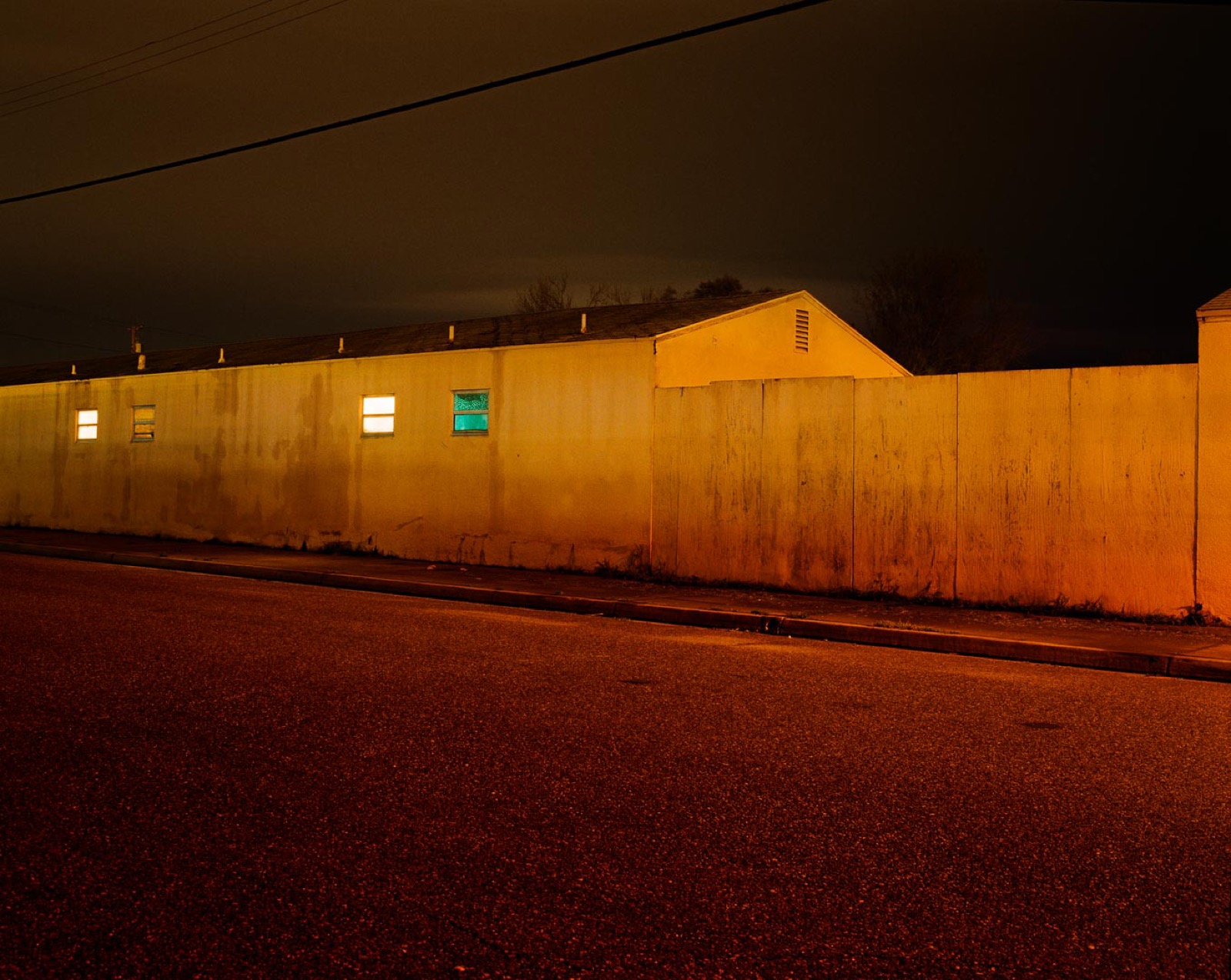
American night seeing has a lineage, from Hopper’s lit rooms to Robert Adams’s moonlit tract houses, and this long stucco wall under sodium light joins it quietly, without asking permission. The street in the foreground lies empty, a wide expanse of asphalt burnished to rust by the streetlight. A plywood fence takes the same amber as the building it adjoins, wall and fence becoming one rampart against the dark trees, while power lines cross the sky like an afterthought of the grid.
Three windows interrupt the wall. One burns white. One has gone dim. The third glows an underwater green, a small aquarium of privacy set into the stucco. Who is awake in there, and what is the color keeping safe? The photograph does not say, and its reticence is a form of courtesy. To photograph other people’s houses at night is to stand at the exact border of belonging, close enough to see the light, too far to be warmed by it. The picture holds that border and does not cross.
The photographer was born in Kent, Ohio, and works from the San Francisco Bay Area; his luminous pictures of houses at night made his name, and his fogged roads extended it. He numbers his images rather than naming them, an austerity the work rewards. Prints are held by SFMOMA, the Getty and the Whitney. In this archival pigment print the ambers stay deep and the one green window keeps its strangeness. Years from now it will still be where your eye goes first, and what it understands last.

American night seeing has a lineage, from Hopper’s lit rooms to Robert Adams’s moonlit tract houses, and this long stucco wall under sodium light joins it quietly, without asking permission. The street in the foreground lies empty, a wide expanse of asphalt burnished to rust by the streetlight. A plywood fence takes the same amber as the building it adjoins, wall and fence becoming one rampart against the dark trees, while power lines cross the sky like an afterthought of the grid.
Three windows interrupt the wall. One burns white. One has gone dim. The third glows an underwater green, a small aquarium of privacy set into the stucco. Who is awake in there, and what is the color keeping safe? The photograph does not say, and its reticence is a form of courtesy. To photograph other people’s houses at night is to stand at the exact border of belonging, close enough to see the light, too far to be warmed by it. The picture holds that border and does not cross.
The photographer was born in Kent, Ohio, and works from the San Francisco Bay Area; his luminous pictures of houses at night made his name, and his fogged roads extended it. He numbers his images rather than naming them, an austerity the work rewards. Prints are held by SFMOMA, the Getty and the Whitney. In this archival pigment print the ambers stay deep and the one green window keeps its strangeness. Years from now it will still be where your eye goes first, and what it understands last.