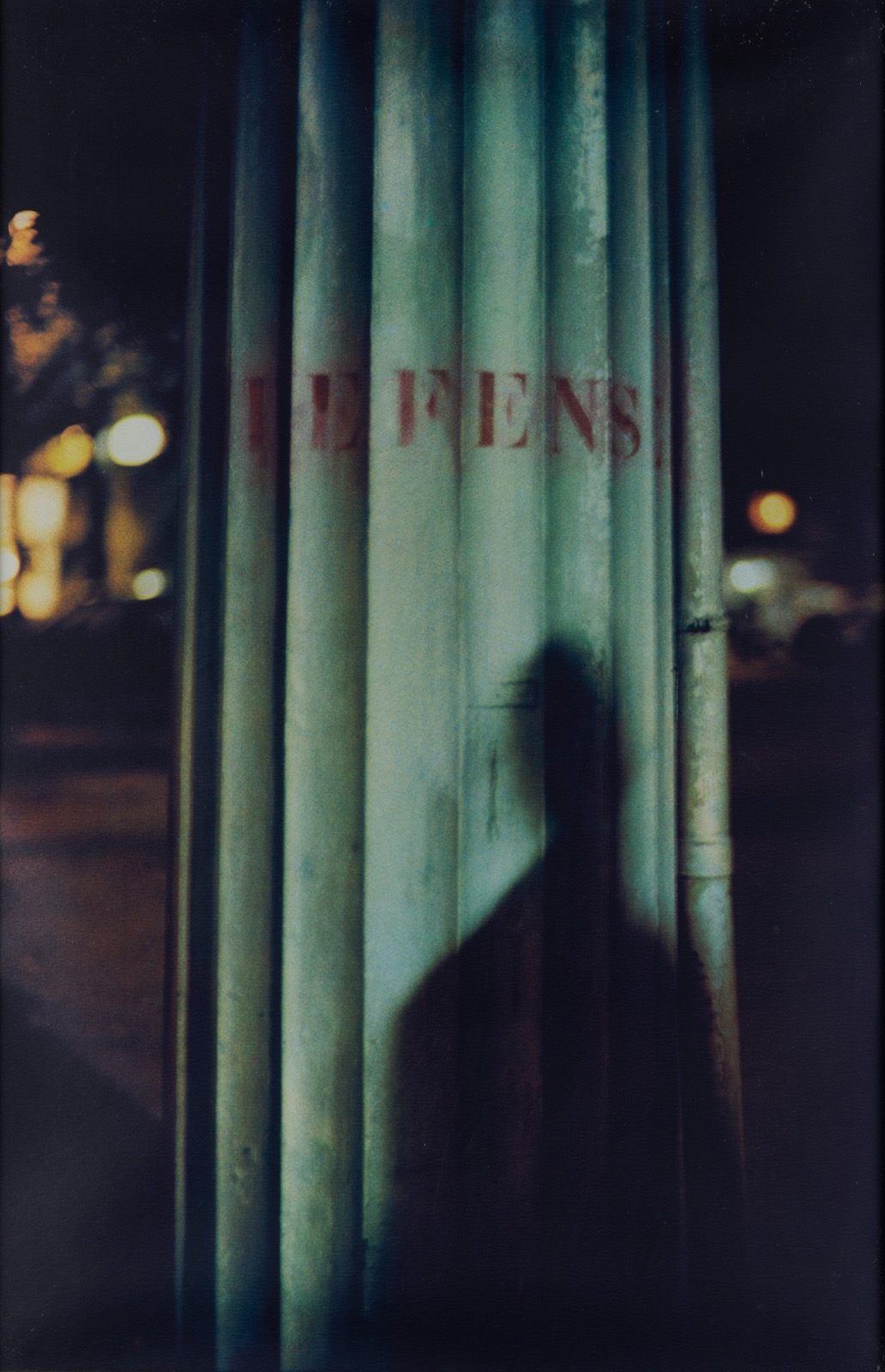
The first thing is the green, that aquarium green washing down the fluted column at the centre of everything, a colour no ordinary film would give you and only the Fresson process, with its slow hand-laid pigment, seems able to dream. It is night, and the column stands lit from somewhere off to the left while the rest of the world dissolves into bruised blues and a smear of amber where the streetlamps go soft. You read the word before you read anything else, because it is red and the rest is not: DÉFENSE, stencilled across the metal, half eaten by rust and shadow, an order and a placename at once.
Then you notice the figure, and it stops you. Not a person but a person's shadow, thrown onto the column, a dark hooded silhouette with no face, leaning into the curved surface as if it had walked there to wait. It could be the photographer, it could be anyone; the wonderful thing is that she lets it stay anonymous, a presence rather than a portrait. Defence against what, you start to wonder, and the picture won't tell you. That withholding is the whole mood.
What lingers is how a piece of municipal nothing—a column, a bit of paint, a passing shadow—becomes this charged, almost cinematic still, the Paris of dream rather than of postcards. Marat made the saturated nocturne her own across decades, and French public collections hold her for good reason. A vintage Fresson print like this is the work itself, that impossible green pressed into paper, irreplaceable and quietly alive.
The first thing is the green, that aquarium green washing down the fluted column at the centre of everything, a colour no ordinary film would give you and only the Fresson process, with its slow hand-laid pigment, seems able to dream. It is night, and the column stands lit from somewhere off to the left while the rest of the world dissolves into bruised blues and a smear of amber where the streetlamps go soft. You read the word before you read anything else, because it is red and the rest is not: DÉFENSE, stencilled across the metal, half eaten by rust and shadow, an order and a placename at once.
Then you notice the figure, and it stops you. Not a person but a person's shadow, thrown onto the column, a dark hooded silhouette with no face, leaning into the curved surface as if it had walked there to wait. It could be the photographer, it could be anyone; the wonderful thing is that she lets it stay anonymous, a presence rather than a portrait. Defence against what, you start to wonder, and the picture won't tell you. That withholding is the whole mood.
What lingers is how a piece of municipal nothing—a column, a bit of paint, a passing shadow—becomes this charged, almost cinematic still, the Paris of dream rather than of postcards. Marat made the saturated nocturne her own across decades, and French public collections hold her for good reason. A vintage Fresson print like this is the work itself, that impossible green pressed into paper, irreplaceable and quietly alive.