Coming soon, the window promises, and promises it backwards: the red words are scrawled on the far side of the glass, addressed to the interior, so the street receives its sales pitch as a spell in mirror writing. To read it straight we would have to stand where the doll stands. Around the words, a delirium of grease-pencil diagrams, clocks, hatchings, spirals, and one enormous black 66, while a couturier’s white signature floats above like a seal on the whole transaction. Commerce here talks to itself, and the camera eavesdrops.
What the glass displays is a body reduced to its selling points: two long legs, wax-pale, doll-smooth, cropped at the hip by the frame and branded at the thigh by the number. They balance on black heels in a bed of white gravel, and to the right a hand with lacquered red nails grips a black bag, nails matched exactly to the vandal red of the scrawl. Woman or effigy? The title says doll; the photograph declines to reassure us. The shop window teaches us to desire in fragments; photography, cropping expertly, was always its best pupil.
The maker of this image, Barcelona-born and long established at the front rank of Spanish fashion photography, shot it in his own city, and the intimacy shows: he knows exactly where the street’s glamour curdles into strangeness. As an archival pigment print it keeps the scene’s forensic clarity, the reds acid, the blacks unbruised, the glass a skin of markings between us and the merchandise. The window advertises what is coming soon. The photograph, less polite, records what was already there.
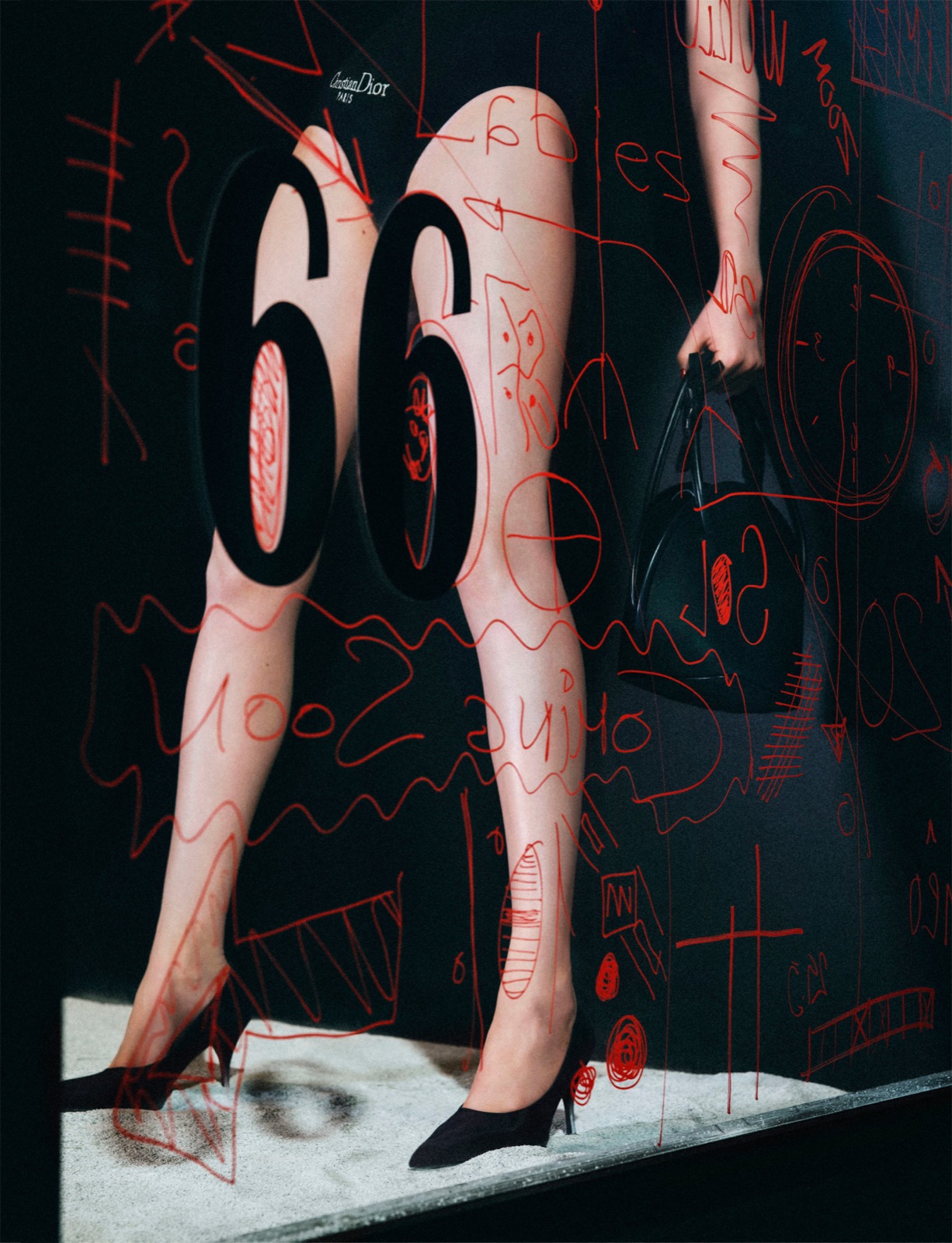

Coming soon, the window promises, and promises it backwards: the red words are scrawled on the far side of the glass, addressed to the interior, so the street receives its sales pitch as a spell in mirror writing. To read it straight we would have to stand where the doll stands. Around the words, a delirium of grease-pencil diagrams, clocks, hatchings, spirals, and one enormous black 66, while a couturier’s white signature floats above like a seal on the whole transaction. Commerce here talks to itself, and the camera eavesdrops.
What the glass displays is a body reduced to its selling points: two long legs, wax-pale, doll-smooth, cropped at the hip by the frame and branded at the thigh by the number. They balance on black heels in a bed of white gravel, and to the right a hand with lacquered red nails grips a black bag, nails matched exactly to the vandal red of the scrawl. Woman or effigy? The title says doll; the photograph declines to reassure us. The shop window teaches us to desire in fragments; photography, cropping expertly, was always its best pupil.
The maker of this image, Barcelona-born and long established at the front rank of Spanish fashion photography, shot it in his own city, and the intimacy shows: he knows exactly where the street’s glamour curdles into strangeness. As an archival pigment print it keeps the scene’s forensic clarity, the reds acid, the blacks unbruised, the glass a skin of markings between us and the merchandise. The window advertises what is coming soon. The photograph, less polite, records what was already there.