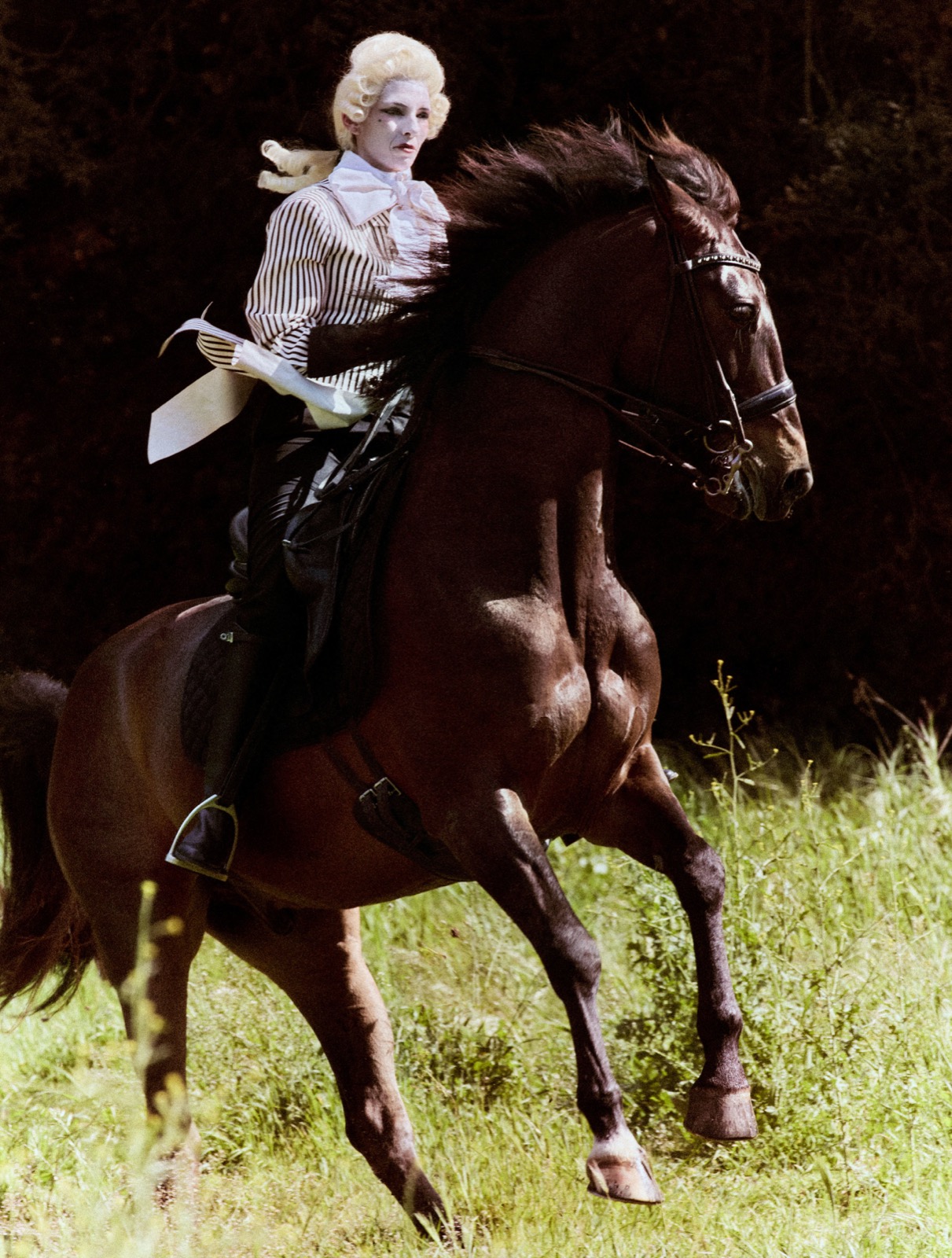
The light arrives late and low, sidelong, setting the tall grass alight in acid green while the wood behind sinks into near-black. Out of that darkness a bay horse breaks forward, glossy, mid-stride, and on its back a rider from another century: a powdered blonde wig, its ringlets streaming sideways in the same wind that flattens the mane, a face painted chalk-white above a striped blouse and a loosened jabot. The weather in the picture is entirely the sun’s doing.
What holds me, though, is a small undoing at the throat: the white jabot has come loose and lifts, a scrap of froth escaping the collar, and in that one detail the whole aristocratic fiction slips. The costume wants the eighteenth century; the loosened ruffle belongs only to now, to this gallop, to the second the shutter opened. I cannot keep my eye on the horse’s beautiful strain. It drifts back to that fluttering white, the place where the pose forgets itself and becomes merely, thrillingly, alive.
Yeste keeps his base near Barcelona, and this belongs to the elemental thread that runs under his fashion work — wind, light, heat — beneath the sheen of Numéro, Harper’s Bazaar and Vogue. As an archival pigment print the greens hold their sunlit acidity and the horse its deep liquid brown, the two so close in value that the rider’s pale wig and painted face float free of both. I keep returning to it the way one returns to a dream of speed: something classical, something wild, and a white ruffle that will not stay in place.
The light arrives late and low, sidelong, setting the tall grass alight in acid green while the wood behind sinks into near-black. Out of that darkness a bay horse breaks forward, glossy, mid-stride, and on its back a rider from another century: a powdered blonde wig, its ringlets streaming sideways in the same wind that flattens the mane, a face painted chalk-white above a striped blouse and a loosened jabot. The weather in the picture is entirely the sun’s doing.
What holds me, though, is a small undoing at the throat: the white jabot has come loose and lifts, a scrap of froth escaping the collar, and in that one detail the whole aristocratic fiction slips. The costume wants the eighteenth century; the loosened ruffle belongs only to now, to this gallop, to the second the shutter opened. I cannot keep my eye on the horse’s beautiful strain. It drifts back to that fluttering white, the place where the pose forgets itself and becomes merely, thrillingly, alive.
Yeste keeps his base near Barcelona, and this belongs to the elemental thread that runs under his fashion work — wind, light, heat — beneath the sheen of Numéro, Harper’s Bazaar and Vogue. As an archival pigment print the greens hold their sunlit acidity and the horse its deep liquid brown, the two so close in value that the rider’s pale wig and painted face float free of both. I keep returning to it the way one returns to a dream of speed: something classical, something wild, and a white ruffle that will not stay in place.