A moment ago the car was moving, and in a moment it will move again; this is the pause between, when the road ahead simply presents itself and asks to be looked at. Snow has taken the lane and smoothed it, and the tire tracks running up the middle are ours or someone’s just before us, a set of parallel lines drawn toward a sun that hangs, pale and enormous, in a sky gone soft with condensation on the glass. The windshield has become a second weather.
Everything here is on its way to disappearing. A dark stand of pines leans in from the left, half dissolved into the fog it stands against; a single telephone pole keeps its post beside the road, the last upright thing before the land gives way to rolling white hills on the right. The picture is calm to the point of reverence, and yet a low unease travels with it, the sense of driving into a brightness that will not tell you what it is or where it ends.
This is a picture about the ethics of the passing glance, the way a place seen from a car is possessed and abandoned in the same second. Hido has spent decades refining this look, the North American road remade as inward weather, snow and sun and mist gathered into one held breath. Printed as an archival pigment print, its whites stay creamy and its shadows deep, the condensation kept as grace rather than flaw. His work lives at SFMOMA, the Getty and the Whitney; here it offers a road and lets you drive it alone.
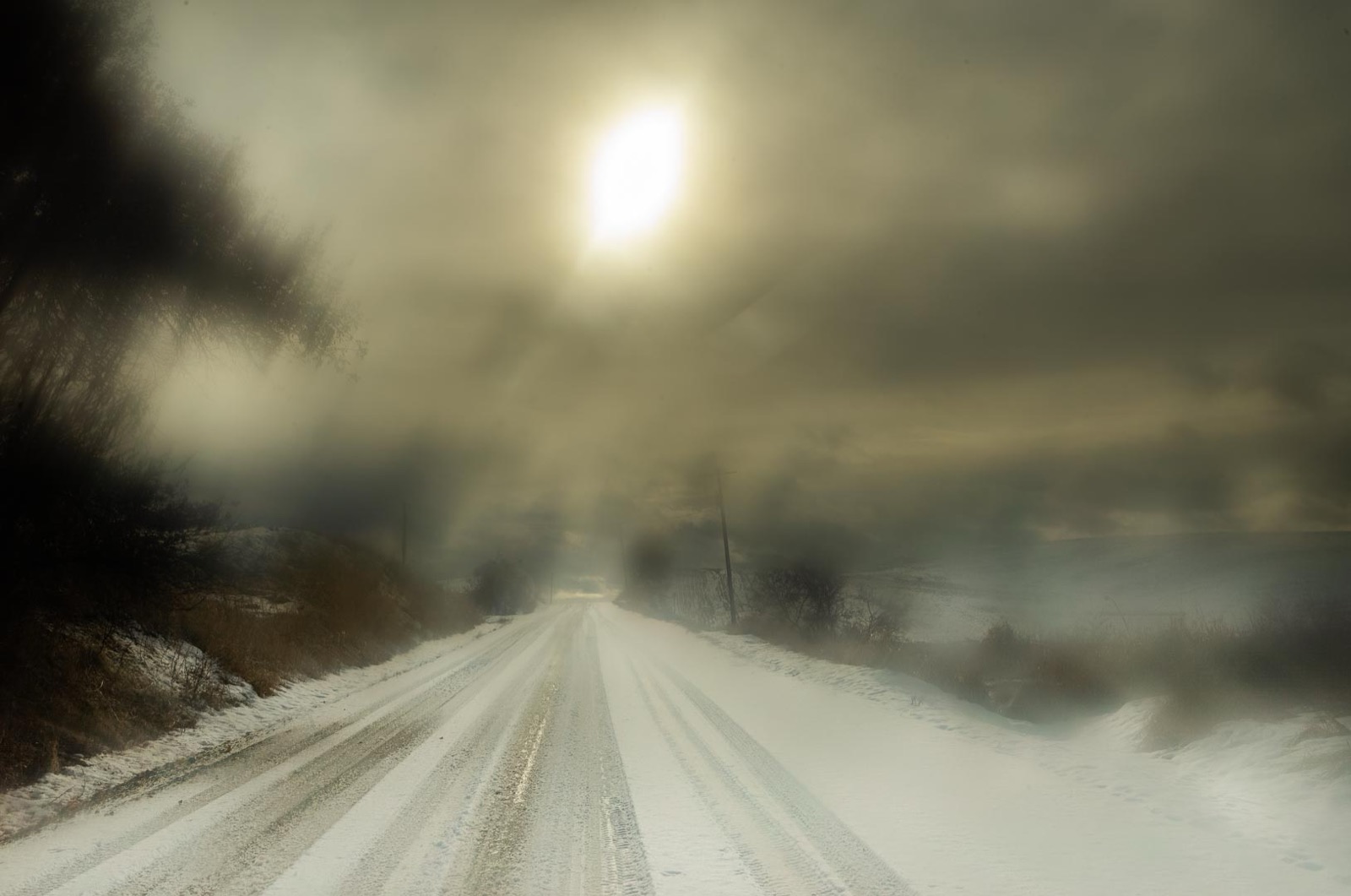

A moment ago the car was moving, and in a moment it will move again; this is the pause between, when the road ahead simply presents itself and asks to be looked at. Snow has taken the lane and smoothed it, and the tire tracks running up the middle are ours or someone’s just before us, a set of parallel lines drawn toward a sun that hangs, pale and enormous, in a sky gone soft with condensation on the glass. The windshield has become a second weather.
Everything here is on its way to disappearing. A dark stand of pines leans in from the left, half dissolved into the fog it stands against; a single telephone pole keeps its post beside the road, the last upright thing before the land gives way to rolling white hills on the right. The picture is calm to the point of reverence, and yet a low unease travels with it, the sense of driving into a brightness that will not tell you what it is or where it ends.
This is a picture about the ethics of the passing glance, the way a place seen from a car is possessed and abandoned in the same second. Hido has spent decades refining this look, the North American road remade as inward weather, snow and sun and mist gathered into one held breath. Printed as an archival pigment print, its whites stay creamy and its shadows deep, the condensation kept as grace rather than flaw. His work lives at SFMOMA, the Getty and the Whitney; here it offers a road and lets you drive it alone.