There is an hour, deep in the countryside’s winter, when the roads are surrendered to weather and every window has gone dark; whoever is still out at that hour is either leaving or returning. From inside that hour comes this photograph: a wet lane bending away between dead grasses, and snow falling so close to the lens that each flake swells into a pale disc, a coin of light, until the night seems minted rather than lit.
I could stay reasonable about the snow; it is the little light that I cannot manage. Far down the road, through the black trees, one lamp burns, and beneath it the asphalt carries a smear of copper, the only warmth in a picture otherwise made of slate and ash. Someone is there. Someone has left a light on, for themselves or for another, and the whole scene gathers itself around that possibility. The flakes are lovely; the light is addressed. It turns me, unreasonably, into the one who was awaited.
Hido often works through the window of his car, and the glass is not an obstacle but an honesty: we always see through our circumstances, winter included. He gives such pictures numbers, not titles, as an archive would, yet nothing here files quietly away. SFMOMA holds his prints, as do the Getty and the Whitney; this one, an archival pigment print, keeps its blues dense and its one copper stain alive. A photograph of snow melts nothing. It is the rare form of weather one can keep.
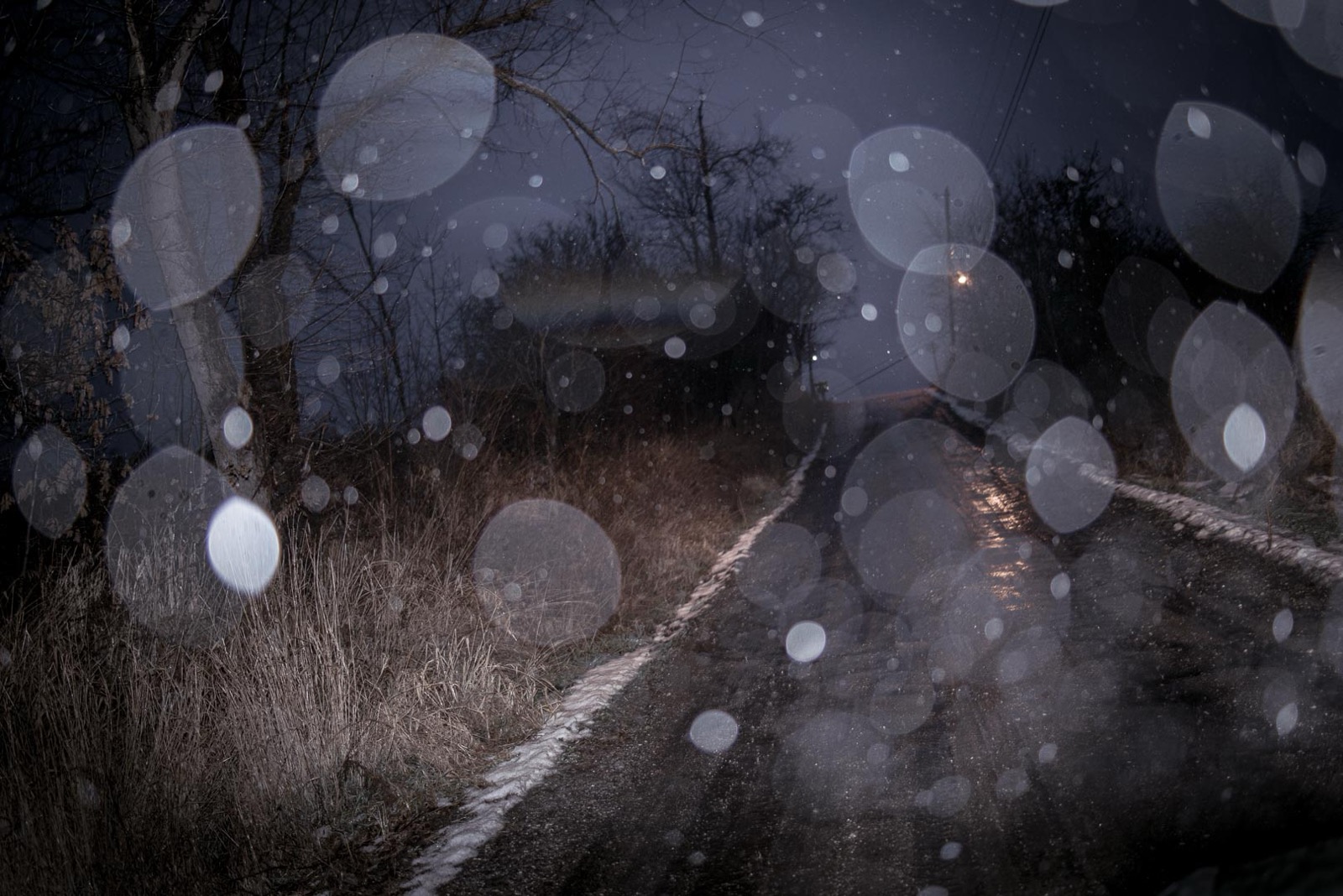

There is an hour, deep in the countryside’s winter, when the roads are surrendered to weather and every window has gone dark; whoever is still out at that hour is either leaving or returning. From inside that hour comes this photograph: a wet lane bending away between dead grasses, and snow falling so close to the lens that each flake swells into a pale disc, a coin of light, until the night seems minted rather than lit.
I could stay reasonable about the snow; it is the little light that I cannot manage. Far down the road, through the black trees, one lamp burns, and beneath it the asphalt carries a smear of copper, the only warmth in a picture otherwise made of slate and ash. Someone is there. Someone has left a light on, for themselves or for another, and the whole scene gathers itself around that possibility. The flakes are lovely; the light is addressed. It turns me, unreasonably, into the one who was awaited.
Hido often works through the window of his car, and the glass is not an obstacle but an honesty: we always see through our circumstances, winter included. He gives such pictures numbers, not titles, as an archive would, yet nothing here files quietly away. SFMOMA holds his prints, as do the Getty and the Whitney; this one, an archival pigment print, keeps its blues dense and its one copper stain alive. A photograph of snow melts nothing. It is the rare form of weather one can keep.