Two men in black trunks, working at each other in flat Rio sunlight. One has the other's arm clamped across his chest and is levering it upward; the second is folded at the waist, head down, the sweat on his back catching the light like spilled water. What holds you is the face above — teeth bared, eyes narrowed to slits — and the hands, four of them knotted at the center of the frame, fingers splayed and gripping. Nothing here is arranged. These are bodies doing what bodies do when one is trying to put the other on the ground.
Weber went to Brazil in 1986 and came back with the Gracies, a family who had made a religion of exactly this. He photographs the fight the way he photographs everything else — close in, admiring, with no apology for the pleasure of looking — and the picture settles in the gap between sport and desire without troubling to choose. The terrace helps: white balustrade, tiled floor, a hotel's clipped greenery behind. It is a setting built for cocktails, and two young men are wrestling on it in the middle of the day.
The gelatin silver print does the rest. The whites burn out to bare paper — the balustrade, the towel crumpled at their feet — and the shadows lie down hard and near-black across the tiles, so the two figures look cut from the glare rather than lit by it. Weber has always known that muscle photographs like landscape, all ridge and hollow, and he lets the bent man's back run the length of the lower frame like a dune. It reads as combat. It also reads as an embrace, which is both the joke and the point.
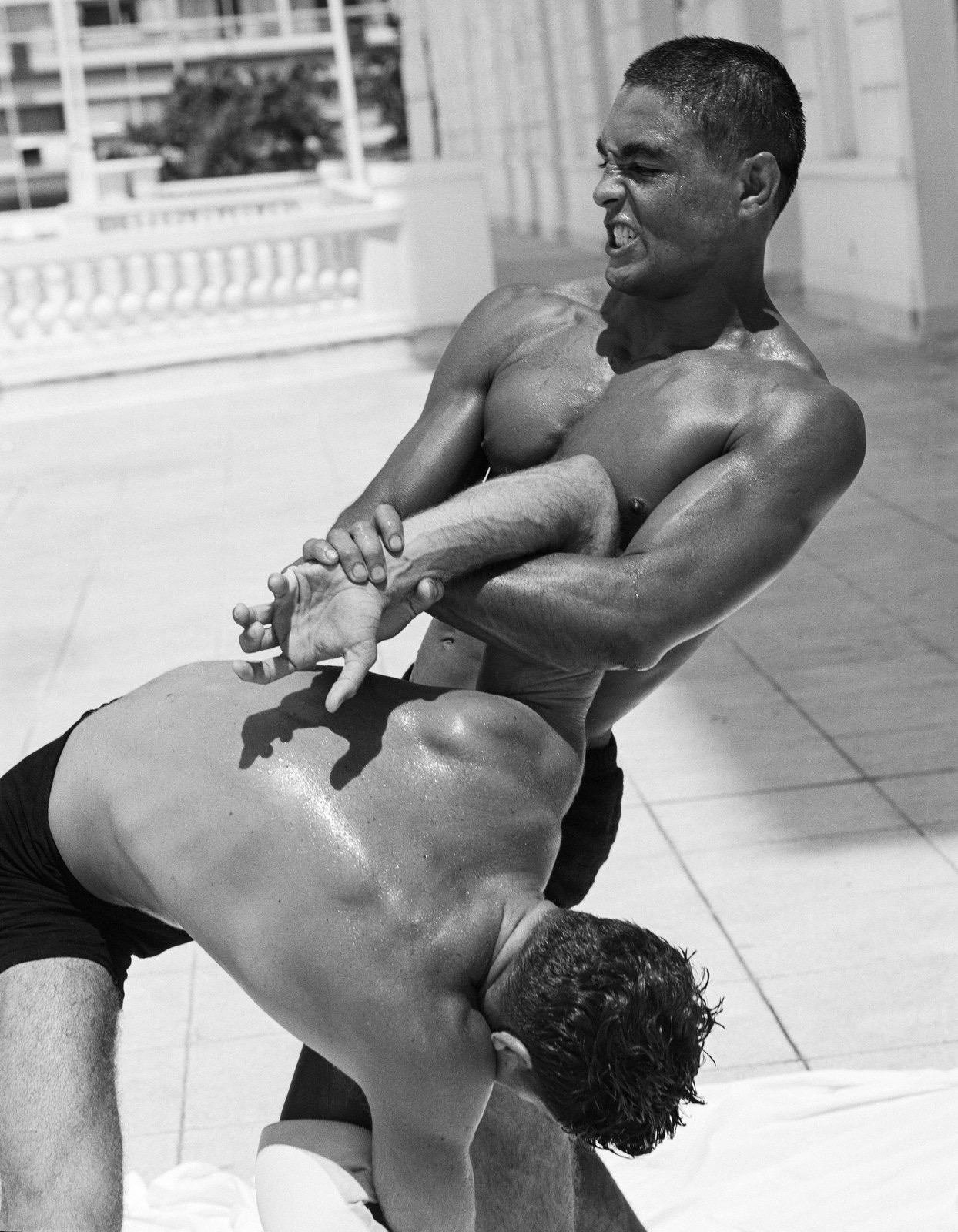

Two men in black trunks, working at each other in flat Rio sunlight. One has the other's arm clamped across his chest and is levering it upward; the second is folded at the waist, head down, the sweat on his back catching the light like spilled water. What holds you is the face above — teeth bared, eyes narrowed to slits — and the hands, four of them knotted at the center of the frame, fingers splayed and gripping. Nothing here is arranged. These are bodies doing what bodies do when one is trying to put the other on the ground.
Weber went to Brazil in 1986 and came back with the Gracies, a family who had made a religion of exactly this. He photographs the fight the way he photographs everything else — close in, admiring, with no apology for the pleasure of looking — and the picture settles in the gap between sport and desire without troubling to choose. The terrace helps: white balustrade, tiled floor, a hotel's clipped greenery behind. It is a setting built for cocktails, and two young men are wrestling on it in the middle of the day.
The gelatin silver print does the rest. The whites burn out to bare paper — the balustrade, the towel crumpled at their feet — and the shadows lie down hard and near-black across the tiles, so the two figures look cut from the glare rather than lit by it. Weber has always known that muscle photographs like landscape, all ridge and hollow, and he lets the bent man's back run the length of the lower frame like a dune. It reads as combat. It also reads as an embrace, which is both the joke and the point.