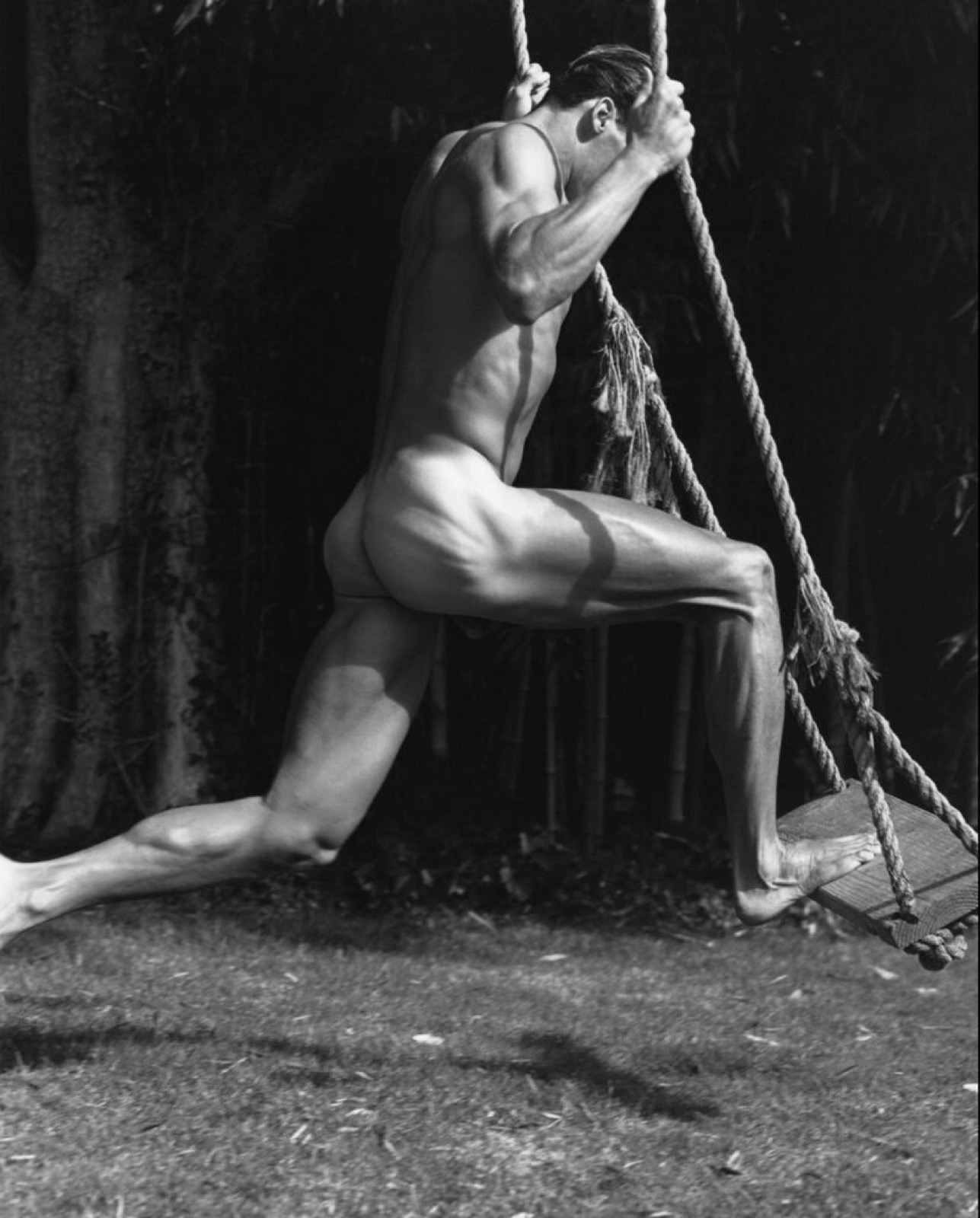
Start with the bare foot, toes curled over the edge of a wooden plank swing, taking a little weight. It is the one ordinary, almost tender thing in an image otherwise built for grandeur. Above it a nude man hauls himself upright on two garden ropes, back and buttocks and thigh carved by hard side light, one leg stretched long to the grass. His face is turned away. The heroic nude wants to be a statue, but the gripping foot keeps insisting he is only a person on a swing.
Photography has always been uneasy with the male nude, unsure whether to salute the antique or admit the desire, and Weber solves it by putting his model outdoors and giving him something to do. The ropes turn a pose into an action; the dappled tree, the fallen leaves, the frayed cord soften the museum solemnity into a Californian afternoon. Light does the sculpting, raking across muscle so the body reads as relief against the dark foliage. It is Greece and a suburban backyard at once, and the picture is relaxed about the contradiction.
This is the register Weber made central to American fashion: the athletic body treated as landscape, wholesome and charged at once. The gelatin silver print is where the light earns its keep, the long grey scale carrying every gradation from the sunlit spine to the near-black of the tree, the grain giving skin and rope and grass a common texture. Strip away the classical myth and what remains is stranger and better: a real man, mid-effort, hanging his whole weight on two ropes and a plank.
Start with the bare foot, toes curled over the edge of a wooden plank swing, taking a little weight. It is the one ordinary, almost tender thing in an image otherwise built for grandeur. Above it a nude man hauls himself upright on two garden ropes, back and buttocks and thigh carved by hard side light, one leg stretched long to the grass. His face is turned away. The heroic nude wants to be a statue, but the gripping foot keeps insisting he is only a person on a swing.
Photography has always been uneasy with the male nude, unsure whether to salute the antique or admit the desire, and Weber solves it by putting his model outdoors and giving him something to do. The ropes turn a pose into an action; the dappled tree, the fallen leaves, the frayed cord soften the museum solemnity into a Californian afternoon. Light does the sculpting, raking across muscle so the body reads as relief against the dark foliage. It is Greece and a suburban backyard at once, and the picture is relaxed about the contradiction.
This is the register Weber made central to American fashion: the athletic body treated as landscape, wholesome and charged at once. The gelatin silver print is where the light earns its keep, the long grey scale carrying every gradation from the sunlit spine to the near-black of the tree, the grain giving skin and rope and grass a common texture. Strip away the classical myth and what remains is stranger and better: a real man, mid-effort, hanging his whole weight on two ropes and a plank.