Three takes of the same instant sit side by side, lifted straight from the strip of film: the perforations, the reversed "SUPER-XX" lettering, the "EASTMAN" rebate and the frame numbers 18 and 17 are all left in view, so we are looking not at a finished fashion plate but at the working surface behind it. A model in a small black hat tips her head back behind a fine net veil, lips parted to release a slow column of cigarette smoke, two lacquered fingers raised to her mouth. The pose barely shifts across the three frames — a fraction of tilt, a breath more smoke — which is exactly the point: this is the decisive moment dismantled into its near-misses.
Over the photographs the artist has laid down the editor's private language as if it were paint — broad grease-pencil crosses in turquoise and green, a violent red smear bleeding across the top edge. These are the marks that normally stay hidden, the selecting and rejecting that happens before a picture reaches the page. Here they are promoted to the foreground, theatrical, gestural, almost abstract-expressionist, so that the act of choosing becomes the performance. The veil's mesh and the soft exhalation supply the glamour; the slashing color cancels and crowns it at once.
This is fashion photography looking at its own machinery, made by an artist who broke the rules from inside the genre. The hand-applied color makes each iteration effectively singular, and his vintage prints are anchored in MoMA and the Centre Pompidou. To hold one is to hold both the polished image and the candid record of how it was assembled.
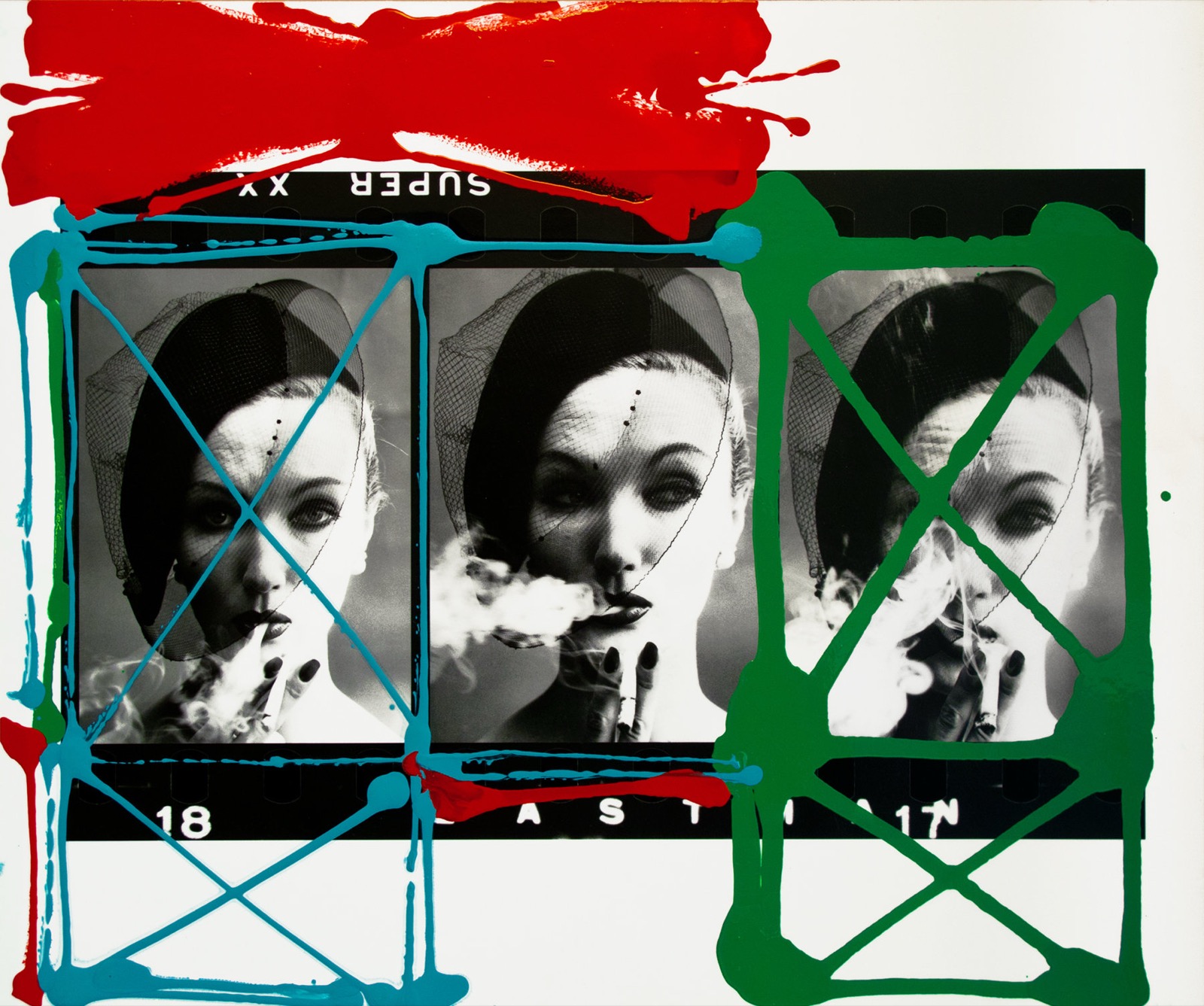

Three takes of the same instant sit side by side, lifted straight from the strip of film: the perforations, the reversed "SUPER-XX" lettering, the "EASTMAN" rebate and the frame numbers 18 and 17 are all left in view, so we are looking not at a finished fashion plate but at the working surface behind it. A model in a small black hat tips her head back behind a fine net veil, lips parted to release a slow column of cigarette smoke, two lacquered fingers raised to her mouth. The pose barely shifts across the three frames — a fraction of tilt, a breath more smoke — which is exactly the point: this is the decisive moment dismantled into its near-misses.
Over the photographs the artist has laid down the editor's private language as if it were paint — broad grease-pencil crosses in turquoise and green, a violent red smear bleeding across the top edge. These are the marks that normally stay hidden, the selecting and rejecting that happens before a picture reaches the page. Here they are promoted to the foreground, theatrical, gestural, almost abstract-expressionist, so that the act of choosing becomes the performance. The veil's mesh and the soft exhalation supply the glamour; the slashing color cancels and crowns it at once.
This is fashion photography looking at its own machinery, made by an artist who broke the rules from inside the genre. The hand-applied color makes each iteration effectively singular, and his vintage prints are anchored in MoMA and the Centre Pompidou. To hold one is to hold both the polished image and the candid record of how it was assembled.