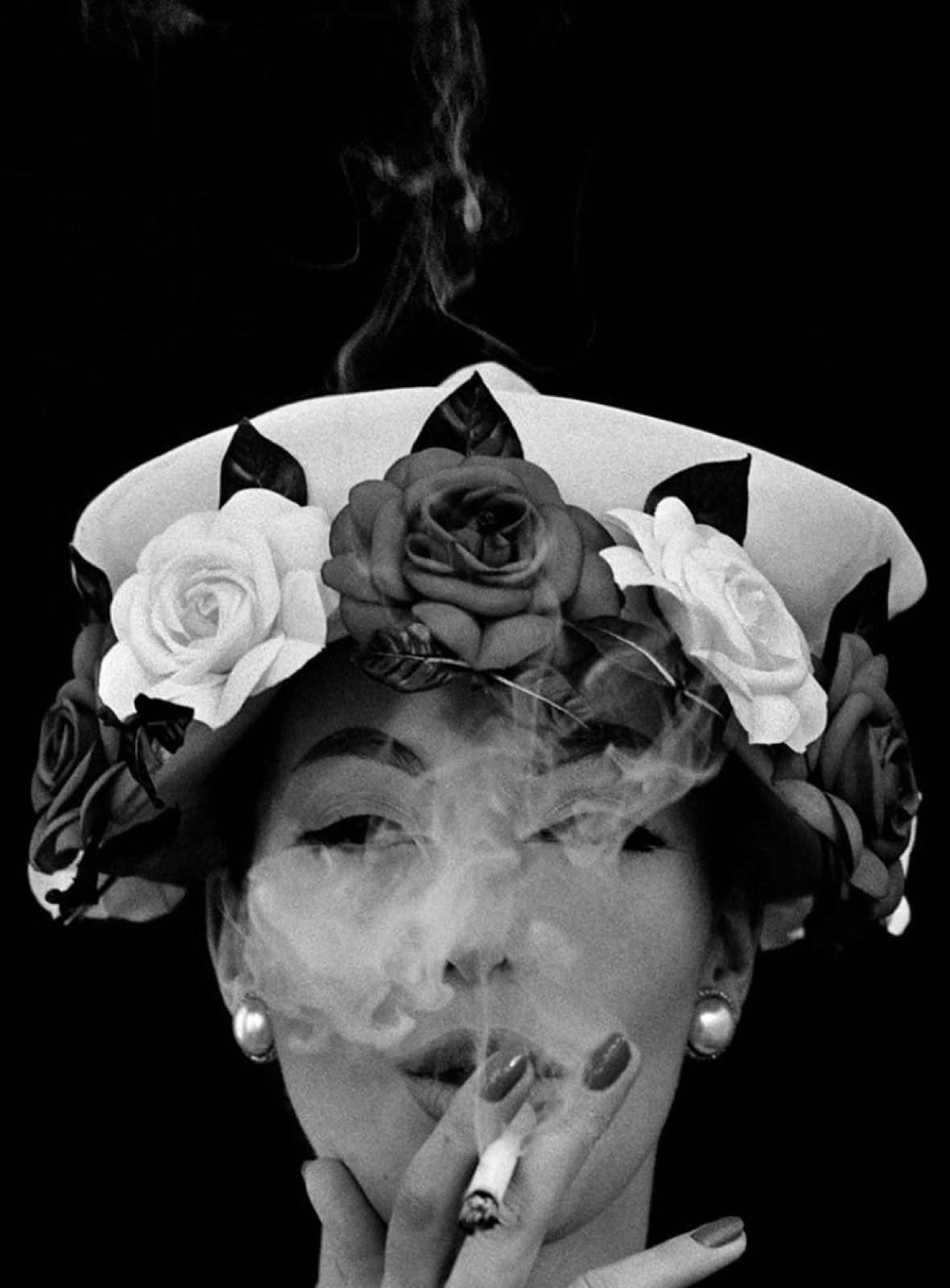
She wears the hat like a confession. A wide, upturned brim banded with roses—one creamy white blossom at the left, a fat dark bloom dead center, another pale one at the right, with smaller buds and pointed leaves crowding the crown—tips back off her brow, theatrical and slightly absurd, the way the best couture millinery always is. But the woman beneath refuses to play along. Instead of poise she gives us smoke, a slow ribbon that curls up through the flowers and dissolves into the black above. The cigarette does the work the pose won't.
Look at the hands. The fingers are lacquered a deep, expensive grey, and they cradle the cigarette with a languor that reads as boredom and seduction at once. A single fat pearl glints at each ear, the only soft punctuation against a ground of pure, unmodulated black that swallows everything but face, hat, and gauze of smoke. The roses are silk, surely, yet rendered in this grain they look both lush and faintly funereal—petals you could touch, a fragrance you can't. Everything sensuous here is also a little dangerous, which is exactly the register fashion rarely dares.
Made for Vogue in 1956, this is the picture that taught fashion photography it could be insolent. He brought the swagger and high-contrast grit of his New York street work straight onto the magazine page, mocking glamour even as he produced it. Held by MoMA and the Centre Pompidou, his work redrew the rules of both genres. A vintage print carries that grain and ink-black density in the hand the way no reproduction can—the smoke, the smolder, the wit, all original.
She wears the hat like a confession. A wide, upturned brim banded with roses—one creamy white blossom at the left, a fat dark bloom dead center, another pale one at the right, with smaller buds and pointed leaves crowding the crown—tips back off her brow, theatrical and slightly absurd, the way the best couture millinery always is. But the woman beneath refuses to play along. Instead of poise she gives us smoke, a slow ribbon that curls up through the flowers and dissolves into the black above. The cigarette does the work the pose won't.
Look at the hands. The fingers are lacquered a deep, expensive grey, and they cradle the cigarette with a languor that reads as boredom and seduction at once. A single fat pearl glints at each ear, the only soft punctuation against a ground of pure, unmodulated black that swallows everything but face, hat, and gauze of smoke. The roses are silk, surely, yet rendered in this grain they look both lush and faintly funereal—petals you could touch, a fragrance you can't. Everything sensuous here is also a little dangerous, which is exactly the register fashion rarely dares.
Made for Vogue in 1956, this is the picture that taught fashion photography it could be insolent. He brought the swagger and high-contrast grit of his New York street work straight onto the magazine page, mocking glamour even as he produced it. Held by MoMA and the Centre Pompidou, his work redrew the rules of both genres. A vintage print carries that grain and ink-black density in the hand the way no reproduction can—the smoke, the smolder, the wit, all original.