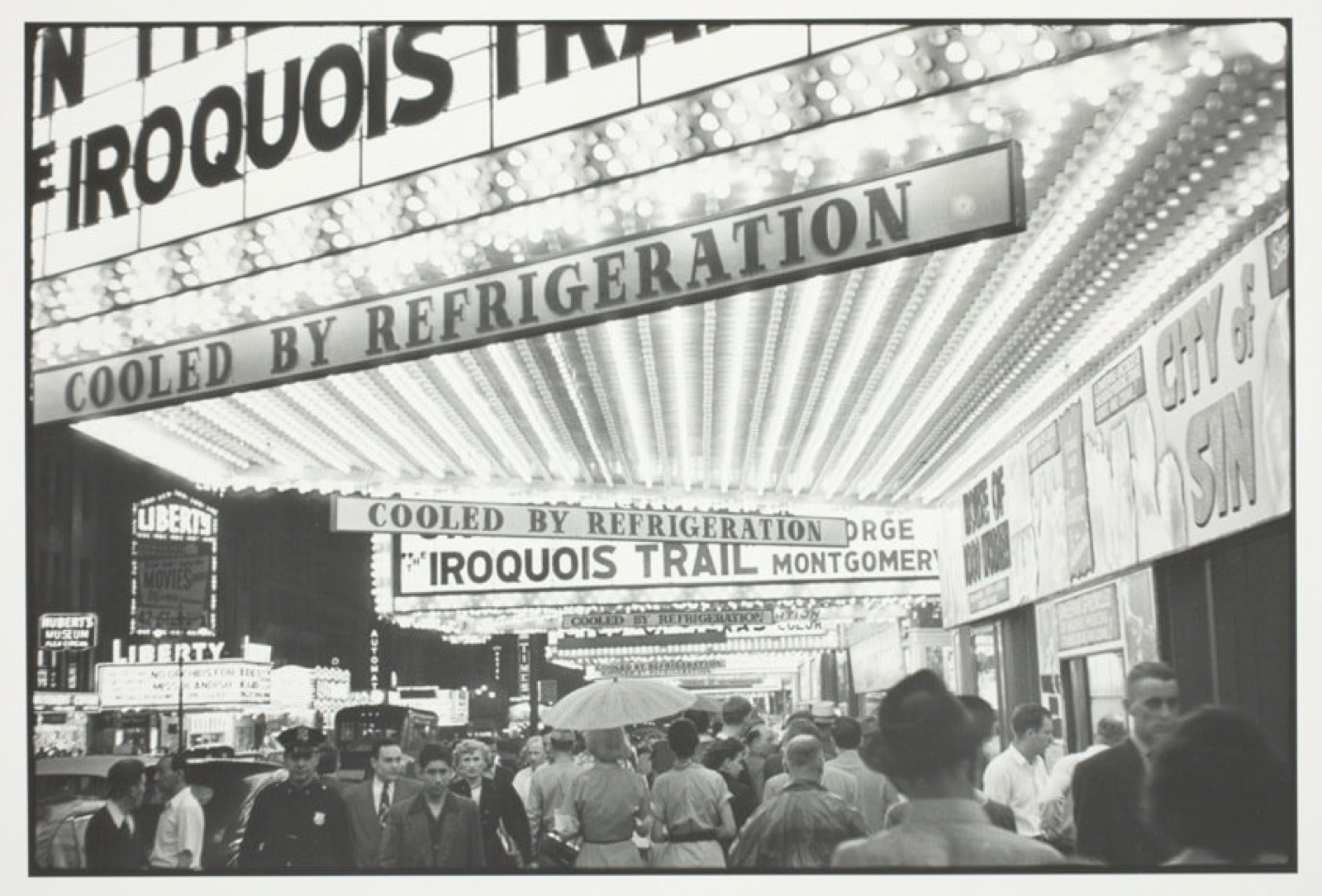
What the marquee will not say, it repeats: COOLED BY REFRIGERATION, twice, three times, banner after banner, while the films themselves — IROQUOIS TRAIL, CITY OF SIN, a blur of LIBERTY — recede to second importance. Faurer tilts his camera upward into the great canopy of bulbs, 1949, and the lights stream away in converging rows toward a vanishing point lost in glare. Beneath that incandescent ceiling a crowd presses along the pavement: a policeman in his cap, men in fedoras, an open umbrella raised against nothing, faces near and far dissolving into grain.
The advertised promise hides the actual one. What the street truly offers is not the picture inside but this — the refreshment of light, the cool delirium of so many bulbs burning at once over so many heads. The denotation is a movie programme; the connotation is appetite, the city selling its own glow back to the people walking through it. The marquee conceals its emptiness behind plenitude, naming sin and comfort in the same breath, a syntax of seduction strung overhead in electric capitals.
And yet a single thing escapes the spectacle and stays with me. Low at the right, very close, a man's head turns half away into shadow, anonymous, almost out of frame — a private face inside the public dazzle. He belongs to no slogan. While the lamps recite their cool refrain into the distance, he carries his own unlit thought through the crowd. Faurer photographs the brilliance, but he leaves, at the edge, one figure the brightness cannot reach, and it is there my attention quietly comes to rest.

What the marquee will not say, it repeats: COOLED BY REFRIGERATION, twice, three times, banner after banner, while the films themselves — IROQUOIS TRAIL, CITY OF SIN, a blur of LIBERTY — recede to second importance. Faurer tilts his camera upward into the great canopy of bulbs, 1949, and the lights stream away in converging rows toward a vanishing point lost in glare. Beneath that incandescent ceiling a crowd presses along the pavement: a policeman in his cap, men in fedoras, an open umbrella raised against nothing, faces near and far dissolving into grain.
The advertised promise hides the actual one. What the street truly offers is not the picture inside but this — the refreshment of light, the cool delirium of so many bulbs burning at once over so many heads. The denotation is a movie programme; the connotation is appetite, the city selling its own glow back to the people walking through it. The marquee conceals its emptiness behind plenitude, naming sin and comfort in the same breath, a syntax of seduction strung overhead in electric capitals.
And yet a single thing escapes the spectacle and stays with me. Low at the right, very close, a man's head turns half away into shadow, anonymous, almost out of frame — a private face inside the public dazzle. He belongs to no slogan. While the lamps recite their cool refrain into the distance, he carries his own unlit thought through the crowd. Faurer photographs the brilliance, but he leaves, at the edge, one figure the brightness cannot reach, and it is there my attention quietly comes to rest.