Black and white, and almost illegible. A tall stemmed vessel — a goblet, or a stack of shallow bowls on a foot — stands at the centre of the frame and has been smeared vertically by movement, so that its rim repeats itself a dozen times in a shivering column. Behind it, a dark band across the upper half and a pale surface below meet in a soft horizon. Nothing in the picture holds still except that division.
The deliberate blur has a long and respectable history. Photographers reached for it whenever exactness began to feel like a limitation — the Pictorialists softened the lens, the Futurists courted the streak, and by the middle of the last century the long exposure had become a standard means of putting time into a still frame rather than excluding it. What is unusual here is the restraint of the subject. This is a piece of glassware on a table, the most ordinary of studio props, and the treatment is doing all the work.
Which is why the photograph reads as a study rather than an effect. Made in the course of a commercial practice, it belongs with the sheets photographers keep aside from the assignment: the frame in which the object was allowed to come apart. The stem stays recognisable, just, and the bowls above it dissolve entirely — a record of exactly how much movement a form can absorb before it stops being a thing.
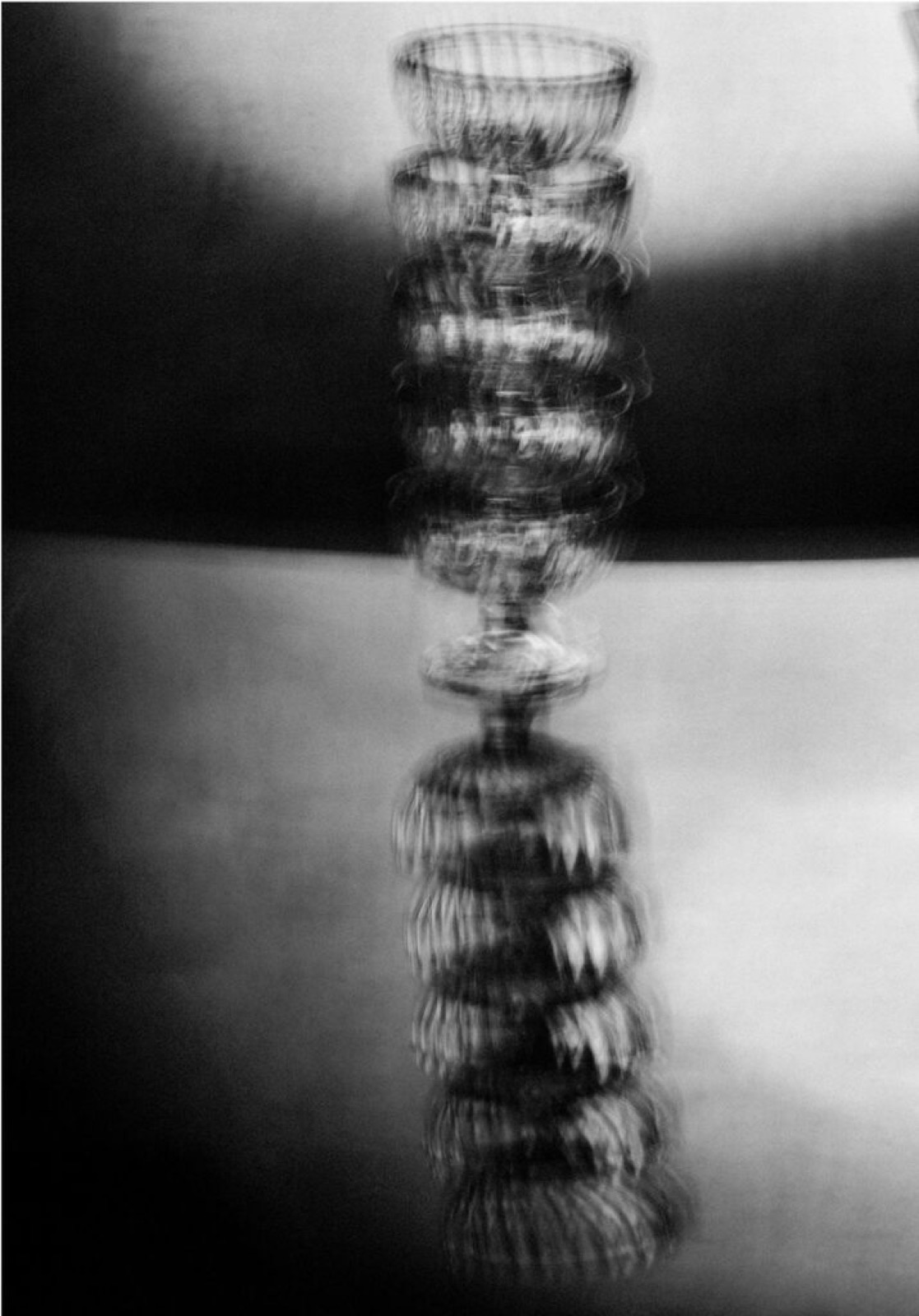

Black and white, and almost illegible. A tall stemmed vessel — a goblet, or a stack of shallow bowls on a foot — stands at the centre of the frame and has been smeared vertically by movement, so that its rim repeats itself a dozen times in a shivering column. Behind it, a dark band across the upper half and a pale surface below meet in a soft horizon. Nothing in the picture holds still except that division.
The deliberate blur has a long and respectable history. Photographers reached for it whenever exactness began to feel like a limitation — the Pictorialists softened the lens, the Futurists courted the streak, and by the middle of the last century the long exposure had become a standard means of putting time into a still frame rather than excluding it. What is unusual here is the restraint of the subject. This is a piece of glassware on a table, the most ordinary of studio props, and the treatment is doing all the work.
Which is why the photograph reads as a study rather than an effect. Made in the course of a commercial practice, it belongs with the sheets photographers keep aside from the assignment: the frame in which the object was allowed to come apart. The stem stays recognisable, just, and the bowls above it dissolve entirely — a record of exactly how much movement a form can absorb before it stops being a thing.