Hammershøi would have recognized this room, though never in apricot. He kept his empty interiors to Copenhagen greys, light strained through white muslin; Hopper, near the end, painted sun in an empty room as if light itself were the tenant. This photograph enters that lineage speaking American: two curtained windows, a bare corner, plush wall-to-wall carpet, and not one object to say who lived here. The color is the country. No Dane ever kept a room this peach.
The curtains are the event. On the left they fall full length, pleat after pleat, a soft architecture doing the work of a wall; on the right they stop short and their hem hangs unevenly, gathered into scallops, as if someone had once lifted them clear of a radiator or a bed and the fabric kept the memory. Light passes through both the way rumor passes through a house: generalized, sourceless, warm. High on the empty wall a single small hook still remains, the last punctuation of a life that has been edited out.
The photographer numbered this stillness 1925, filing it in the archive that also holds his night houses; rooms and facades belong to one continuous inquiry into American shelter, and museums — SFMOMA, the Getty, the Whitney — keep his prints. In archival pigment, the peach deepens toward rose at the ceiling and pales at the glowing sheers, a narrow register held with great care. What remains when a home is emptied? Here: light, fabric, carpet, and the patience to look at them.
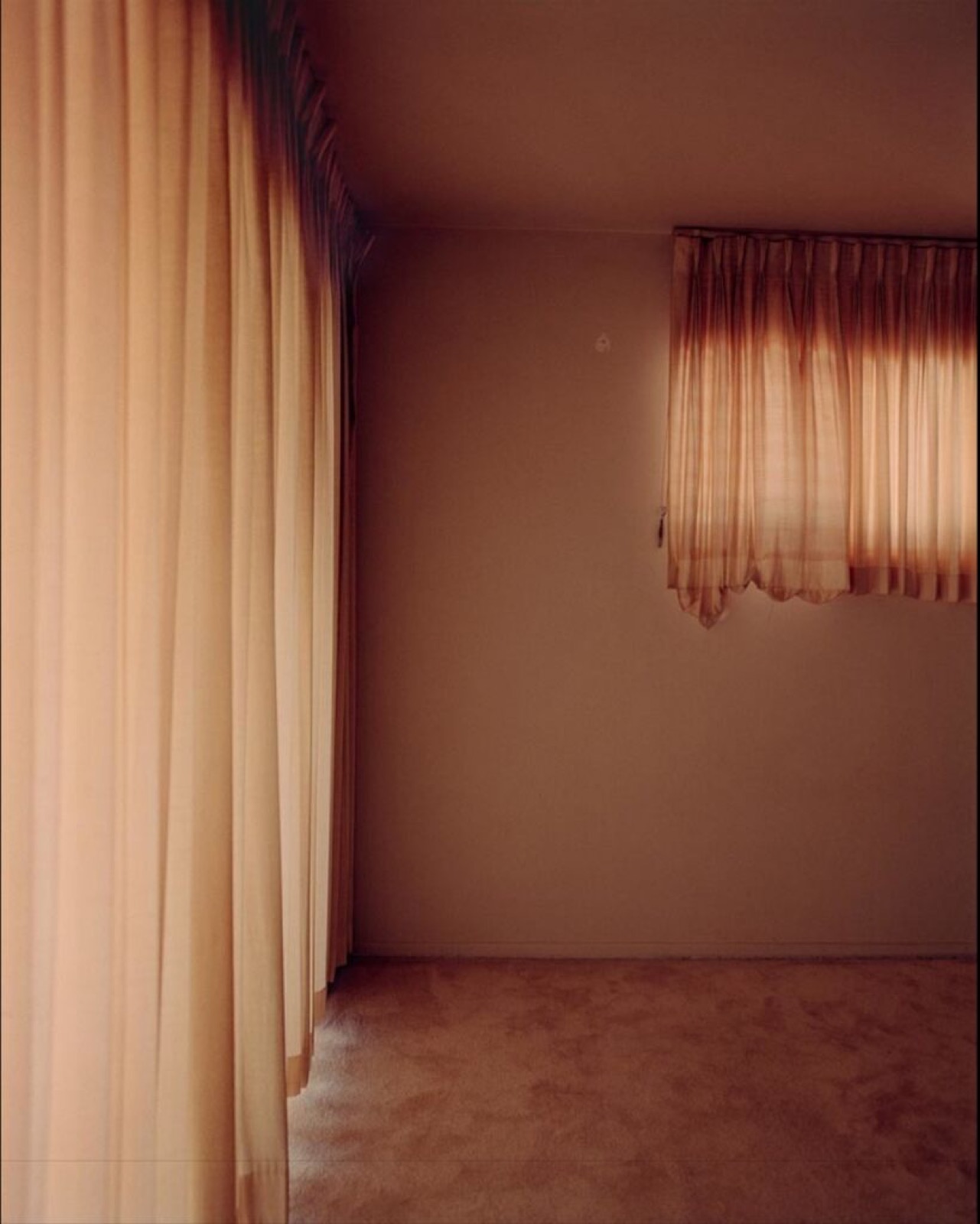

Hammershøi would have recognized this room, though never in apricot. He kept his empty interiors to Copenhagen greys, light strained through white muslin; Hopper, near the end, painted sun in an empty room as if light itself were the tenant. This photograph enters that lineage speaking American: two curtained windows, a bare corner, plush wall-to-wall carpet, and not one object to say who lived here. The color is the country. No Dane ever kept a room this peach.
The curtains are the event. On the left they fall full length, pleat after pleat, a soft architecture doing the work of a wall; on the right they stop short and their hem hangs unevenly, gathered into scallops, as if someone had once lifted them clear of a radiator or a bed and the fabric kept the memory. Light passes through both the way rumor passes through a house: generalized, sourceless, warm. High on the empty wall a single small hook still remains, the last punctuation of a life that has been edited out.
The photographer numbered this stillness 1925, filing it in the archive that also holds his night houses; rooms and facades belong to one continuous inquiry into American shelter, and museums — SFMOMA, the Getty, the Whitney — keep his prints. In archival pigment, the peach deepens toward rose at the ceiling and pales at the glowing sheers, a narrow register held with great care. What remains when a home is emptied? Here: light, fabric, carpet, and the patience to look at them.