Wind is in this picture twice. Once in the palm, whose fronds have been smeared to soft feathers by an exposure that outlasted them, and once in the leaning cypress, shaped by years of the same weather the photograph caught in seconds. Meanwhile the true light source is not the sky, which has gone a dull mauve, but a corner window with its blinds drawn, glowing greenish-gold like a screen switched on in a dark room, the evening news for an audience of hedges.
That window does what photography does: it shows by withholding. The blinds turn the interior into pure luminance; against them floats one dark shape, round-shouldered, unreadable — a head, a chair, a lamp, we cannot say. The house becomes a camera turned inside out, projecting its private evening onto the street, and the photographer, standing on the far side of the lawn, simply accepted the transmission. Even the lawn cooperates, taking the spill of light and turning an implausible green, while a single white flower shows up at the base of the wall like a signature.
Numbered 1862, it belongs with the night houses on which the photographer’s reputation rests, pictures now held by SFMOMA, the Getty and the Whitney. The archival pigment print manages the hard part: keeping a window that bright without letting it burn to blank paper, so the blinds stay legible, line by thin line, and the shadow keeps its mystery. Photography began by fixing light; here it fixes the weather too, wind and all.
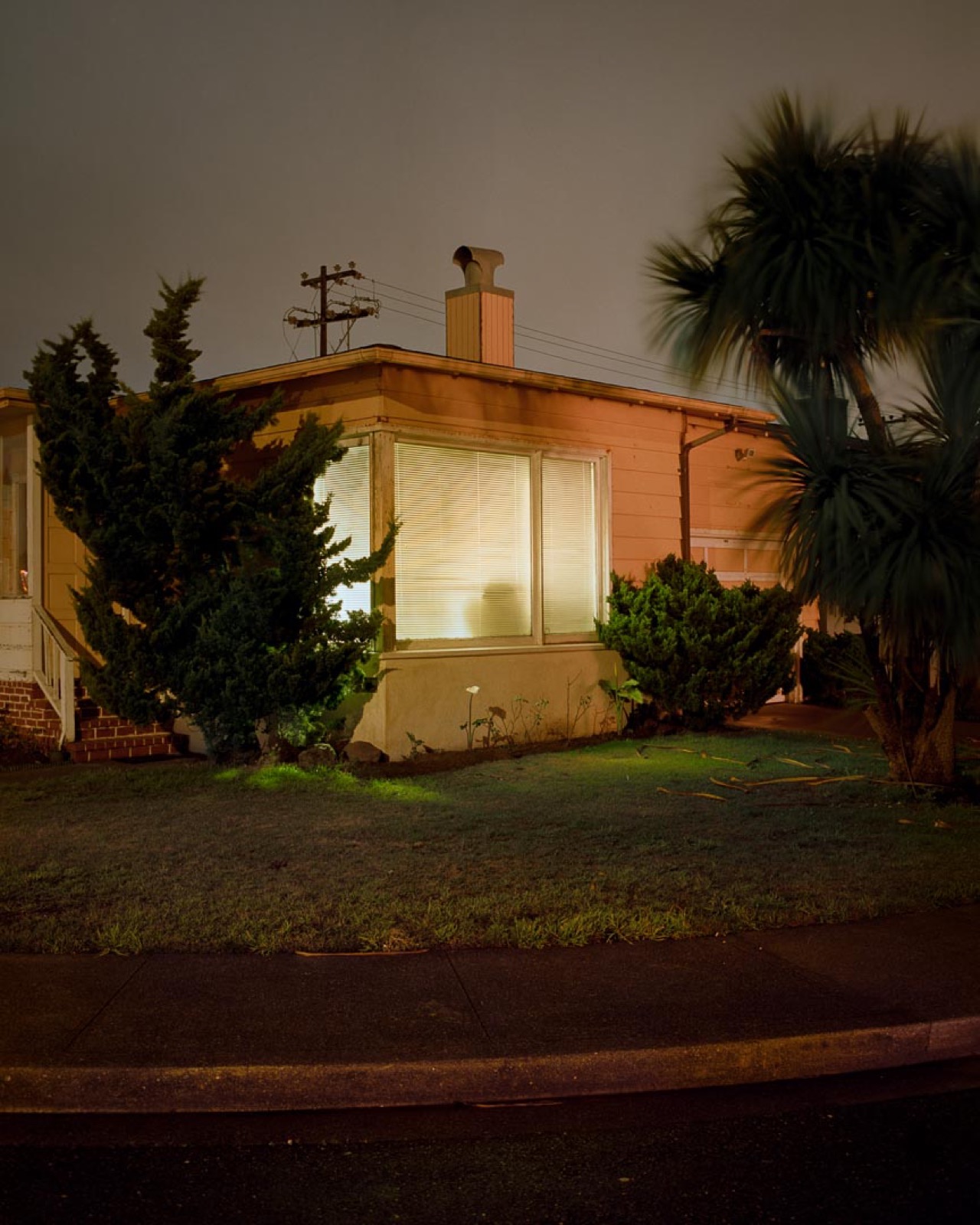

Wind is in this picture twice. Once in the palm, whose fronds have been smeared to soft feathers by an exposure that outlasted them, and once in the leaning cypress, shaped by years of the same weather the photograph caught in seconds. Meanwhile the true light source is not the sky, which has gone a dull mauve, but a corner window with its blinds drawn, glowing greenish-gold like a screen switched on in a dark room, the evening news for an audience of hedges.
That window does what photography does: it shows by withholding. The blinds turn the interior into pure luminance; against them floats one dark shape, round-shouldered, unreadable — a head, a chair, a lamp, we cannot say. The house becomes a camera turned inside out, projecting its private evening onto the street, and the photographer, standing on the far side of the lawn, simply accepted the transmission. Even the lawn cooperates, taking the spill of light and turning an implausible green, while a single white flower shows up at the base of the wall like a signature.
Numbered 1862, it belongs with the night houses on which the photographer’s reputation rests, pictures now held by SFMOMA, the Getty and the Whitney. The archival pigment print manages the hard part: keeping a window that bright without letting it burn to blank paper, so the blinds stay legible, line by thin line, and the shadow keeps its mystery. Photography began by fixing light; here it fixes the weather too, wind and all.