A landscape photograph is always partly a fiction about distance, and this one admits as much. What looks like the edge of the world, a run of low volcanic hills with one dark cone lifting slightly higher, is dissolved almost to rumor by fog and by the water beaded on the glass Hido shot through. Those droplets, scattered like soft coins across the lower frame, keep insisting that we are inside a moving car, that the sublime here is something glimpsed at speed, not stood before.
The palette does the persuading. Everything arrives in ochre and smoked gold, the barren ground below darkening to bitumen, a pale band of light laid along the horizon like the last warmth of a day already gone. It reads as staged even though nothing was arranged; Hido simply waited for weather to compose the picture for him, then framed it so severely that the land occupies a thin strip and the vaporous sky claims the rest. The result feels less documented than dreamed, an atmosphere printed rather than a place.
This is the register Hido moved into as his work matured, away from the lit suburban house and toward pure mood, the road-trip landscape reduced to color, distance and moisture. Issued as an archival pigment print, the image holds its long tonal drift from dark earth to bleached sky without a seam, so the fog stays velvet rather than grain. His pictures are collected by SFMOMA, the Getty and the Whitney; this one asks only that you accept a horizon you cannot quite reach.
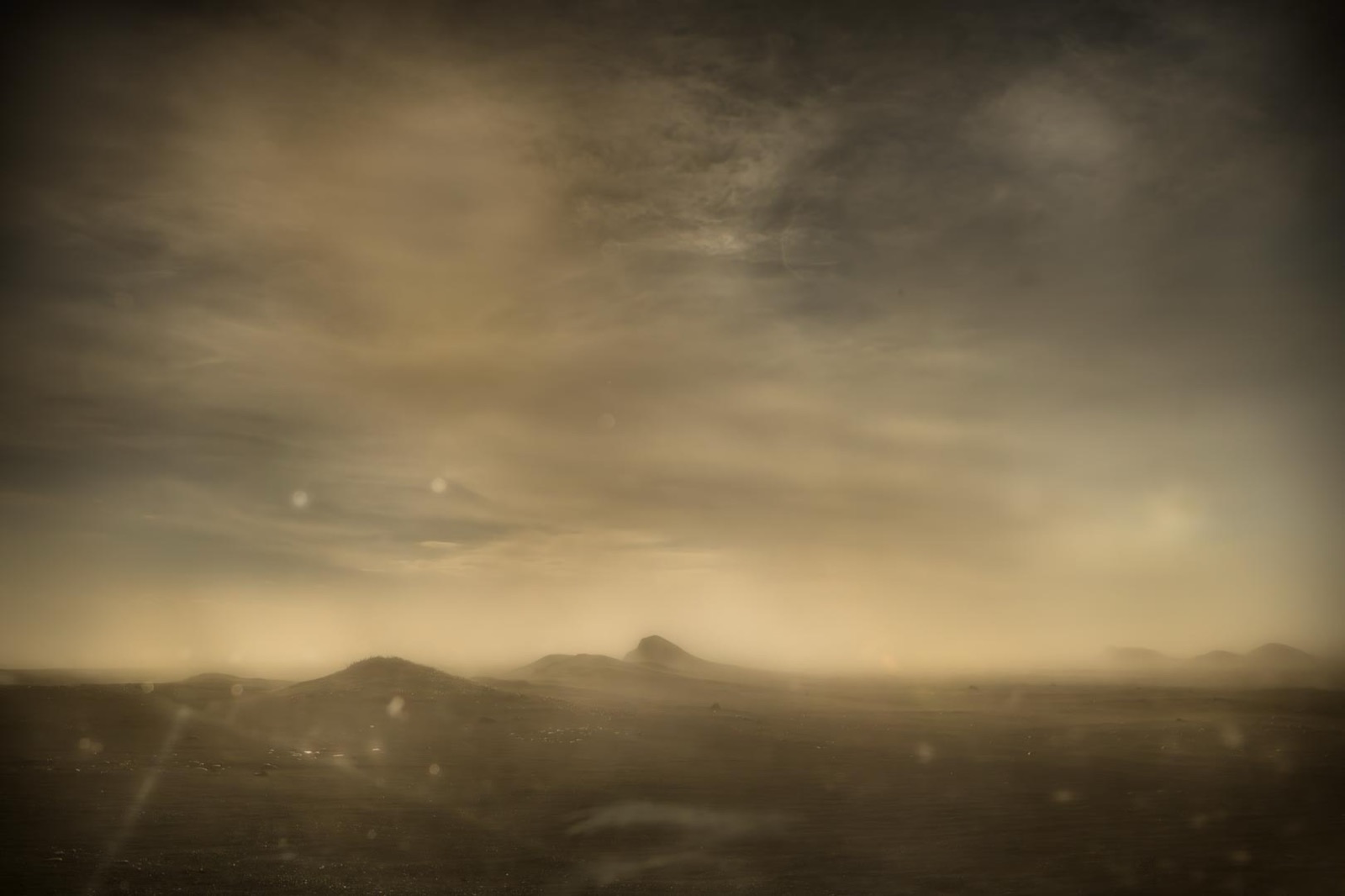

A landscape photograph is always partly a fiction about distance, and this one admits as much. What looks like the edge of the world, a run of low volcanic hills with one dark cone lifting slightly higher, is dissolved almost to rumor by fog and by the water beaded on the glass Hido shot through. Those droplets, scattered like soft coins across the lower frame, keep insisting that we are inside a moving car, that the sublime here is something glimpsed at speed, not stood before.
The palette does the persuading. Everything arrives in ochre and smoked gold, the barren ground below darkening to bitumen, a pale band of light laid along the horizon like the last warmth of a day already gone. It reads as staged even though nothing was arranged; Hido simply waited for weather to compose the picture for him, then framed it so severely that the land occupies a thin strip and the vaporous sky claims the rest. The result feels less documented than dreamed, an atmosphere printed rather than a place.
This is the register Hido moved into as his work matured, away from the lit suburban house and toward pure mood, the road-trip landscape reduced to color, distance and moisture. Issued as an archival pigment print, the image holds its long tonal drift from dark earth to bleached sky without a seam, so the fog stays velvet rather than grain. His pictures are collected by SFMOMA, the Getty and the Whitney; this one asks only that you accept a horizon you cannot quite reach.