The Empire State Building is here pinned into the narrow slot between two older masses of masonry, its summit caught in a clear, late wash of sun while everything beneath it cools into shadow. Meyerowitz lets the tower recede to a vertical seam, and gives the foreground instead to a green traffic globe glowing at the corner and the small enamel arrow lettered BROADWAY hung from its post. The REGAL SHOES marquee and the worn promise YOURS TRULY hold the base of the frame; a single car waits at the curb in the soft, granular light of dusk. The grandeur of the icon is demoted to a sign among signs.
Made in 1978, the picture belongs to the body of New York street work in which Meyerowitz, having committed fully to color earlier in the decade, pressed the large-format and 35mm camera toward an argument that hue carried meaning grayscale could not. One sees the case made along this block: champagne limestone against soot-darkened brick, the steel-blue of evening air, the warm pulse held in the building's crown. These are distinctions a black-and-white print would surrender entirely.
That conviction placed Meyerowitz, with Eggleston and Shore, at the center of the shift that made color photography serious; his work from these years now sits in the Museum of Modern Art and the Metropolitan among other major collections. The frame describes a city worn and dignified, its age legible in stone and signage rather than in spectacle, and asks only that the monument be seen as part of the street that carries it.
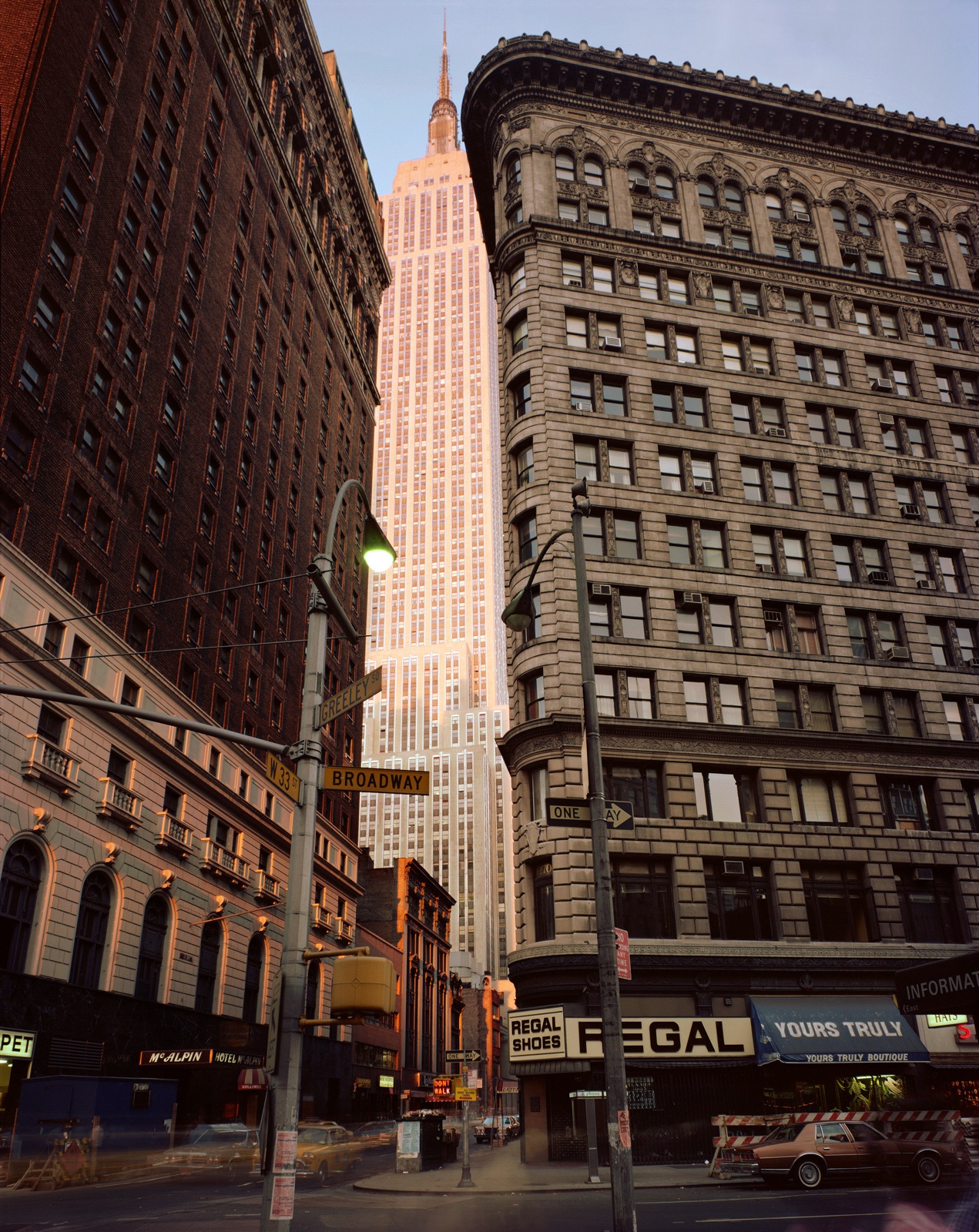

The Empire State Building is here pinned into the narrow slot between two older masses of masonry, its summit caught in a clear, late wash of sun while everything beneath it cools into shadow. Meyerowitz lets the tower recede to a vertical seam, and gives the foreground instead to a green traffic globe glowing at the corner and the small enamel arrow lettered BROADWAY hung from its post. The REGAL SHOES marquee and the worn promise YOURS TRULY hold the base of the frame; a single car waits at the curb in the soft, granular light of dusk. The grandeur of the icon is demoted to a sign among signs.
Made in 1978, the picture belongs to the body of New York street work in which Meyerowitz, having committed fully to color earlier in the decade, pressed the large-format and 35mm camera toward an argument that hue carried meaning grayscale could not. One sees the case made along this block: champagne limestone against soot-darkened brick, the steel-blue of evening air, the warm pulse held in the building's crown. These are distinctions a black-and-white print would surrender entirely.
That conviction placed Meyerowitz, with Eggleston and Shore, at the center of the shift that made color photography serious; his work from these years now sits in the Museum of Modern Art and the Metropolitan among other major collections. The frame describes a city worn and dignified, its age legible in stone and signage rather than in spectacle, and asks only that the monument be seen as part of the street that carries it.