By 1978 the Empire State Building had long stopped being news; it had become weather, a fact of the sky one walked beneath without raising the head. Meyerowitz raises it. He stands somewhere down on the side streets of the garment and import district, where the wholesalers sold children's wear and linens to anyone who came up the stairs, and he lets the tower rise pale and silver out of a haze of late afternoon, far enough off that it seems to belong to a different city than the one in the foreground.
And the foreground is everything. A neon script spells "Central" in red cursive above the block letters SODA LUNCH, the tubing cool and unlit in daylight, hung from a wire that cuts the frame on a long diagonal. Below it the painted board of James Betesh Import Co. lists its trades like a small poem — footwear, novelties, housewares, wholesale only — and further down CHERYL IMPORTING runs its name in primary colors along a low cornice. Fire escapes zigzag the cream-colored facades on the right; air conditioners lean from windows. Nobody is in the picture, yet the whole street speaks in the voices of people who hang signs.
What stays with me is the courtesy of the arrangement, the way the monument and the lunch counter are given equal seriousness, equal light. Meyerowitz does not rank them. The skyscraper is the kind of thing tourists photograph; the neon and the hand-lettered board vanish first, painted over, taken down, forgotten by the very neighborhood that depended on them. He has set them in one breath, the eternal and the soon-to-be-erased, and let the soft New York haze hold them there a little longer than they deserved.
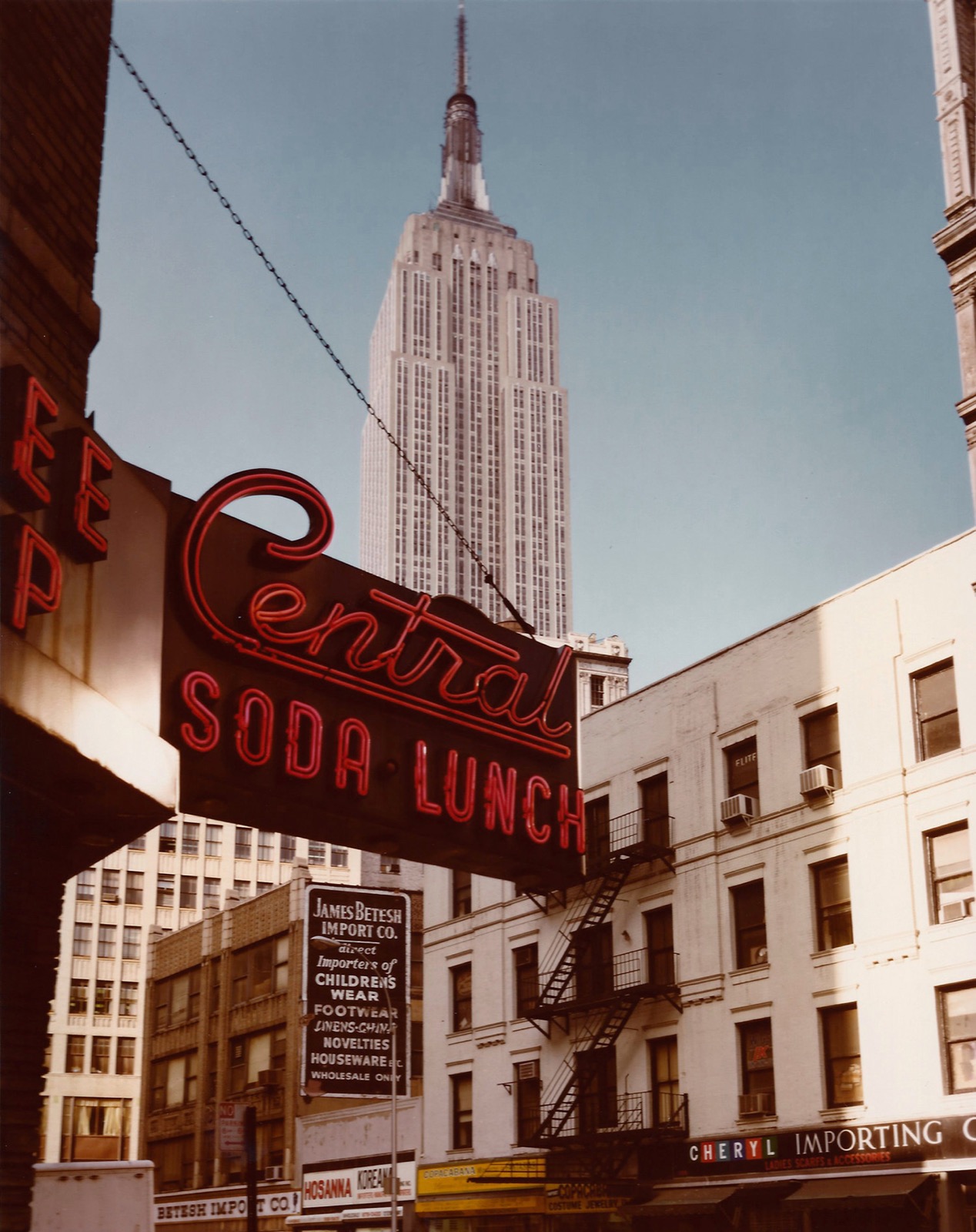

By 1978 the Empire State Building had long stopped being news; it had become weather, a fact of the sky one walked beneath without raising the head. Meyerowitz raises it. He stands somewhere down on the side streets of the garment and import district, where the wholesalers sold children's wear and linens to anyone who came up the stairs, and he lets the tower rise pale and silver out of a haze of late afternoon, far enough off that it seems to belong to a different city than the one in the foreground.
And the foreground is everything. A neon script spells "Central" in red cursive above the block letters SODA LUNCH, the tubing cool and unlit in daylight, hung from a wire that cuts the frame on a long diagonal. Below it the painted board of James Betesh Import Co. lists its trades like a small poem — footwear, novelties, housewares, wholesale only — and further down CHERYL IMPORTING runs its name in primary colors along a low cornice. Fire escapes zigzag the cream-colored facades on the right; air conditioners lean from windows. Nobody is in the picture, yet the whole street speaks in the voices of people who hang signs.
What stays with me is the courtesy of the arrangement, the way the monument and the lunch counter are given equal seriousness, equal light. Meyerowitz does not rank them. The skyscraper is the kind of thing tourists photograph; the neon and the hand-lettered board vanish first, painted over, taken down, forgotten by the very neighborhood that depended on them. He has set them in one breath, the eternal and the soon-to-be-erased, and let the soft New York haze hold them there a little longer than they deserved.