The night here is not black but brown: burnt sugar, old varnish, tobacco left in a jar. A field of winter grass takes the light like velvet taking a hand, every blade distinct, warm, almost combustible, while the bare trees behind hold up their nerves against a sky of smoked umber. One tree still wears its dead gold leaves. I did not know darkness could be this nourishing, this close to the colors of food and sleep.
And yet the light must come from somewhere, and I suspect it comes from us: headlights, a beam brought to the edge of a field where no one was expected. The photograph admits its own intrusion. The grass is lit the way a stage is lit an instant before the actor enters, and no actor enters; the drama is that the field goes on being a field under our interrogation. What unsettles me is not fear. It is the courtesy of the trees, standing for their portrait at an hour when they believed themselves unseen.
Hido made his name photographing suburban houses at night, their windows lit from within; here the current reverses, the dark countryside lit from without, by whoever has come looking. SFMOMA, the Getty and the Whitney keep his prints, which is to say this sensibility is now part of photography’s official memory. The archival pigment print matters more than usual: cheap reproduction would rot these browns into mud, and they must stay warm, graded, edible. I return to the gold-leafed tree. It is the photograph’s heartbeat, and it does not know it.
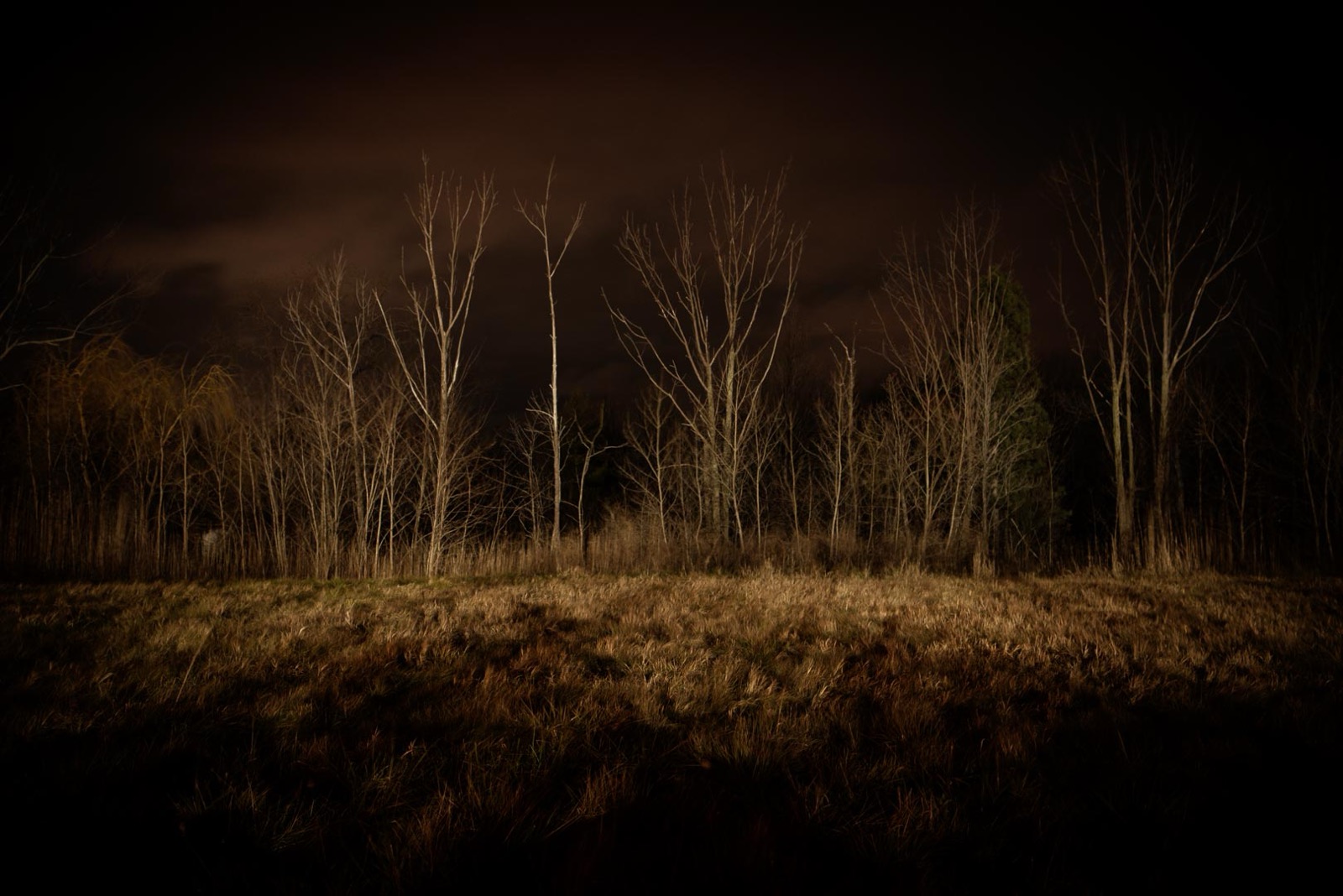

The night here is not black but brown: burnt sugar, old varnish, tobacco left in a jar. A field of winter grass takes the light like velvet taking a hand, every blade distinct, warm, almost combustible, while the bare trees behind hold up their nerves against a sky of smoked umber. One tree still wears its dead gold leaves. I did not know darkness could be this nourishing, this close to the colors of food and sleep.
And yet the light must come from somewhere, and I suspect it comes from us: headlights, a beam brought to the edge of a field where no one was expected. The photograph admits its own intrusion. The grass is lit the way a stage is lit an instant before the actor enters, and no actor enters; the drama is that the field goes on being a field under our interrogation. What unsettles me is not fear. It is the courtesy of the trees, standing for their portrait at an hour when they believed themselves unseen.
Hido made his name photographing suburban houses at night, their windows lit from within; here the current reverses, the dark countryside lit from without, by whoever has come looking. SFMOMA, the Getty and the Whitney keep his prints, which is to say this sensibility is now part of photography’s official memory. The archival pigment print matters more than usual: cheap reproduction would rot these browns into mud, and they must stay warm, graded, edible. I return to the gold-leafed tree. It is the photograph’s heartbeat, and it does not know it.