The weather has just left, and the light is what it left behind: a rose afterglow lying along the ridge, too weak to reach the ground, so the ground has arranged its own reception. Four puddles hold what the sky no longer quite offers, each one a different temperature of pink fading to silver, set into gravel gone black with rain. The rock keeps its back to us. All the event is in the water.
Hido is usually discussed as a poet of found places, but his instincts are directorial, and here the location behaves like a set someone has dressed and lit. The puddles read as recessed lighting, screens laid flat, each glowing at its own stop; the silhouetted crag could be a backdrop wheeled in for the shoot. Nothing was staged, which is the point: the picture demonstrates how completely a photographer can think in production values while touching nothing but a shutter.
That fluency between the found and the fabricated is why his work sits so comfortably in contemporary collections, SFMOMA, the Getty and the Whitney among them, alongside artists who build their pictures from scratch. As an archival pigment print, the image keeps its extremes intact, gravel held just above pure black, the rose light arriving through reflection rather than assertion, and it rewards the slow viewing that screens have almost trained out of us. It is a landscape at the end of light, cinema without a cast, its story only weather. The water will be gone by morning; the color already belongs to the print.
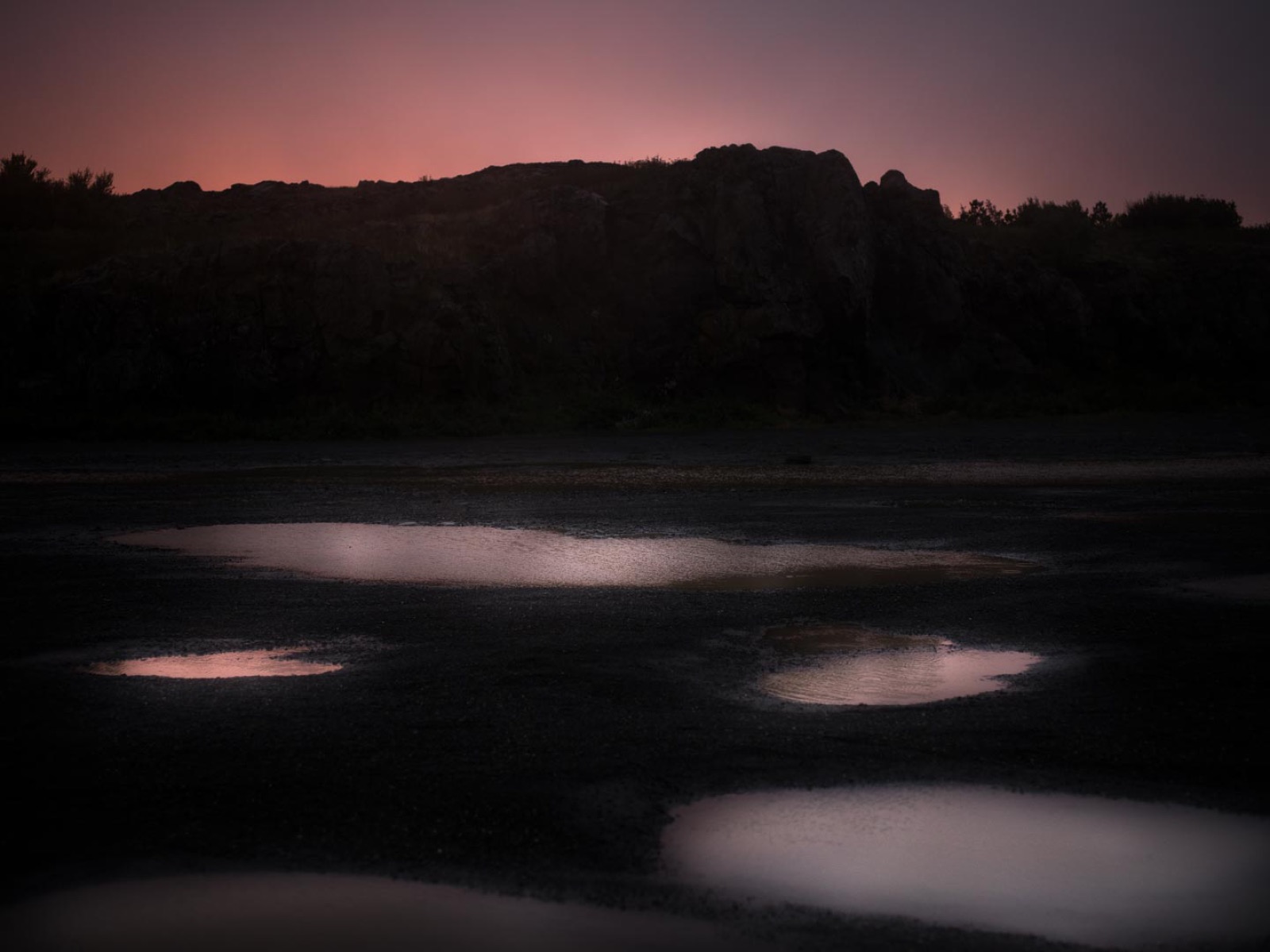

The weather has just left, and the light is what it left behind: a rose afterglow lying along the ridge, too weak to reach the ground, so the ground has arranged its own reception. Four puddles hold what the sky no longer quite offers, each one a different temperature of pink fading to silver, set into gravel gone black with rain. The rock keeps its back to us. All the event is in the water.
Hido is usually discussed as a poet of found places, but his instincts are directorial, and here the location behaves like a set someone has dressed and lit. The puddles read as recessed lighting, screens laid flat, each glowing at its own stop; the silhouetted crag could be a backdrop wheeled in for the shoot. Nothing was staged, which is the point: the picture demonstrates how completely a photographer can think in production values while touching nothing but a shutter.
That fluency between the found and the fabricated is why his work sits so comfortably in contemporary collections, SFMOMA, the Getty and the Whitney among them, alongside artists who build their pictures from scratch. As an archival pigment print, the image keeps its extremes intact, gravel held just above pure black, the rose light arriving through reflection rather than assertion, and it rewards the slow viewing that screens have almost trained out of us. It is a landscape at the end of light, cinema without a cast, its story only weather. The water will be gone by morning; the color already belongs to the print.