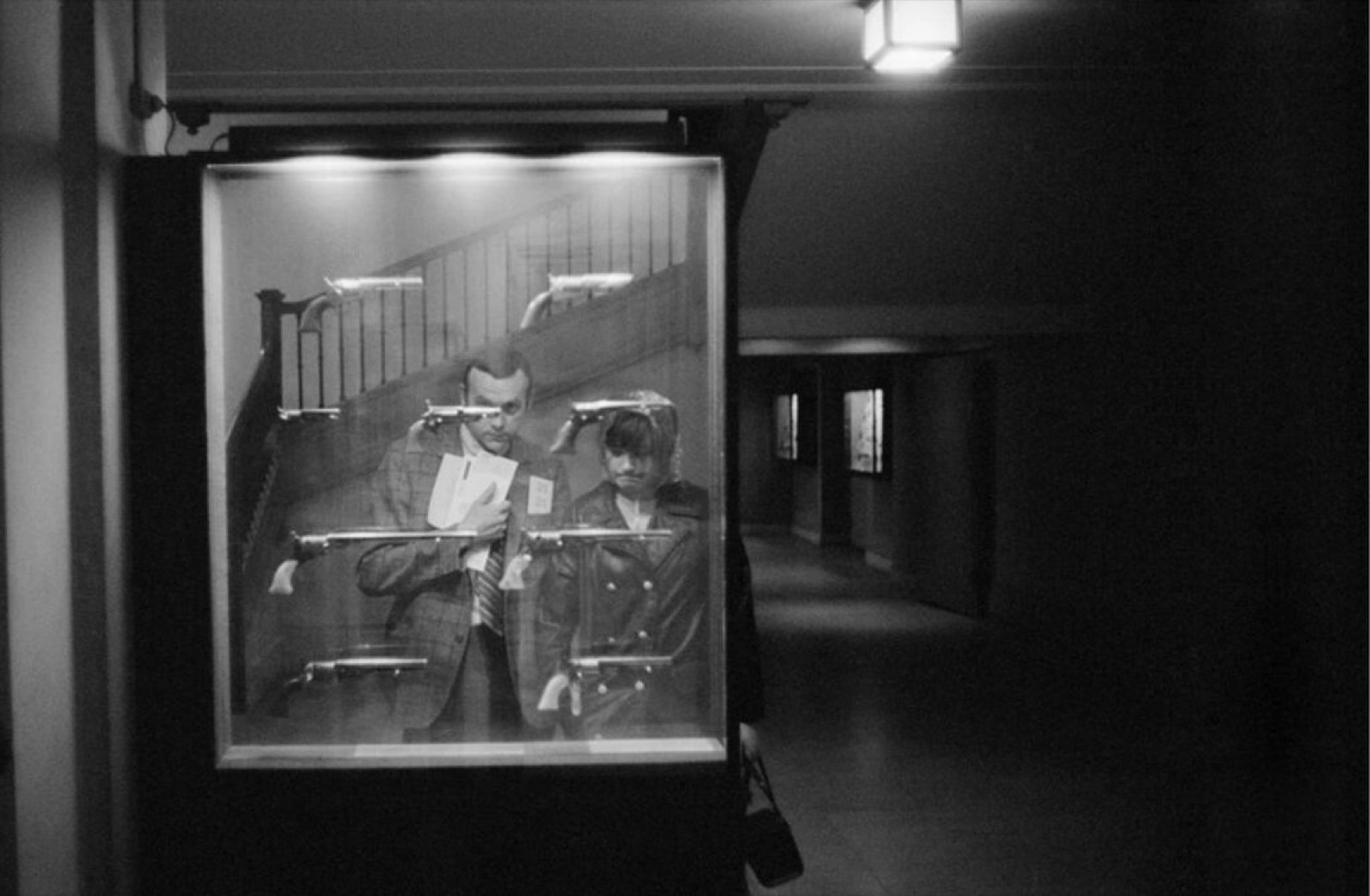
The darkness on the right withholds the room’s far end; refused any footing there, the eye returns to the one lit thing, a glass vitrine of mounted pistols on the near wall. Within that glaze a man in a checked jacket and a woman in a leather coat rise up, half present, half thrown there as reflection. He holds a white card against his chest; a banister climbs behind their heads. Whether the two stand inside the case or float across its surface from the corridor, the picture declines to say, and that refusal is the subject.
Everything hangs on the pane. Glass, the most photographic of materials, does here what emulsion does elsewhere: it superimposes, fusing the hard chrome of the weapons with the soft dark of two faces until pistol and person share one plane. The little bracketed barrels line up like exhibits, each labelled by light. The frame is built from surfaces that admit and repel the gaze, so that the ordinary act of stopping to look turns strange, doubled, faintly forensic.
He made this on the street, in the years he worked close to Robert Frank’s example, before the view camera and the luminous colour that would make his name. The instinct is already whole: let American light compose, trust the accident of a reflection over any staged clarity. Issued now as an archival pigment print, the object keeps its grain and its withholding intact, read the way one reads the case, layer beneath layer. His work hangs at the Modern, the Met and the Boston MFA; this frame earns its place by refusing to resolve.
The darkness on the right withholds the room’s far end; refused any footing there, the eye returns to the one lit thing, a glass vitrine of mounted pistols on the near wall. Within that glaze a man in a checked jacket and a woman in a leather coat rise up, half present, half thrown there as reflection. He holds a white card against his chest; a banister climbs behind their heads. Whether the two stand inside the case or float across its surface from the corridor, the picture declines to say, and that refusal is the subject.
Everything hangs on the pane. Glass, the most photographic of materials, does here what emulsion does elsewhere: it superimposes, fusing the hard chrome of the weapons with the soft dark of two faces until pistol and person share one plane. The little bracketed barrels line up like exhibits, each labelled by light. The frame is built from surfaces that admit and repel the gaze, so that the ordinary act of stopping to look turns strange, doubled, faintly forensic.
He made this on the street, in the years he worked close to Robert Frank’s example, before the view camera and the luminous colour that would make his name. The instinct is already whole: let American light compose, trust the accident of a reflection over any staged clarity. Issued now as an archival pigment print, the object keeps its grain and its withholding intact, read the way one reads the case, layer beneath layer. His work hangs at the Modern, the Met and the Boston MFA; this frame earns its place by refusing to resolve.