A sign is nailed low on the utility pole at the center of the frame, its few words dissolved by the darkness into pure graphic mark, a rectangle of pale nothing. It is the only text here, and it tells us nothing — which is fitting, because the great event this couple has come to witness is also absent, off beyond the top of the picture, over the Florida palms. The photograph is about waiting, and about the strange props waiting requires.
The arrangement is deliberate. A young man has carried a folding chair onto the roof of a pale sedan and sits enthroned, chin lifted, scanning a sky we cannot see; a woman perches on the fender in a light dress, legs crossed, already bored. The flash has bleached them and the car out of the enormous night, so that palm trunks and a pegged pole loom like stage flats behind. To photograph people awaiting a spectacle is to admit that the spectacle is never quite the subject; the tableau of anticipation is.
Meyerowitz made this at Cape Canaveral on the night of a moon launch, still in black and white, before the color and the view camera that, with Shore and Eggleston, made his name; his work is now honored by MoMA, the Met and the Boston MFA. The choice to face away from the rocket and toward the two people is the whole argument of his art. As an archival pigment print the blacks are dense and the flash-lit skin luminous, the palms silvered above. He keeps the sublime offstage and hands us only its human overture.
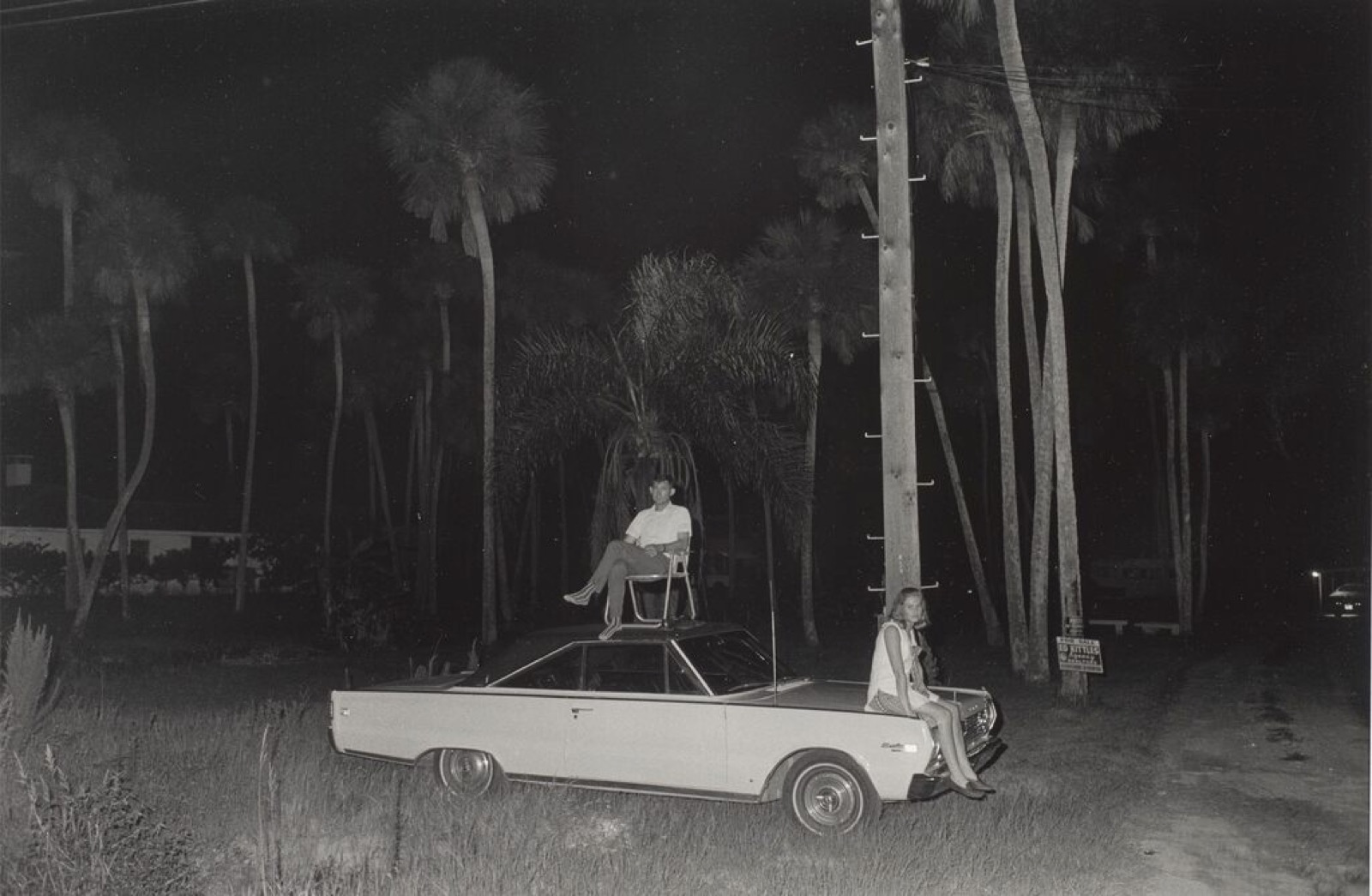

A sign is nailed low on the utility pole at the center of the frame, its few words dissolved by the darkness into pure graphic mark, a rectangle of pale nothing. It is the only text here, and it tells us nothing — which is fitting, because the great event this couple has come to witness is also absent, off beyond the top of the picture, over the Florida palms. The photograph is about waiting, and about the strange props waiting requires.
The arrangement is deliberate. A young man has carried a folding chair onto the roof of a pale sedan and sits enthroned, chin lifted, scanning a sky we cannot see; a woman perches on the fender in a light dress, legs crossed, already bored. The flash has bleached them and the car out of the enormous night, so that palm trunks and a pegged pole loom like stage flats behind. To photograph people awaiting a spectacle is to admit that the spectacle is never quite the subject; the tableau of anticipation is.
Meyerowitz made this at Cape Canaveral on the night of a moon launch, still in black and white, before the color and the view camera that, with Shore and Eggleston, made his name; his work is now honored by MoMA, the Met and the Boston MFA. The choice to face away from the rocket and toward the two people is the whole argument of his art. As an archival pigment print the blacks are dense and the flash-lit skin luminous, the palms silvered above. He keeps the sublime offstage and hands us only its human overture.