Every lit window at night is an accusation and a consolation at once: proof that someone is awake, evidence that we are outside. Hido's two-storey building, stucco the colour of weak tea beneath a red tile roof, offers a row of such windows, and only one glows with a pinkish warmth that might be a curtain, might be a body. A wooden fence crowned with razor wire runs the length of the frame; a camouflaged dumpster squats at the right; a tall lamp throws its cold circle onto empty asphalt.
The photograph is unsentimental about the poverty of the scene and yet refuses contempt. Coiled wire and a lot swept clean of people are the plain vocabulary of the American margin, the motels and rentals the culture prefers not to look at. Melancholy here is not a mood applied to the picture; it is the residue of attention paid to a place that expects none. To look this steadily is already a kind of ethics.
Rendered as an archival pigment print on Dibond, the image has the seamless surface of something manufactured, which suits its subject: a building assembled from standard parts, inhabited anonymously. From the Outskirts series, it belongs to Hido's ongoing inventory of after-dark loneliness. What we are given is not a story but a threshold, the single warm window against which the whole cold geometry of the lot is measured, and found wanting.
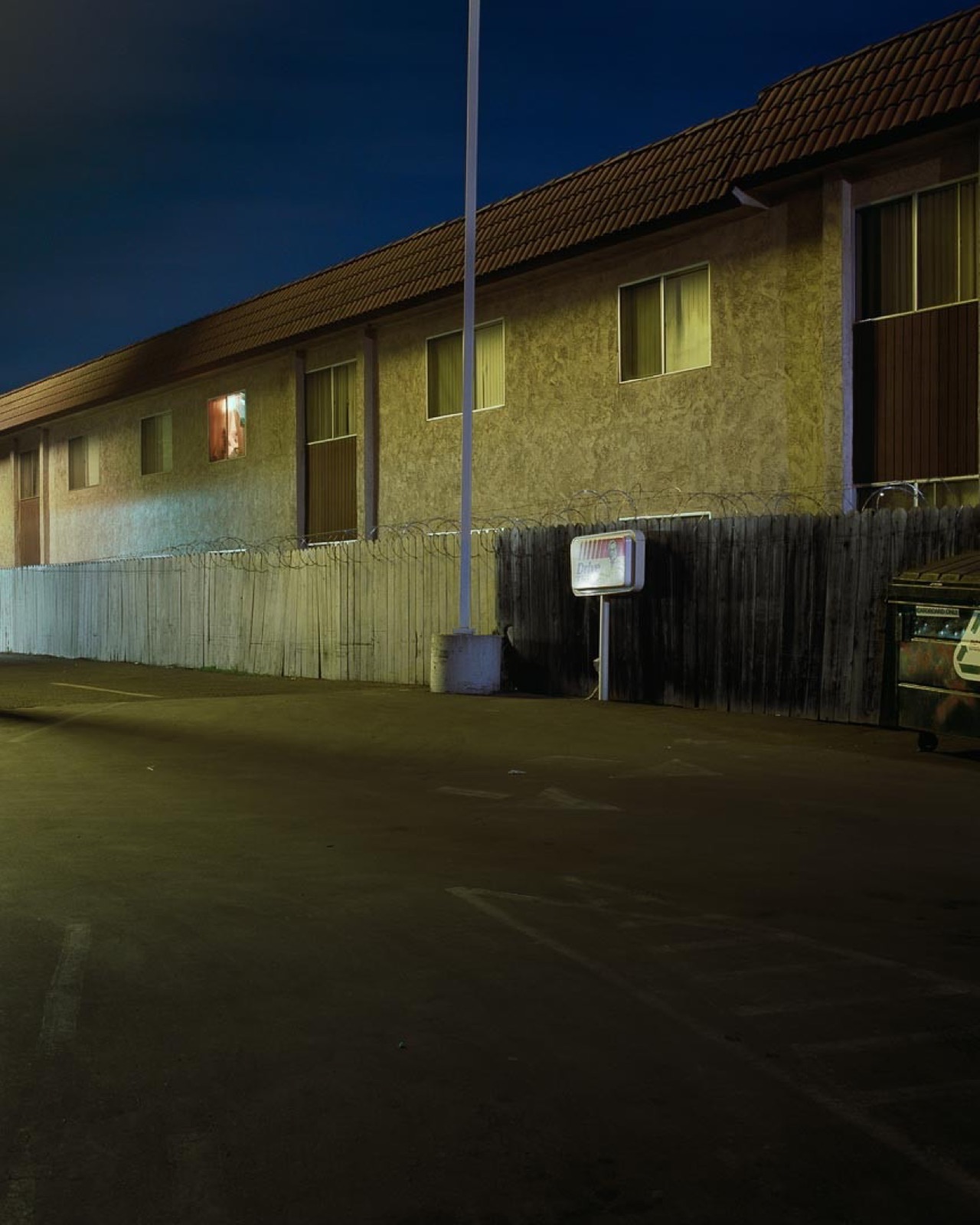

Every lit window at night is an accusation and a consolation at once: proof that someone is awake, evidence that we are outside. Hido's two-storey building, stucco the colour of weak tea beneath a red tile roof, offers a row of such windows, and only one glows with a pinkish warmth that might be a curtain, might be a body. A wooden fence crowned with razor wire runs the length of the frame; a camouflaged dumpster squats at the right; a tall lamp throws its cold circle onto empty asphalt.
The photograph is unsentimental about the poverty of the scene and yet refuses contempt. Coiled wire and a lot swept clean of people are the plain vocabulary of the American margin, the motels and rentals the culture prefers not to look at. Melancholy here is not a mood applied to the picture; it is the residue of attention paid to a place that expects none. To look this steadily is already a kind of ethics.
Rendered as an archival pigment print on Dibond, the image has the seamless surface of something manufactured, which suits its subject: a building assembled from standard parts, inhabited anonymously. From the Outskirts series, it belongs to Hido's ongoing inventory of after-dark loneliness. What we are given is not a story but a threshold, the single warm window against which the whole cold geometry of the lot is measured, and found wanting.