The streetlight is doing all the work, buzzing away up on its pole, throwing down a hard cone of mercury-blue that the camera has simply stood under and accepted, the way you'd stand under it yourself if your truck had stopped and you'd nowhere to be. And it really is a buzz you can almost hear in the picture — that particular sodium-and-insect drone of an American back lot at the hour when everyone's already inside. The pole splits the frame nearly in two, and to the right the old pickup sits there in the dirt with its chrome grille catching the light like a set of bared teeth, the only thing in the photograph that looks even faintly proud of itself.
Then you notice the window. One small lit window in the cinderblock wall of the nearest house, glowing a warm orange that has no business being so moving and is, anyway, completely moving — because it's the single sign that someone is home, awake, lamp on, while the whole rest of the scene stands abandoned to that cold sky and that churned, rutted ground in the foreground where nothing grows and a car would get stuck. The blue and the orange aren't fighting so much as ignoring each other, which is somehow worse.
What's strange is how little has to happen. Nobody walks into the frame. The truck won't start. And yet the whole thing tilts, quietly, toward the feeling of having driven all night and pulled over somewhere you didn't choose. This belongs to the long unnumbered survey of American houses-after-dark that made the artist's name through the book House Hunting and the work that followed — exteriors shot from the road, from outside, always from the position of the one who isn't going in. The warm window is the punchline and the wound at once: somebody got to stay.
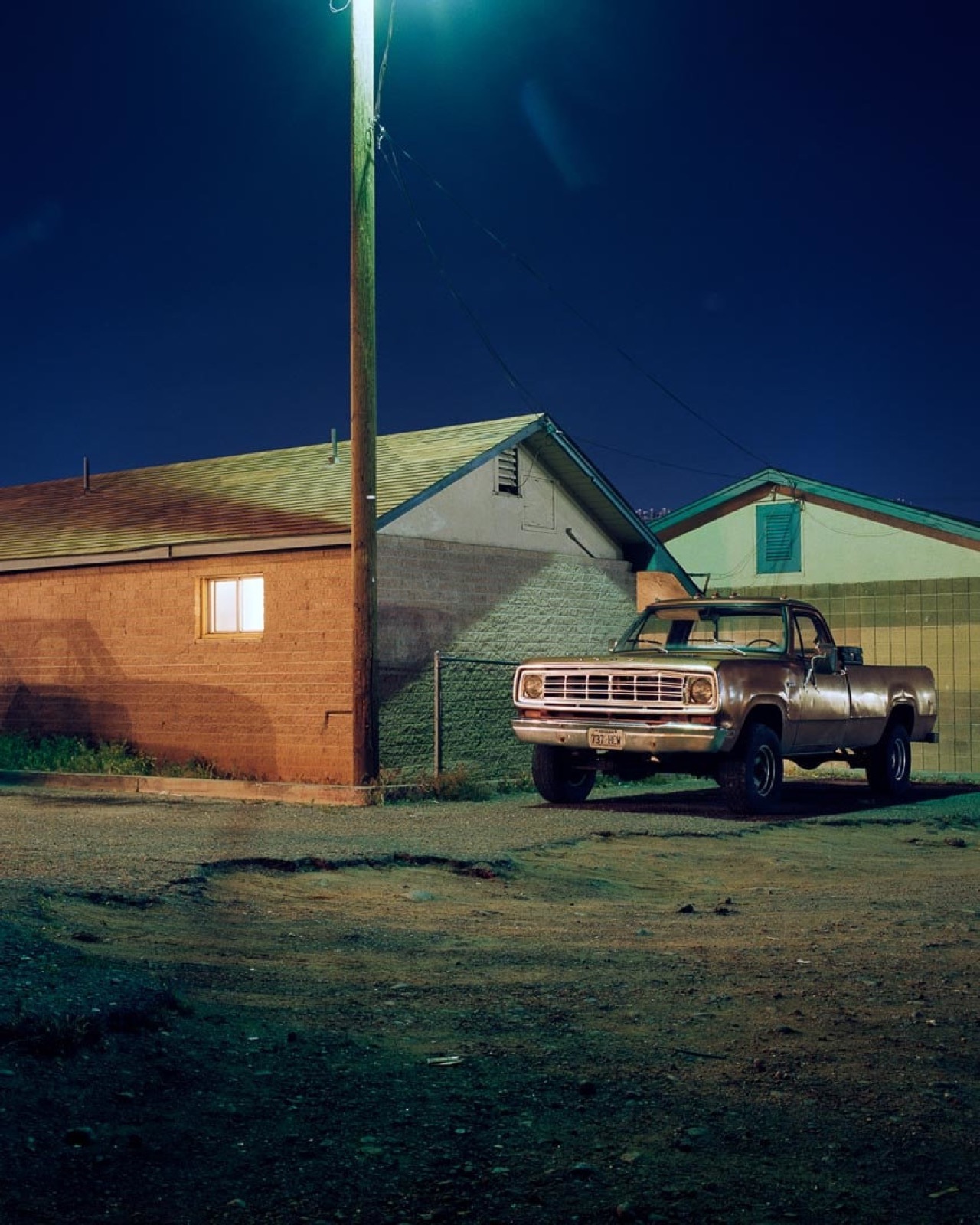

The streetlight is doing all the work, buzzing away up on its pole, throwing down a hard cone of mercury-blue that the camera has simply stood under and accepted, the way you'd stand under it yourself if your truck had stopped and you'd nowhere to be. And it really is a buzz you can almost hear in the picture — that particular sodium-and-insect drone of an American back lot at the hour when everyone's already inside. The pole splits the frame nearly in two, and to the right the old pickup sits there in the dirt with its chrome grille catching the light like a set of bared teeth, the only thing in the photograph that looks even faintly proud of itself.
Then you notice the window. One small lit window in the cinderblock wall of the nearest house, glowing a warm orange that has no business being so moving and is, anyway, completely moving — because it's the single sign that someone is home, awake, lamp on, while the whole rest of the scene stands abandoned to that cold sky and that churned, rutted ground in the foreground where nothing grows and a car would get stuck. The blue and the orange aren't fighting so much as ignoring each other, which is somehow worse.
What's strange is how little has to happen. Nobody walks into the frame. The truck won't start. And yet the whole thing tilts, quietly, toward the feeling of having driven all night and pulled over somewhere you didn't choose. This belongs to the long unnumbered survey of American houses-after-dark that made the artist's name through the book House Hunting and the work that followed — exteriors shot from the road, from outside, always from the position of the one who isn't going in. The warm window is the punchline and the wound at once: somebody got to stay.