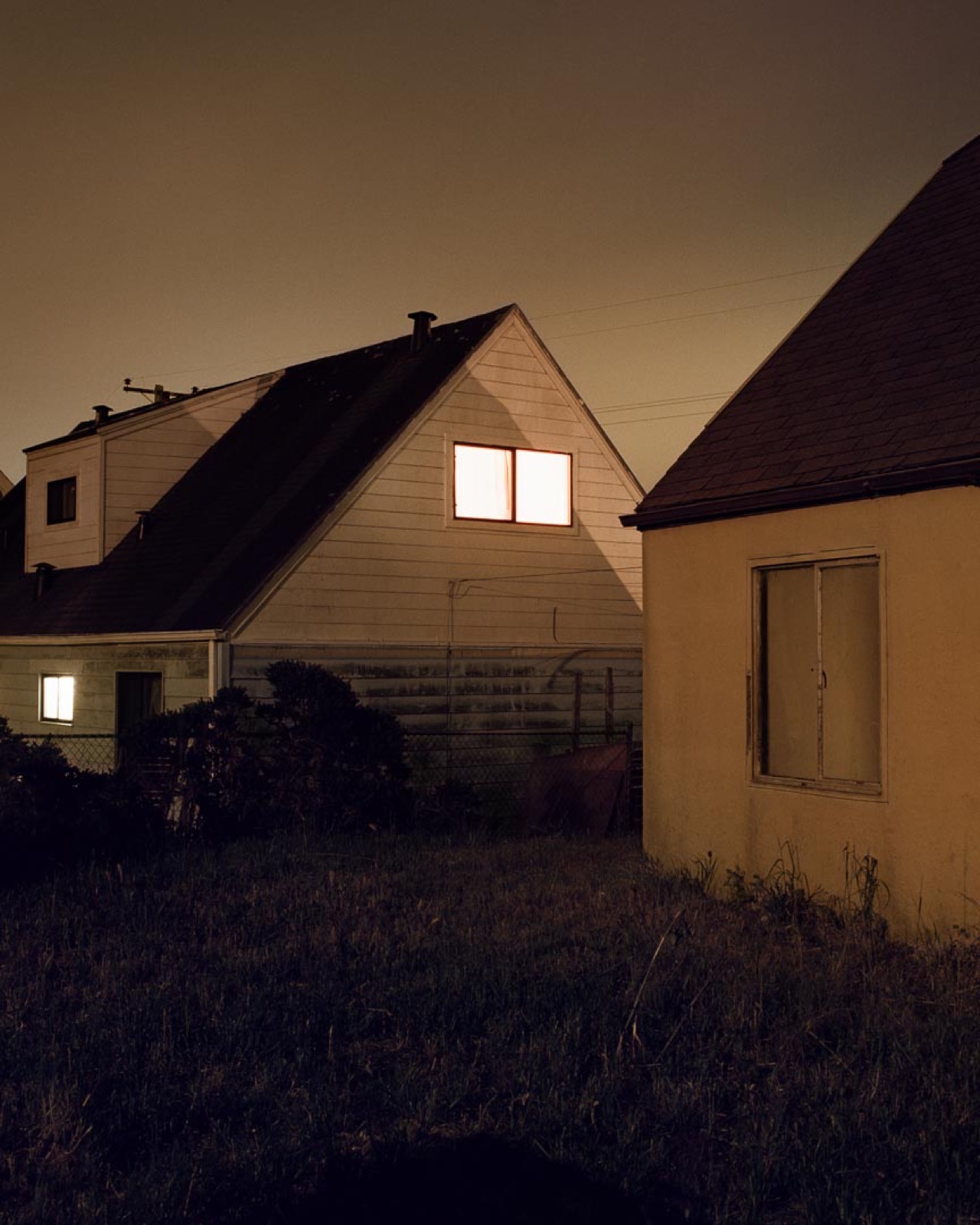
The backs of houses are more truthful than their fronts. Here, in the weedy gap between three of them, the proposition is put to the test: streaked siding that no one repainted because no one was meant to look, a chain-link fence, tall grass gone to seed, and above it all a peaked gable with one double window burning, its left pane dimmed to ember by a drawn curtain, its right pane bare and bright. The front of a house is an argument; the back is an admission.
The tonal structure is unusually rich for so plain a subject. The sky keeps a last sediment of dusk, a brown-gold wash against which the shingled roofs read as cut paper. The ochre stucco corner at right, with its blank aluminum window, presses close like a bystander. A second, whiter light burns low in the left wing, so the picture holds two households awake at different temperatures. Everything in between, weeds, wire, a shape slumped against the fence, belongs to no one, and the photograph grants it equal care.
Hido stands in the line of American photographers who found the national character legible in its housing, though he works at the hour when Walker Evans’s daylight documents give way to something closer to memory. His night pictures of ordinary houses are held by SFMOMA, the Getty and the Whitney. In the archival pigment print the values stay legible from the brightest pane to the deepest weed, a range that rewards slow looking and repays it with unease.

The backs of houses are more truthful than their fronts. Here, in the weedy gap between three of them, the proposition is put to the test: streaked siding that no one repainted because no one was meant to look, a chain-link fence, tall grass gone to seed, and above it all a peaked gable with one double window burning, its left pane dimmed to ember by a drawn curtain, its right pane bare and bright. The front of a house is an argument; the back is an admission.
The tonal structure is unusually rich for so plain a subject. The sky keeps a last sediment of dusk, a brown-gold wash against which the shingled roofs read as cut paper. The ochre stucco corner at right, with its blank aluminum window, presses close like a bystander. A second, whiter light burns low in the left wing, so the picture holds two households awake at different temperatures. Everything in between, weeds, wire, a shape slumped against the fence, belongs to no one, and the photograph grants it equal care.
Hido stands in the line of American photographers who found the national character legible in its housing, though he works at the hour when Walker Evans’s daylight documents give way to something closer to memory. His night pictures of ordinary houses are held by SFMOMA, the Getty and the Whitney. In the archival pigment print the values stay legible from the brightest pane to the deepest weed, a range that rewards slow looking and repays it with unease.