A dead tree stopped at the roadside is already a film set. This one, lopped to a dark torso and posted beside a diamond sign that turns its back to us, needs no crew: a yellow drum marks its position like a taped stage cue, telephone wires run in on a diagonal to meet it, and a heap of cut branches waits in the wings. Even the word painted on the asphalt plays along, STOP addressed to traffic arriving from elsewhere, so that we read it backwards, as if standing on the wrong side of the screen.
The staging is real, which is the point. Photographed through the windshield, the world arrives pre-produced: a pink-grey storm light grades every surface toward the same dusty rose, a dark cloud system holds the left of the sky, the plowed field runs to low hills, and the blur at the edges is pure lens, honest about its apparatus. In the 1990s a generation of photographers learned to treat the found landscape as if it had been directed; this picture shows how little persuasion the landscape needs. Nothing here was arranged, and yet everything behaves as though it had been.
It belongs to the photographer’s long project of driving and looking, the fogged roads that share a numbered archive with his luminous houses at night; this frame is number 1609-a. His prints are held by SFMOMA, the Getty and the Whitney; in this archival pigment print the haze keeps its warmth, rose into buff into brown, a color memory of a road after rain.
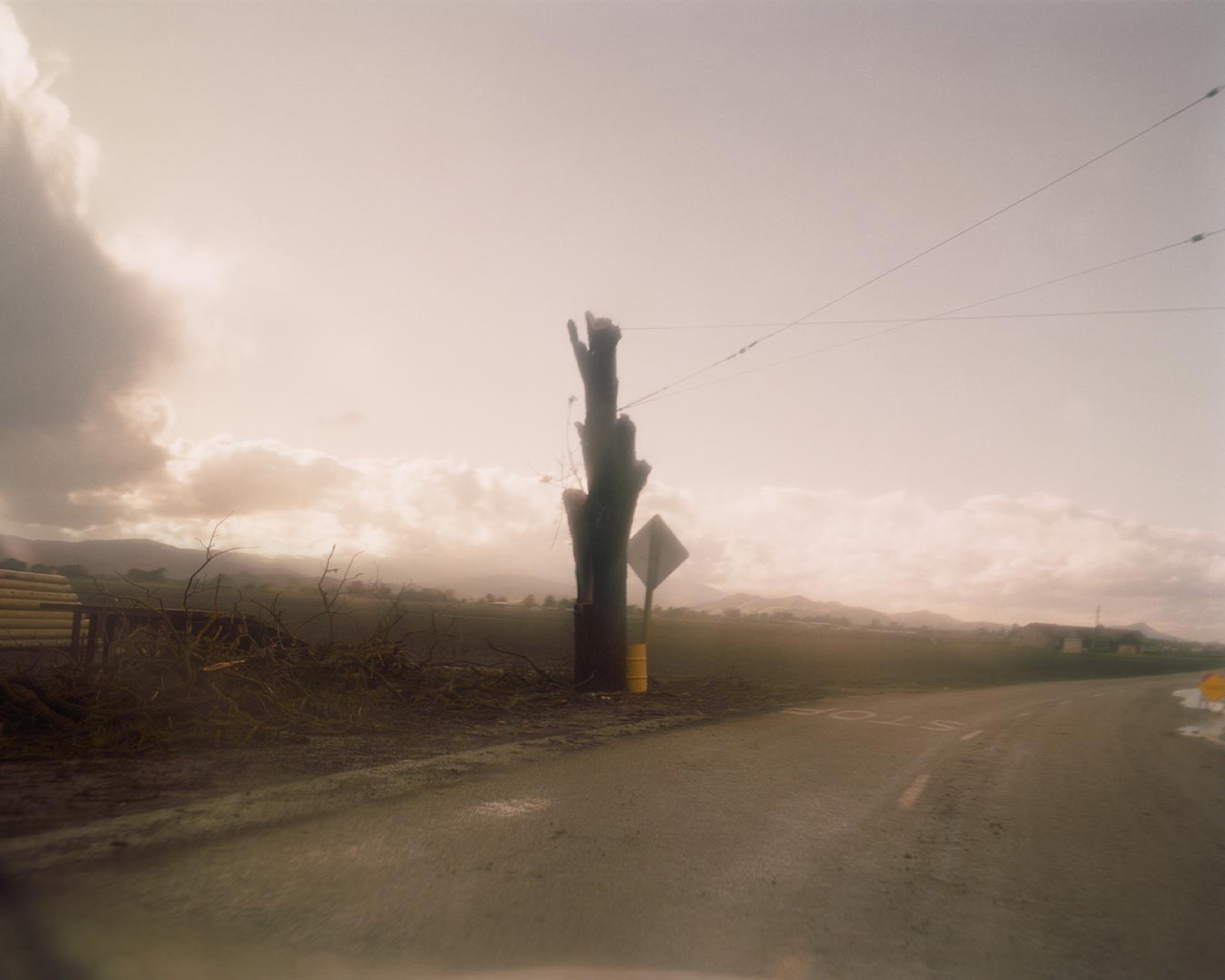

A dead tree stopped at the roadside is already a film set. This one, lopped to a dark torso and posted beside a diamond sign that turns its back to us, needs no crew: a yellow drum marks its position like a taped stage cue, telephone wires run in on a diagonal to meet it, and a heap of cut branches waits in the wings. Even the word painted on the asphalt plays along, STOP addressed to traffic arriving from elsewhere, so that we read it backwards, as if standing on the wrong side of the screen.
The staging is real, which is the point. Photographed through the windshield, the world arrives pre-produced: a pink-grey storm light grades every surface toward the same dusty rose, a dark cloud system holds the left of the sky, the plowed field runs to low hills, and the blur at the edges is pure lens, honest about its apparatus. In the 1990s a generation of photographers learned to treat the found landscape as if it had been directed; this picture shows how little persuasion the landscape needs. Nothing here was arranged, and yet everything behaves as though it had been.
It belongs to the photographer’s long project of driving and looking, the fogged roads that share a numbered archive with his luminous houses at night; this frame is number 1609-a. His prints are held by SFMOMA, the Getty and the Whitney; in this archival pigment print the haze keeps its warmth, rose into buff into brown, a color memory of a road after rain.