A glove has just landed. The boy at right has driven his right hand square into his opponent's jaw, snapping the blond head sideways, and Horvat releases the shutter at the instant the leather meets the face rather than a breath before or after. What organizes the frame, though, is not the blow but the woman behind it: planted dead center against the brick, a shopping bag hanging from her fist, she watches the fight with the unbothered attention of someone who has seen it many times. The whole drama of the picture passes between her steadiness and the boys' violence.
Horvat made this in Lambeth in 1955, soon after settling in London at the close of his itinerant years as a photojournalist for Picture Post and Réalités. The work belongs to the reportage that preceded his celebrated turn to fashion, when he carried the candor of the street into the studio. Here the Victorian terrace supplies the proscenium—blind windows, a dark doorway, bicycles laid against the wall—while the seated children along the curb form a low chorus, one small boy grinning straight out at us, already aware of the camera the fighters have forgotten.
What lasts is the descriptive precision: braces and rolled sleeves, the soft blur of the recoiling arm against the held sharpness of the standing crowd, the contest staged on a public pavement that the neighborhood has quietly agreed to lend it. Vintage prints of Horvat's London survive in few hands, and this gelatin silver sheet renders the brick's grain and the gloves' worn sheen with the authority of a photographer who knew exactly when a gesture becomes an image.
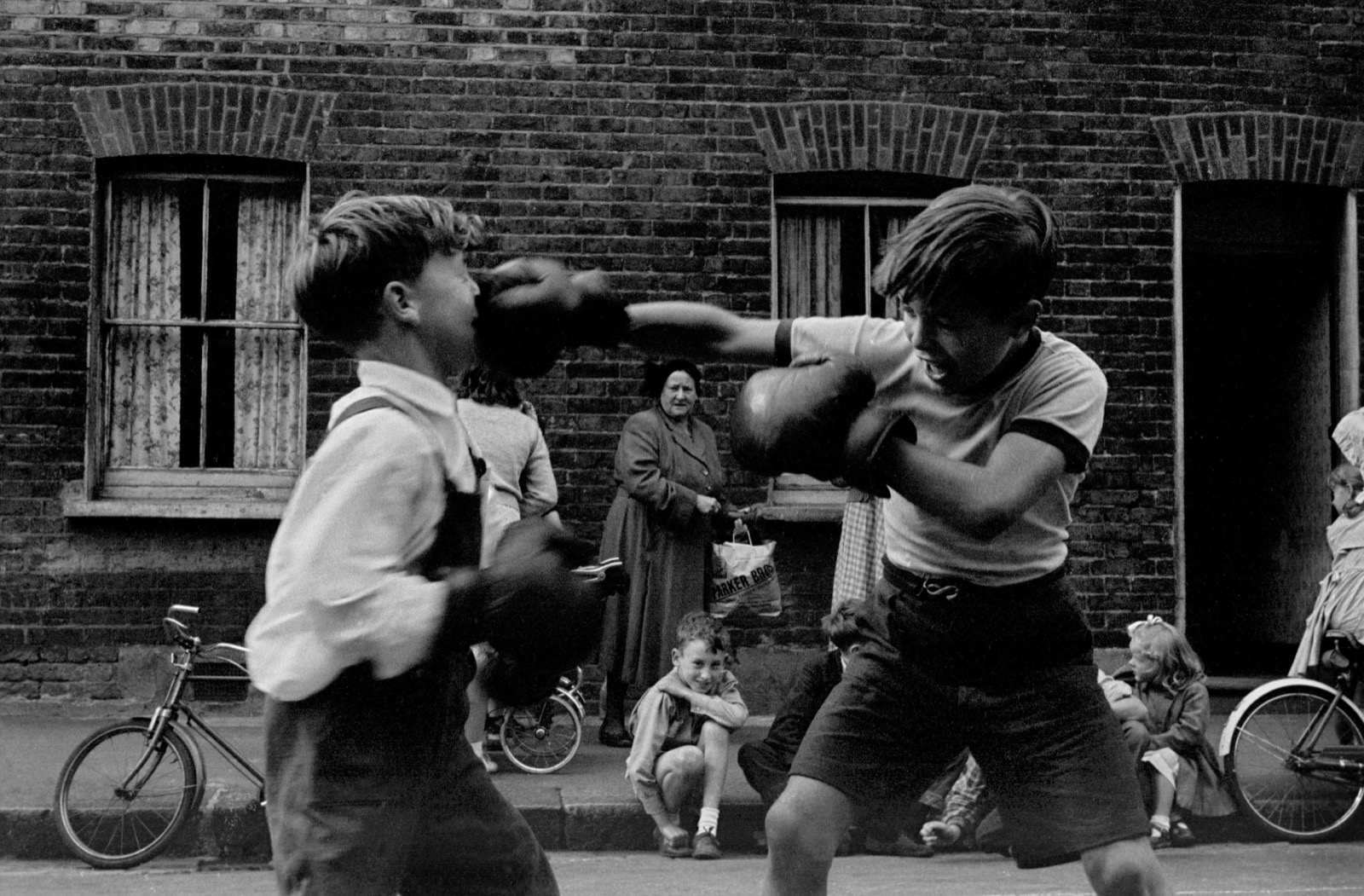

A glove has just landed. The boy at right has driven his right hand square into his opponent's jaw, snapping the blond head sideways, and Horvat releases the shutter at the instant the leather meets the face rather than a breath before or after. What organizes the frame, though, is not the blow but the woman behind it: planted dead center against the brick, a shopping bag hanging from her fist, she watches the fight with the unbothered attention of someone who has seen it many times. The whole drama of the picture passes between her steadiness and the boys' violence.
Horvat made this in Lambeth in 1955, soon after settling in London at the close of his itinerant years as a photojournalist for Picture Post and Réalités. The work belongs to the reportage that preceded his celebrated turn to fashion, when he carried the candor of the street into the studio. Here the Victorian terrace supplies the proscenium—blind windows, a dark doorway, bicycles laid against the wall—while the seated children along the curb form a low chorus, one small boy grinning straight out at us, already aware of the camera the fighters have forgotten.
What lasts is the descriptive precision: braces and rolled sleeves, the soft blur of the recoiling arm against the held sharpness of the standing crowd, the contest staged on a public pavement that the neighborhood has quietly agreed to lend it. Vintage prints of Horvat's London survive in few hands, and this gelatin silver sheet renders the brick's grain and the gloves' worn sheen with the authority of a photographer who knew exactly when a gesture becomes an image.