What the picture keeps from us is the young man’s gaze: his eyes are shut, his face half-covered by a leathery hand, so that the one human we might read is turned inward and unavailable. We are given instead the setting of a first date at its most scripted, white tablecloth, a champagne flute, a single rose laid across a small plate, salt and pepper standing to attention. And beside him, in an identical black suit and polka-dot tie, sits a chimpanzee, leaning in to kiss.
Weber withholds the explanation as deliberately as the gaze. Nothing tells us whether this is satire, tenderness, a fashion story or a fable, and the restraint is what makes the image linger; a lesser director would have played it for a laugh. Instead every prop is arranged with the gravity of a real romance, the chimp’s hand cupping the boy’s jaw with something like care. The staging insists we take the impossible couple seriously, and by the second glance, unsettlingly, we do.
Animals have always shared Weber’s frames as equals rather than props, and here that democratic tenderness is pushed to its edge, a beast dressed for dinner and granted the standing of a suitor. The gelatin silver print gives the joke its straight face: crisp restaurant whites, the deep black of the two suits, the fur and the boy’s hair rendered in the same patient grey. Printed by hand, the surface holds the tablecloth’s glare and the plush shadow of the booth without strain.
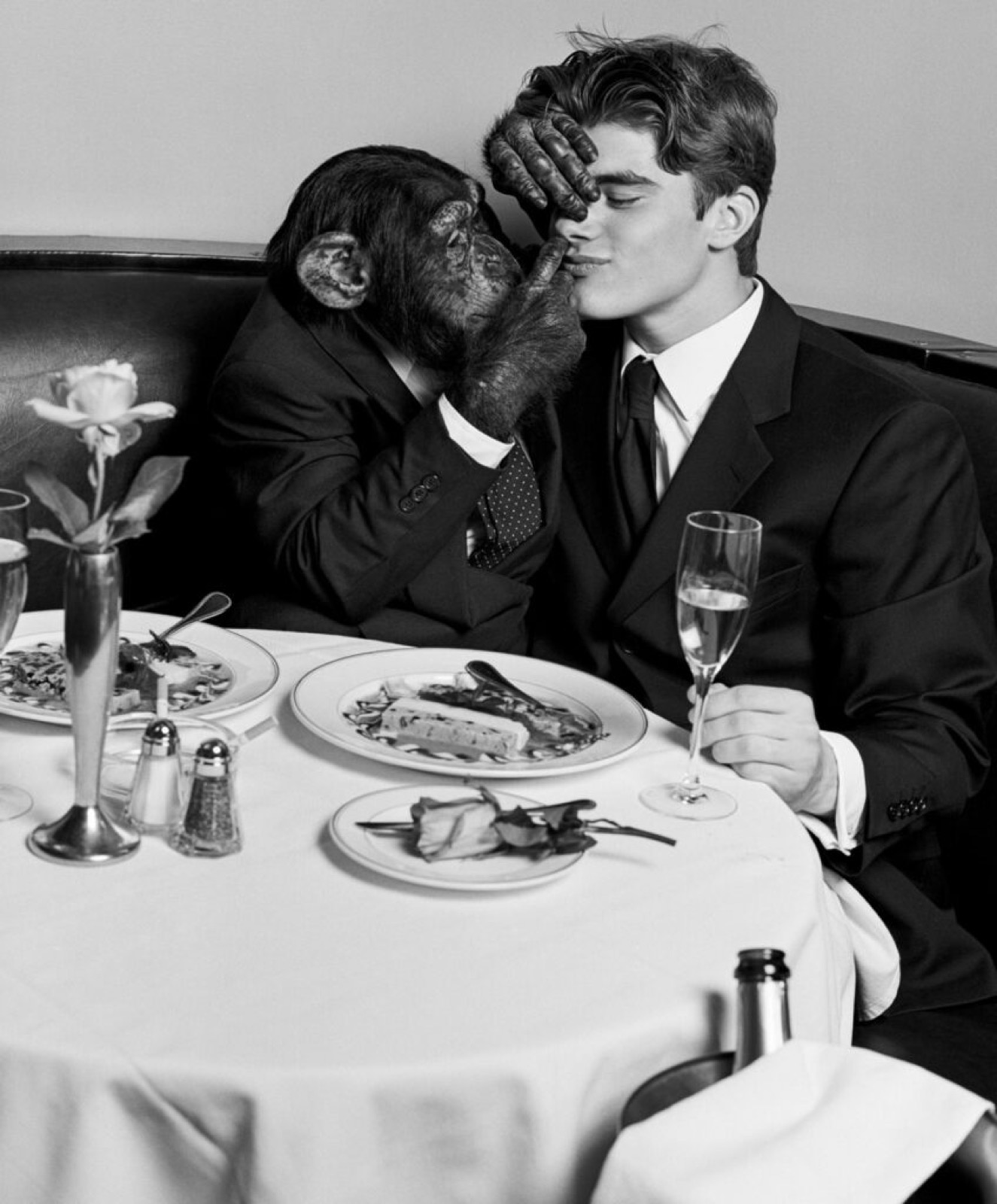

What the picture keeps from us is the young man’s gaze: his eyes are shut, his face half-covered by a leathery hand, so that the one human we might read is turned inward and unavailable. We are given instead the setting of a first date at its most scripted, white tablecloth, a champagne flute, a single rose laid across a small plate, salt and pepper standing to attention. And beside him, in an identical black suit and polka-dot tie, sits a chimpanzee, leaning in to kiss.
Weber withholds the explanation as deliberately as the gaze. Nothing tells us whether this is satire, tenderness, a fashion story or a fable, and the restraint is what makes the image linger; a lesser director would have played it for a laugh. Instead every prop is arranged with the gravity of a real romance, the chimp’s hand cupping the boy’s jaw with something like care. The staging insists we take the impossible couple seriously, and by the second glance, unsettlingly, we do.
Animals have always shared Weber’s frames as equals rather than props, and here that democratic tenderness is pushed to its edge, a beast dressed for dinner and granted the standing of a suitor. The gelatin silver print gives the joke its straight face: crisp restaurant whites, the deep black of the two suits, the fur and the boy’s hair rendered in the same patient grey. Printed by hand, the surface holds the tablecloth’s glare and the plush shadow of the booth without strain.