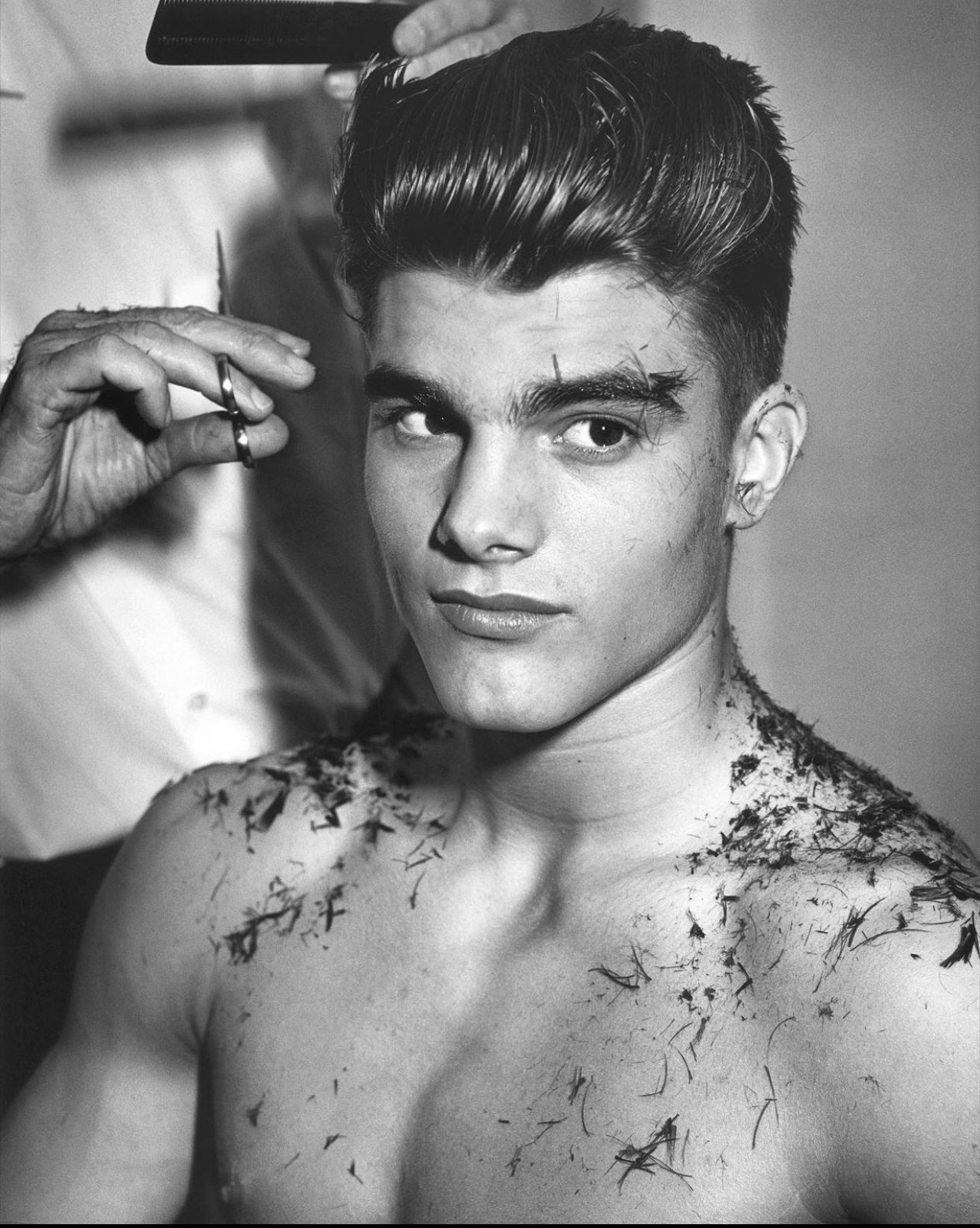
The barber’s hands hover above the young man’s crown, one steadying a black comb through the freshly built pompadour, the other pinching small scissors mid-snip. Weber catches the ritual at its most suspended instant, the moment when nothing is being cut and everything is about to be. Those hands are the picture’s quiet argument: veined, weathered, decades older than the smooth shoulders beneath them, an inheritance of craft passing over a body still new to the world.
Snipped hair scatters across his skin, dark commas strewn over the collarbone and shoulders like iron filings on a magnet, and it is this litter that gives the photograph its grain and its wit. Against the near-white of the barber’s shirt and the pale wall, the print modulates a full scale of greys, from the wet gloss of the styled hair to the faint down on the young man’s chest. He meets the lens directly, lips just parted, more amused than vain, aware of being made into an image.
Grooming has always been one of Weber’s true subjects, less about vanity than the tenderness of one person attending another, the locker room and the barbershop as chapels of American masculinity. The gelatin silver print serves that intimacy with unusual fidelity, its rich blacks and controlled highlights giving the loose hairs an almost tactile presence on the paper. Weber, who redefined the look of fashion in the 1980s, works here in the older documentary key of the studio portrait, dignifying an ordinary haircut without ever letting it turn sentimental.
The barber’s hands hover above the young man’s crown, one steadying a black comb through the freshly built pompadour, the other pinching small scissors mid-snip. Weber catches the ritual at its most suspended instant, the moment when nothing is being cut and everything is about to be. Those hands are the picture’s quiet argument: veined, weathered, decades older than the smooth shoulders beneath them, an inheritance of craft passing over a body still new to the world.
Snipped hair scatters across his skin, dark commas strewn over the collarbone and shoulders like iron filings on a magnet, and it is this litter that gives the photograph its grain and its wit. Against the near-white of the barber’s shirt and the pale wall, the print modulates a full scale of greys, from the wet gloss of the styled hair to the faint down on the young man’s chest. He meets the lens directly, lips just parted, more amused than vain, aware of being made into an image.
Grooming has always been one of Weber’s true subjects, less about vanity than the tenderness of one person attending another, the locker room and the barbershop as chapels of American masculinity. The gelatin silver print serves that intimacy with unusual fidelity, its rich blacks and controlled highlights giving the loose hairs an almost tactile presence on the paper. Weber, who redefined the look of fashion in the 1980s, works here in the older documentary key of the studio portrait, dignifying an ordinary haircut without ever letting it turn sentimental.