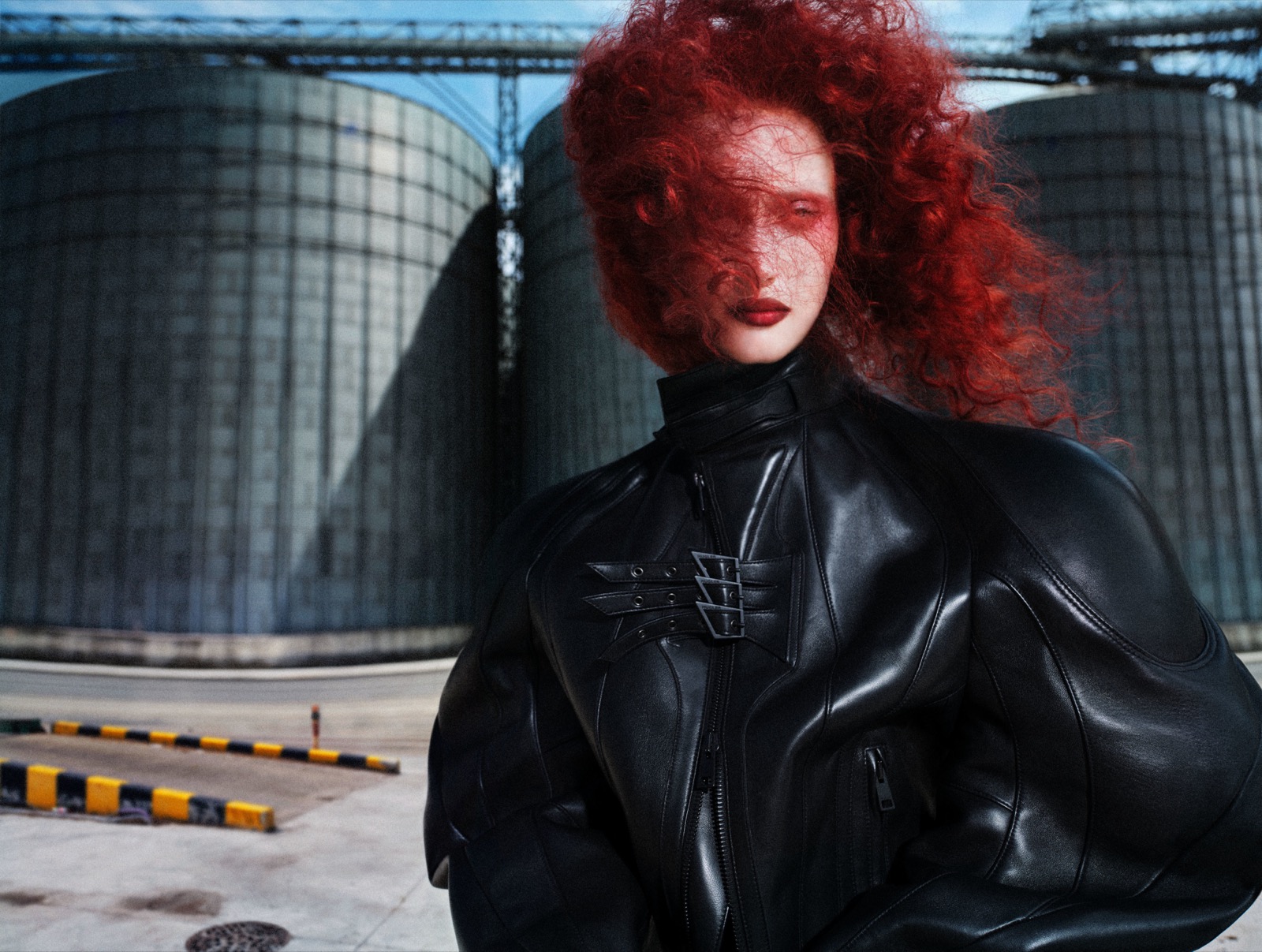
Fashion has always coveted the factory — Newton beside a pool, Guy Bourdin against tiled walls — and this frame drops that lineage before two vast grain silos, their corrugated flanks curving away like grounded hulls. Set against all that industrial grey, a torrent of dark-red curls detonates, blown half across the face until only one eye and a painted mouth surface. The Mugler leather, zipped and buckled at the sternum, answers the metal with its own hard sheen.
What a piece of casting the hair becomes. It performs where a face would ordinarily do the work, a red weather system with its own private wind, and the model lets it — chin lifted, shoulders squared inside borrowed armour cut for someone larger. The buckled harness across the chest reads like tack for a thoroughbred; the yellow-and-black curb at the left edge stripes the tarmac with a warning nobody heeds. Glamour here is a standoff between soft and rigid, between combustion and the patient geometry of storage.
Yeste came up in the front rank of Spanish fashion image-making — Numéro, Harper’s Bazaar, Vogue — and an elemental streak runs through it, wind and fire smuggled into a commercial commission. This is that instinct made portable and permanent: an archival pigment print in which the reds hold their heat and the grey silos keep their cool, no tonal compromise between them. Hung, it behaves less like an editorial page than a wall-scaled event, the kind of picture that keeps burning long after the magazine it might have graced is recycled.
Fashion has always coveted the factory — Newton beside a pool, Guy Bourdin against tiled walls — and this frame drops that lineage before two vast grain silos, their corrugated flanks curving away like grounded hulls. Set against all that industrial grey, a torrent of dark-red curls detonates, blown half across the face until only one eye and a painted mouth surface. The Mugler leather, zipped and buckled at the sternum, answers the metal with its own hard sheen.
What a piece of casting the hair becomes. It performs where a face would ordinarily do the work, a red weather system with its own private wind, and the model lets it — chin lifted, shoulders squared inside borrowed armour cut for someone larger. The buckled harness across the chest reads like tack for a thoroughbred; the yellow-and-black curb at the left edge stripes the tarmac with a warning nobody heeds. Glamour here is a standoff between soft and rigid, between combustion and the patient geometry of storage.
Yeste came up in the front rank of Spanish fashion image-making — Numéro, Harper’s Bazaar, Vogue — and an elemental streak runs through it, wind and fire smuggled into a commercial commission. This is that instinct made portable and permanent: an archival pigment print in which the reds hold their heat and the grey silos keep their cool, no tonal compromise between them. Hung, it behaves less like an editorial page than a wall-scaled event, the kind of picture that keeps burning long after the magazine it might have graced is recycled.