The ground is what this photograph refuses me: no earth, no horizon, no island, only a sky of curdled cloud and a body with nowhere to land. I cannot say whether she is rising or falling, and the picture, serenely, declines to settle the question. Around her a ring of volcanic stones hangs in the air, each one obedient, as though gravity had been adjourned by decree.
I inventory the marvels calmly enough: the spread arms, the open palms, the dark costume with its ruffle of stitching, the sculptural necklace lying glossy at her throat, the face lifted and composed as an effigy’s. Then I arrive at the soles of her feet, bare, pressed together, turned toward me, and my composure goes. Everything else in the frame performs; the soles do not know how. They are the body’s most unguarded skin, the part that touches the earth, and here the earth has been taken away. It is this, not the floating stones, that makes the levitation real to me.
Yeste made his name in the great fashion magazines; he calls the series Beauty, and I accept the word on the condition that beauty here means suspension, the moment before consequence. On La Gomera the stones are volcanic; in the photograph they are punctuation. The print, an archival pigment print, gives the greys their full register, cloud-white through basalt-black, and keeps every pore of stone and skin distinct. I look up at her as one looks at a ceiling painted with a single, weightless saint.
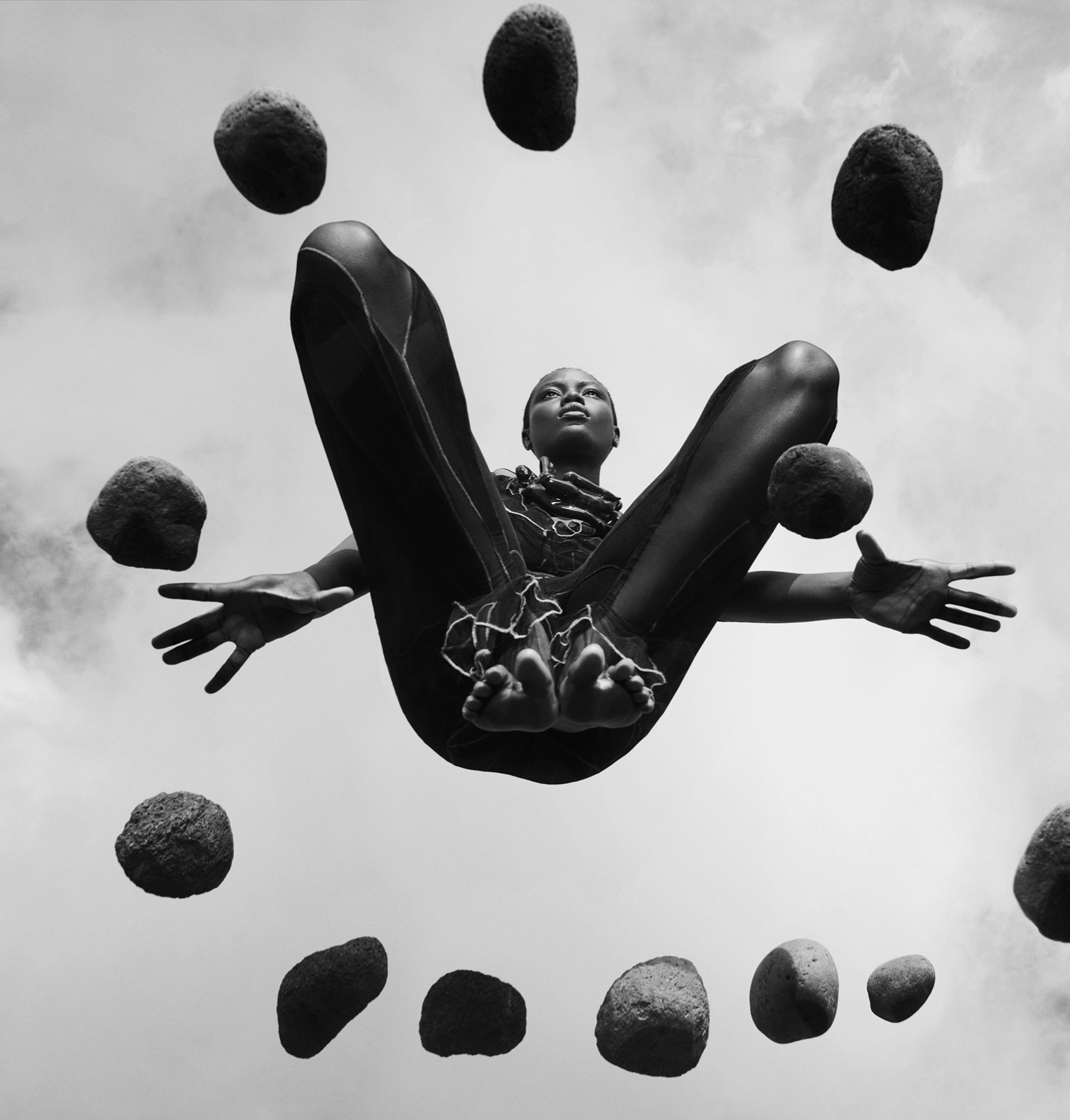

The ground is what this photograph refuses me: no earth, no horizon, no island, only a sky of curdled cloud and a body with nowhere to land. I cannot say whether she is rising or falling, and the picture, serenely, declines to settle the question. Around her a ring of volcanic stones hangs in the air, each one obedient, as though gravity had been adjourned by decree.
I inventory the marvels calmly enough: the spread arms, the open palms, the dark costume with its ruffle of stitching, the sculptural necklace lying glossy at her throat, the face lifted and composed as an effigy’s. Then I arrive at the soles of her feet, bare, pressed together, turned toward me, and my composure goes. Everything else in the frame performs; the soles do not know how. They are the body’s most unguarded skin, the part that touches the earth, and here the earth has been taken away. It is this, not the floating stones, that makes the levitation real to me.
Yeste made his name in the great fashion magazines; he calls the series Beauty, and I accept the word on the condition that beauty here means suspension, the moment before consequence. On La Gomera the stones are volcanic; in the photograph they are punctuation. The print, an archival pigment print, gives the greys their full register, cloud-white through basalt-black, and keeps every pore of stone and skin distinct. I look up at her as one looks at a ceiling painted with a single, weightless saint.