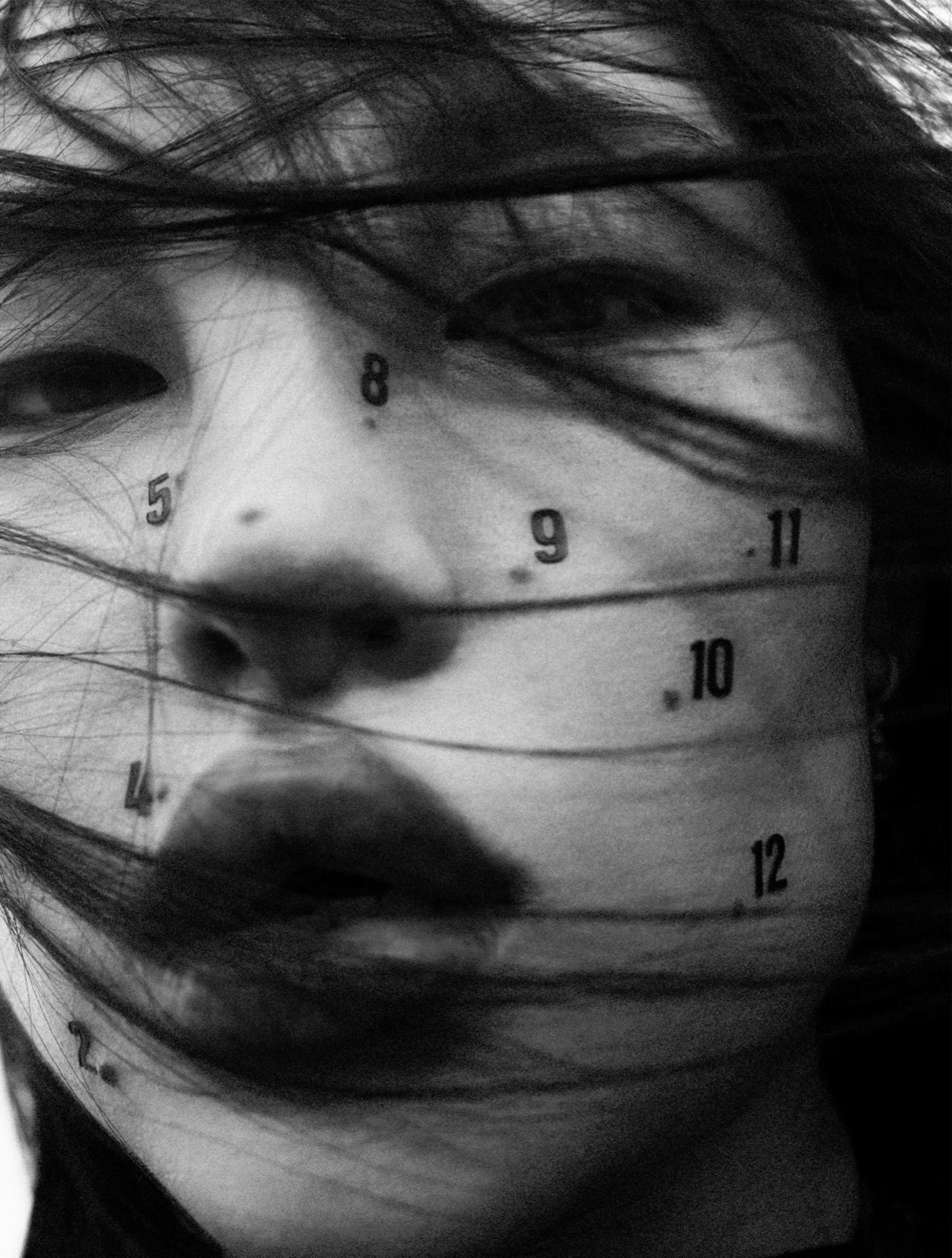
There was a moment, early in photography’s working life, when astronomers pressed it into service as a clerk: night skies on glass plates, each star assigned a small printed numeral so that the heavens could be filed. This portrait remembers that clerical job and reassigns it. Across a young woman’s face, wind-crossed by strands of dark hair, the beauty marks have been numbered, 2, 4, 5, 8, 9, 10, 11, 12, as though her skin were a sky requiring a catalogue.
Photography has form here. Faces have been gridded and measured since the first police archives, and the beauty business has its own cartography, zones, charts, corrective diagrams. What rescues this image from either bureaucracy is the weather in it: hair blown across the features like the connecting lines of a constellation chart, so that the numbered moles become stars in a private zodiac. Her lips are parted, her gaze heavy, sidelong and unbothered. She is not being processed; she is being read, and she appears to know the difference.
Txema Yeste made this in Cadaqués, on the same Catalan coast that keeps drawing his beauty work out of the studio and into the elements; the wind in it reads as fact, not styling. Born in Barcelona, he has long stood at the sharp end of Spanish fashion photography, working for Numéro, Harper’s Bazaar and Vogue, precisely because of images like this, which take a beauty assignment and return a question. The archival pigment print keeps every last grain of that grey weather intact.
There was a moment, early in photography’s working life, when astronomers pressed it into service as a clerk: night skies on glass plates, each star assigned a small printed numeral so that the heavens could be filed. This portrait remembers that clerical job and reassigns it. Across a young woman’s face, wind-crossed by strands of dark hair, the beauty marks have been numbered, 2, 4, 5, 8, 9, 10, 11, 12, as though her skin were a sky requiring a catalogue.
Photography has form here. Faces have been gridded and measured since the first police archives, and the beauty business has its own cartography, zones, charts, corrective diagrams. What rescues this image from either bureaucracy is the weather in it: hair blown across the features like the connecting lines of a constellation chart, so that the numbered moles become stars in a private zodiac. Her lips are parted, her gaze heavy, sidelong and unbothered. She is not being processed; she is being read, and she appears to know the difference.
Txema Yeste made this in Cadaqués, on the same Catalan coast that keeps drawing his beauty work out of the studio and into the elements; the wind in it reads as fact, not styling. Born in Barcelona, he has long stood at the sharp end of Spanish fashion photography, working for Numéro, Harper’s Bazaar and Vogue, precisely because of images like this, which take a beauty assignment and return a question. The archival pigment print keeps every last grain of that grey weather intact.