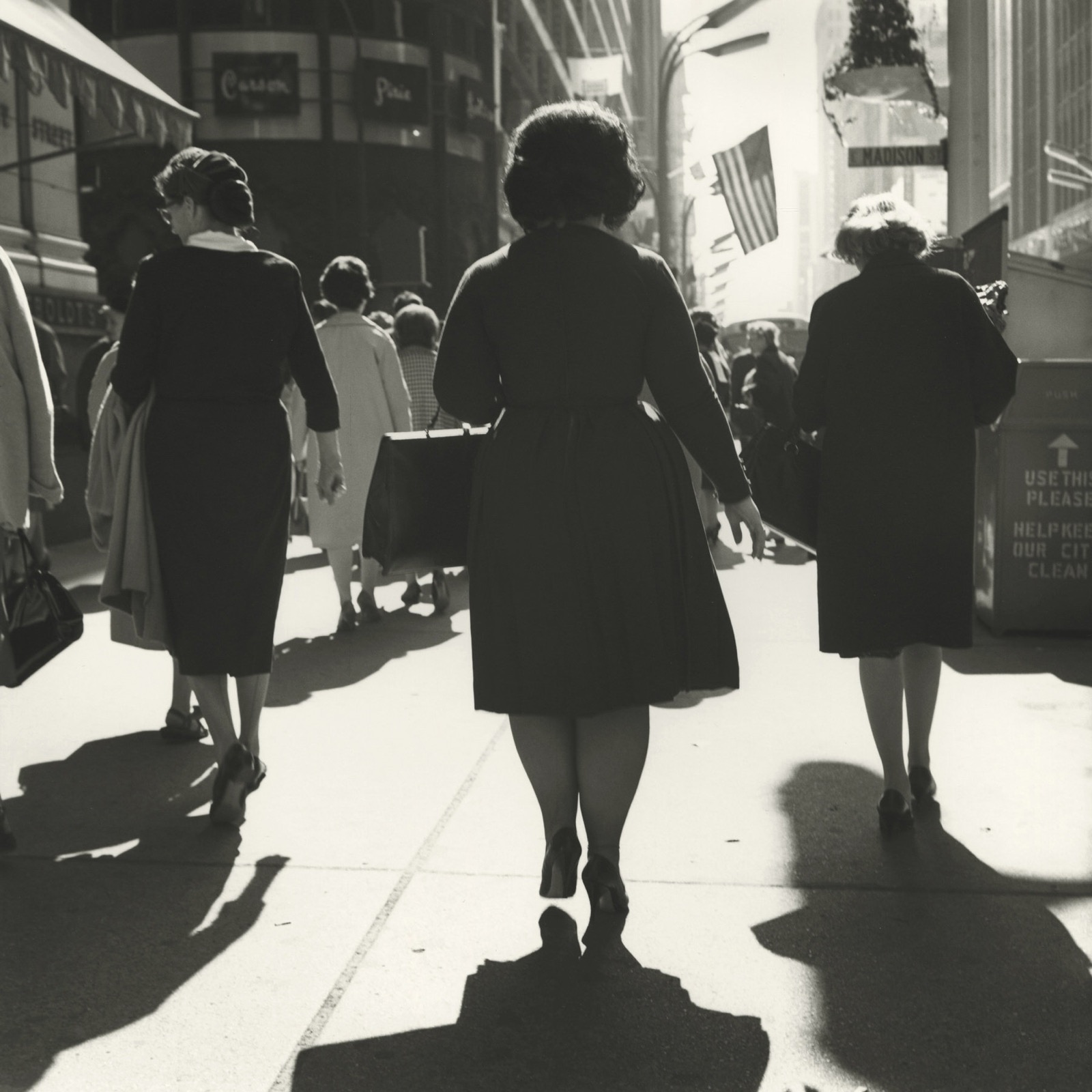
Photography has always been fascinated by the figure seen from behind, walking away, its face surrendered to the street; this picture joins that lineage and sharpens it. A woman in a dark belted coat strides down a Chicago sidewalk directly into low sun, her body a near-silhouette, her shadow thrown back toward us across the pavement like a second, flattened self. Two more women in dark coats flank her, all three receding from the lens.
What could be a snapshot behaves like a fashion plate staged by chance. The contre-jour light rims each coat and hairstyle in silver, turning ordinary shoppers into a procession of silhouettes as considered as any studio setup. Behind them the department-store signs, Carson, Pirie, a hanging American flag, a Madison Street marker, compose a backdrop of mid-century commerce. A trash bin at the right politely asks the city to keep itself clean, its lettering a caption Maier did not write but chose to include.
This is the directorial eye operating without direction, finding in the crowd the graphic clarity a later generation would build sets to achieve. Maier showed none of it; the work stayed sealed in her negatives until an auction after her death made her, posthumously, one of the century’s essential street photographers. Printed later in gelatin silver, the image lives on its extremes, the deep black of the coats, the blaze of sunlit sidewalk, the long shadows stretching toward the viewer, proof that a picture of three strangers’ backs can hold a whole city’s afternoon.

Photography has always been fascinated by the figure seen from behind, walking away, its face surrendered to the street; this picture joins that lineage and sharpens it. A woman in a dark belted coat strides down a Chicago sidewalk directly into low sun, her body a near-silhouette, her shadow thrown back toward us across the pavement like a second, flattened self. Two more women in dark coats flank her, all three receding from the lens.
What could be a snapshot behaves like a fashion plate staged by chance. The contre-jour light rims each coat and hairstyle in silver, turning ordinary shoppers into a procession of silhouettes as considered as any studio setup. Behind them the department-store signs, Carson, Pirie, a hanging American flag, a Madison Street marker, compose a backdrop of mid-century commerce. A trash bin at the right politely asks the city to keep itself clean, its lettering a caption Maier did not write but chose to include.
This is the directorial eye operating without direction, finding in the crowd the graphic clarity a later generation would build sets to achieve. Maier showed none of it; the work stayed sealed in her negatives until an auction after her death made her, posthumously, one of the century’s essential street photographers. Printed later in gelatin silver, the image lives on its extremes, the deep black of the coats, the blaze of sunlit sidewalk, the long shadows stretching toward the viewer, proof that a picture of three strangers’ backs can hold a whole city’s afternoon.