By the early years of this century, the American countryside had become, for most of its citizens, a view at windshield distance, and this picture accepts the condition honestly: a snow-dusted road, dark tire tracks, the sun a pale disc taken through glass that has been breathed on all morning. The camera does not pretend to stand in the field. It sits where the photographer sat, behind glass, above the faint gleam of the hood.
The organization is simpler than it looks. A single sagging wire crosses the sky and supplies the upper half with its one straight line; the road performs the same office below, entering at the left and curving off around a stand of russet weeds. Between them, low hills hold their patches of snow and keep the halves apart. A white farm building sits at the far left edge, small enough to miss, large enough to matter. The soft blur crowding the corners, which a technician would call a fault, is here put to work: it tells us the glass is real, and that the warmth inside it is real too.
The photographer, an Ohioan settled in the San Francisco Bay Area, has made this vantage his own, numbering his pictures rather than titling them; SFMOMA, the Getty and the Whitney hold his prints. In archival pigment the tonal run from milk sun to wet track prints long and smooth, and the picture keeps its modest, durable claim: that a man in a car, paying attention, is still a serious instrument.
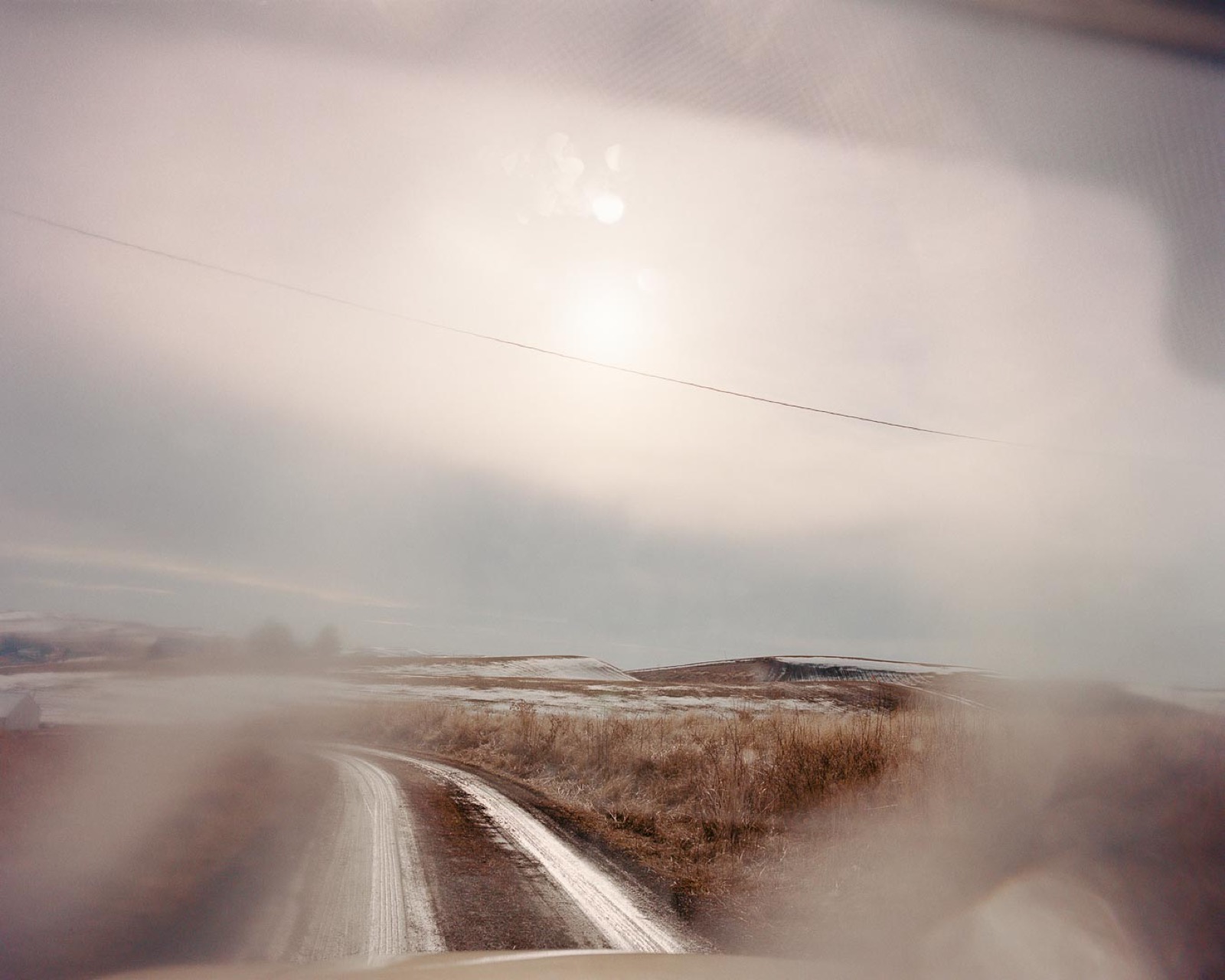

By the early years of this century, the American countryside had become, for most of its citizens, a view at windshield distance, and this picture accepts the condition honestly: a snow-dusted road, dark tire tracks, the sun a pale disc taken through glass that has been breathed on all morning. The camera does not pretend to stand in the field. It sits where the photographer sat, behind glass, above the faint gleam of the hood.
The organization is simpler than it looks. A single sagging wire crosses the sky and supplies the upper half with its one straight line; the road performs the same office below, entering at the left and curving off around a stand of russet weeds. Between them, low hills hold their patches of snow and keep the halves apart. A white farm building sits at the far left edge, small enough to miss, large enough to matter. The soft blur crowding the corners, which a technician would call a fault, is here put to work: it tells us the glass is real, and that the warmth inside it is real too.
The photographer, an Ohioan settled in the San Francisco Bay Area, has made this vantage his own, numbering his pictures rather than titling them; SFMOMA, the Getty and the Whitney hold his prints. In archival pigment the tonal run from milk sun to wet track prints long and smooth, and the picture keeps its modest, durable claim: that a man in a car, paying attention, is still a serious instrument.