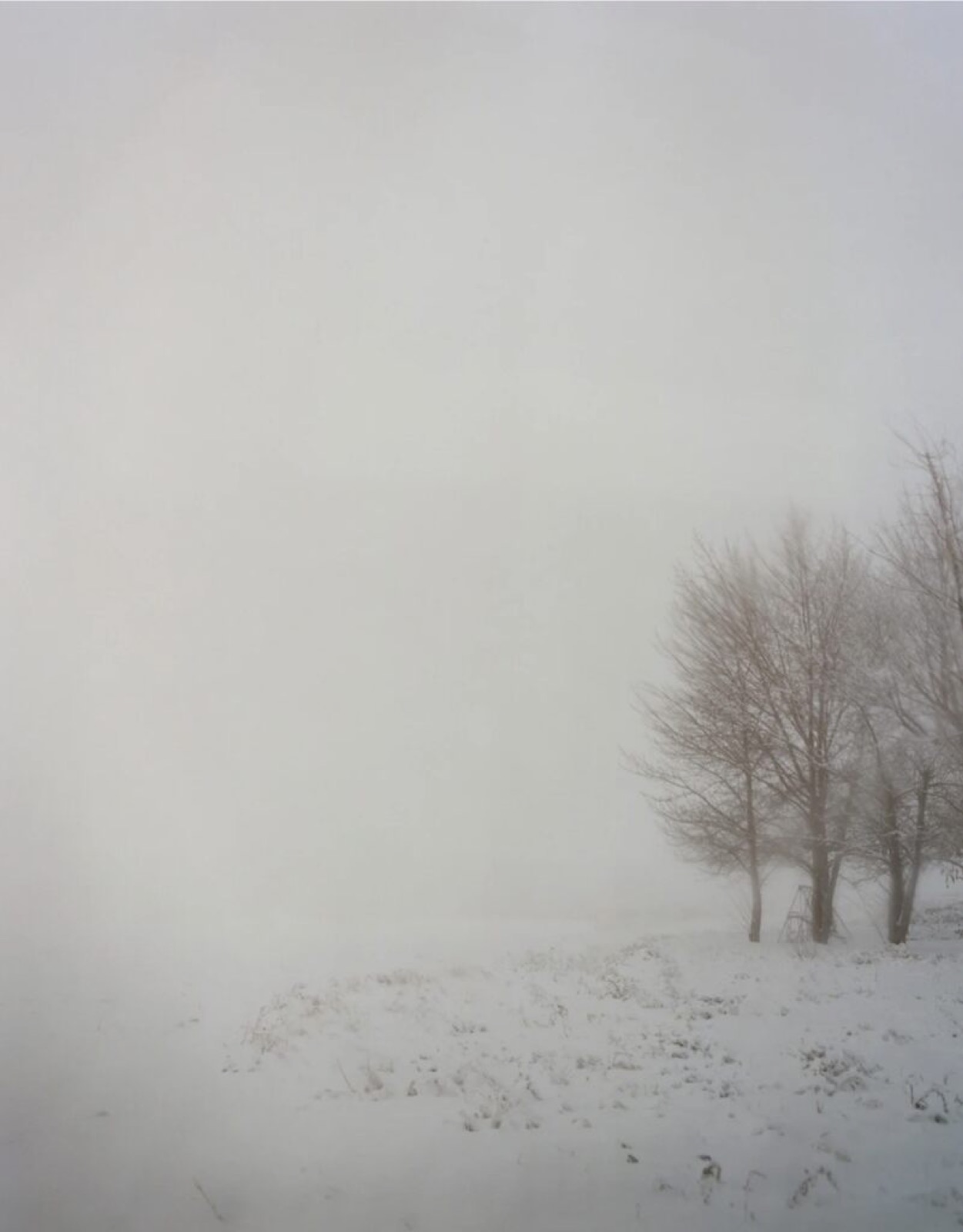
In a field that has stopped declaring itself, snow underfoot, fog overhead, there is nowhere a line where one gives way to the other. Only along the right edge does the world consent to particulars, a huddle of bare trees, branches feathered grey-brown into the whiteness, and beneath them a stubble of dried weeds breaking the snow crust. Everything else is an enormous, luminous refusal.
Photographs are supposed to be dense with fact; that is their oldest boast. This one hoards almost nothing, and there lies both its seduction and its argument. A picture so empty flatters us into believing we contemplate essence rather than weather, and one ought to distrust the flattery. Yet the emptiness is no trick: a whiteout is exactly this, transcribed with unnerving fidelity. The photograph refuses to perform, and the refusal becomes the performance. Its subject is the eye’s appetite, honestly starved.
The photographer grew up in Kent, Ohio, and works from the San Francisco Bay Area, driving until the landscape offers such disappearances; he titles the results with bare numbers, as if captions too were clutter. Museums that prize exactitude — SFMOMA, the Getty, the Whitney — keep his prints, which says something about how exact this vagueness is. In the archival pigment print the field’s whites turn out not to be blankness at all but tone upon tone, warm greys shading into colder ones, the weeds’ brown flecks precise as punctuation. What the fog withholds from the eye, the print quietly restores to it: not information, but the dignity of looking without being told.
In a field that has stopped declaring itself, snow underfoot, fog overhead, there is nowhere a line where one gives way to the other. Only along the right edge does the world consent to particulars, a huddle of bare trees, branches feathered grey-brown into the whiteness, and beneath them a stubble of dried weeds breaking the snow crust. Everything else is an enormous, luminous refusal.
Photographs are supposed to be dense with fact; that is their oldest boast. This one hoards almost nothing, and there lies both its seduction and its argument. A picture so empty flatters us into believing we contemplate essence rather than weather, and one ought to distrust the flattery. Yet the emptiness is no trick: a whiteout is exactly this, transcribed with unnerving fidelity. The photograph refuses to perform, and the refusal becomes the performance. Its subject is the eye’s appetite, honestly starved.
The photographer grew up in Kent, Ohio, and works from the San Francisco Bay Area, driving until the landscape offers such disappearances; he titles the results with bare numbers, as if captions too were clutter. Museums that prize exactitude — SFMOMA, the Getty, the Whitney — keep his prints, which says something about how exact this vagueness is. In the archival pigment print the field’s whites turn out not to be blankness at all but tone upon tone, warm greys shading into colder ones, the weeds’ brown flecks precise as punctuation. What the fog withholds from the eye, the print quietly restores to it: not information, but the dignity of looking without being told.