Hand-signed by the artist, with title, date, and edition number inscribed in ink on an archival label affixed to the reverse side of the mounted photograph.
The vantage is straight down, from directly above, onto a surface with no edges: pink flowers packed so tightly that stems, soil and background have all disappeared, leaving only bloom against bloom to the four sides of the frame. There is no horizon to steady us and no single subject to settle on. A pale hibiscus with a crimson throat holds the left, a coral rose burns at the center, a lone deep-purple bloom anchors the lower right, and everything between is a dense continuous weave of petals.
Photography rarely commits so completely to flatness. By filling the frame corner to corner and denying us any ground, Harvey turns a heap of cut flowers into something closer to a textile or a painted field, an all-over composition in the modernist sense, where the eye is invited to wander and refused a place to rest. It is a picture about abundance as a formal problem: how much pink can a single image hold before quantity becomes its own subject? The answer, apparently, is more than seems decent.
Harvey, who lives and gardens in Rockport, Maine and is widely collected by American museums, has built books like Blue Violet and You an Orchestra a Bomb on this pressure of the sensory, color pushed to the edge of excess and held there. The archival pigment print is what makes the gambit work, resolving the salmon, magenta, blush and violet as distinct notes rather than one screaming chord, so the density reads as richness instead of noise, and the hundred small differences between one rose and its neighbor survive.
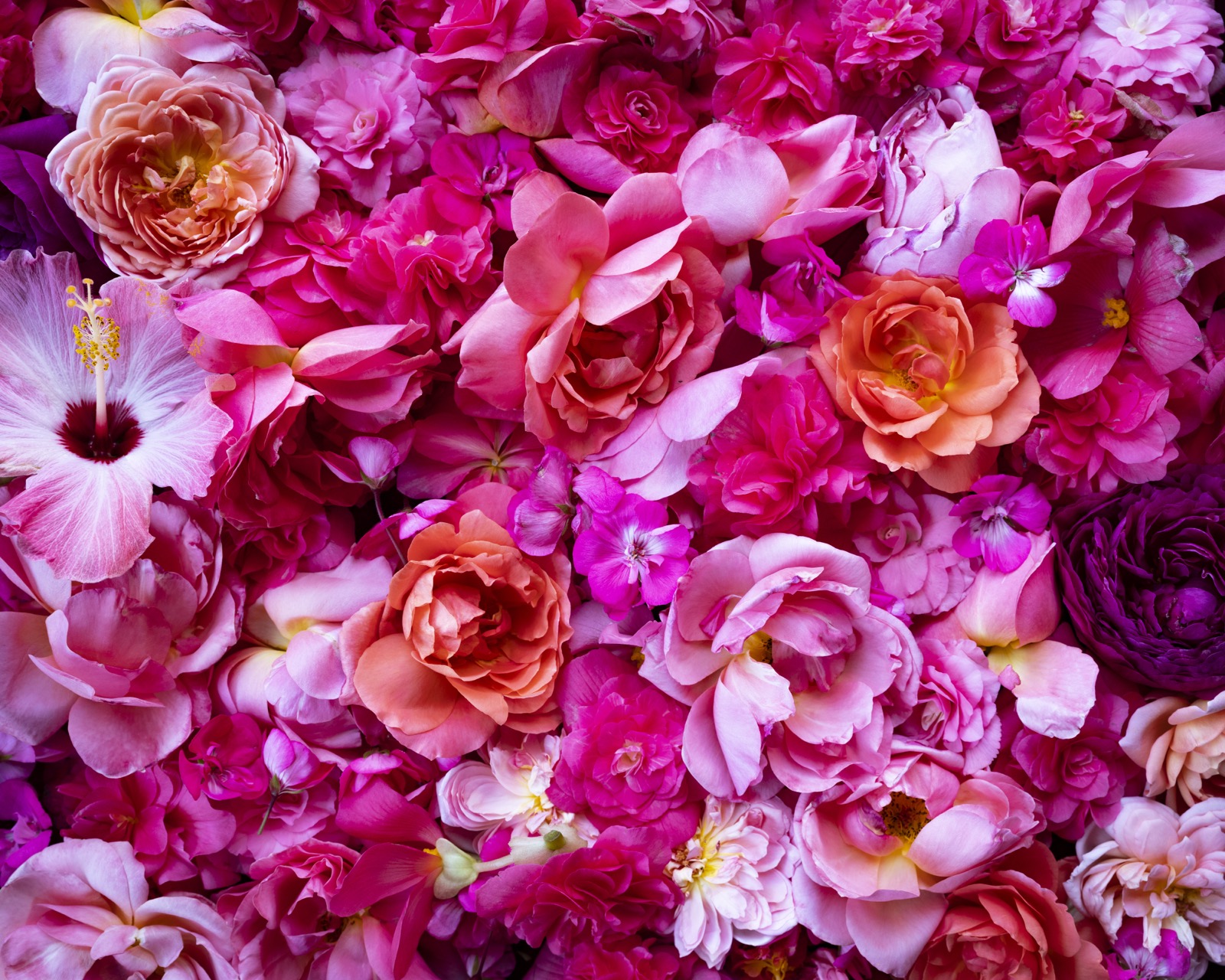

The vantage is straight down, from directly above, onto a surface with no edges: pink flowers packed so tightly that stems, soil and background have all disappeared, leaving only bloom against bloom to the four sides of the frame. There is no horizon to steady us and no single subject to settle on. A pale hibiscus with a crimson throat holds the left, a coral rose burns at the center, a lone deep-purple bloom anchors the lower right, and everything between is a dense continuous weave of petals.
Photography rarely commits so completely to flatness. By filling the frame corner to corner and denying us any ground, Harvey turns a heap of cut flowers into something closer to a textile or a painted field, an all-over composition in the modernist sense, where the eye is invited to wander and refused a place to rest. It is a picture about abundance as a formal problem: how much pink can a single image hold before quantity becomes its own subject? The answer, apparently, is more than seems decent.
Harvey, who lives and gardens in Rockport, Maine and is widely collected by American museums, has built books like Blue Violet and You an Orchestra a Bomb on this pressure of the sensory, color pushed to the edge of excess and held there. The archival pigment print is what makes the gambit work, resolving the salmon, magenta, blush and violet as distinct notes rather than one screaming chord, so the density reads as richness instead of noise, and the hundred small differences between one rose and its neighbor survive.