
Steven Meisel
American, b. 1954Karen Elson, New York, 2006
Archival Pigment Print.
Small / Image: 50.8 x 38.4 cm / 20 x 15 1/8 in / Sheet: 61 x 50.8 cm / 24 x 20 in
Medium / Image: 101.6 x 76.7 cm / 40 x 30 1/4 in / Sheet: 106.7 x 81.8 cm / 42 x 32 1/4 in
Large / Image : 152.4 x 115.1 cm / 60 x 45 1/4 in / Sheet : 157.5 x 120.1 cm / 62 x 47 1/4 in
XL / Image: 195.1 x 147.3 cm / 76 3/4 x 58 in / Sheet: 200.2 x 152.4 cm / 78 3/4 x 60 in
Hand-signed by artist, titled, numbered and print date in ink label affixed to mount verso
Edition of 7 — Image: 50.8 x 38.4 cm / 20 x 15 1/8 in / Sheet: 61 x 50.8 cm / 24 x 20 in
Edition of 6 — Image: 101.6 x 76.7 cm / 40 x 30 1/4 in / Sheet: 106.7 x 81.8 cm / 42 x 32 1/4 in
Edition of 3 — Image : 152.4 x 115.1 cm / 60 x 45 1/4 in / Sheet : 157.5 x 120.1 cm / 62 x 47 1/4 in
Edition of 1 — Image: 195.1 x 147.3 cm / 76 3/4 x 58 in / Sheet: 200.2 x 152.4 cm / 78 3/4 x 60 in
© The Artist
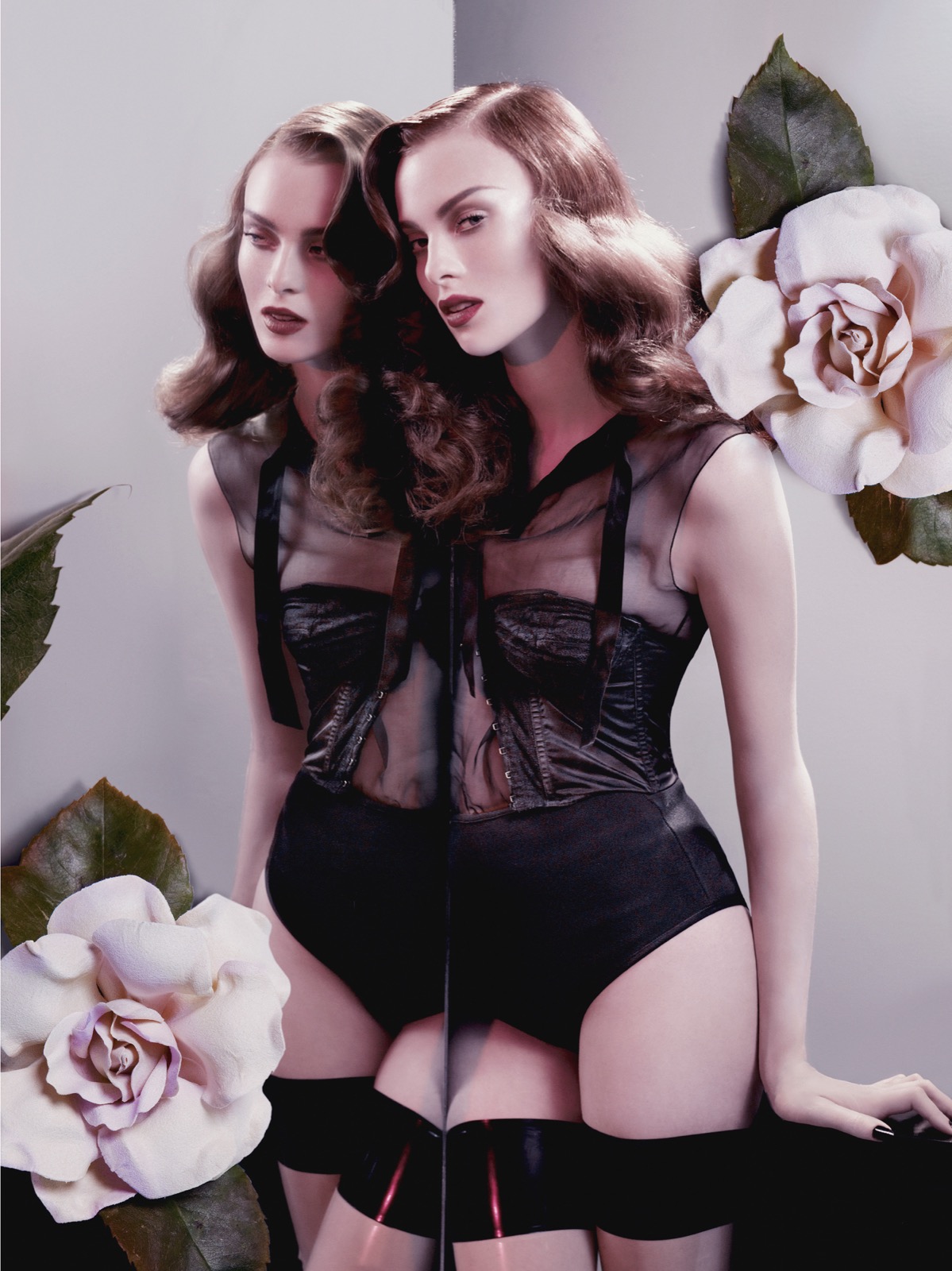
Photographers have posed their sitters against mirrors since the medium's first decades — nineteenth-century studios doubled a face to advertise the camera's cleverness, and the Hollywood portraitists of the 1940s used reflection to give a single profile the drama of a duet. Steven Meisel works inside that lineage with a historian's exactness. Karen Elson leans into the glass until her cheek nearly meets its double, and the photograph briefly contains two sitters: one who faces the lens directly, one who drifts elsewhere.
Every element is period-inflected without settling into any period. The finger-waved hair, the oxblood mouth, the black corsetry beneath sheer chiffon recall mid-century studio glamour; the pale fabric roses fixed at the corners of the set belong to a still older convention of the decorated backdrop. The light, though, is contemporary — cool, even, unsentimental — and the mirror's seam runs down the composition like a rule drawn to separate the woman from the image of her.
What endures is the picture's discipline. Nothing is candid and nothing pretends to be; artifice is declared at every layer, from the ribbon at the throat to the black lacquer of the nails. Meisel quotes the archive of glamour, trims away its sentimentality, and returns it to circulation intact.