Pink is the one colour we are taught not to trust; it flatters, it sweetens, it asks to be dismissed. This photograph floods itself with pink and dares me to dismiss it. Everything is bathed in the same rose wash, the tousled tower of hair, the bare shoulder, the soft wall behind, until the picture seems to blush all over. Then, at the mouth, a single orange ranunculus, the one thing that refuses the tint, held up like a small correction to all that sweetness.
It is the flower that holds me, or rather the green stem descending from it across the bare shoulder, a thin diagonal the pink cannot quite absorb. The face is composed, the eyes level and darkly lined, a beauty mark set on the cheek like punctuation; the styling is grand, the hair teased into a storm. But the stem is ordinary, almost awkward, a real plant intruding on a confection, and it is there that the image comes alive for me, where artifice admits a little truth.
Meisel, who made every Vogue Italia cover for a quarter-century, understood that a beauty picture is a seduction, and that seduction is most persuasive when it lets one flaw show. He gives us the whole apparatus of glamour, then undercuts it with a single bloom and a candid gaze. Issued as an archival pigment print, the delicate pink monochrome holds together, the orange of the flower singing against it without breaking the spell. I keep coming back not to the beauty but to that stem, where the picture stops performing and begins, quietly, to mean.
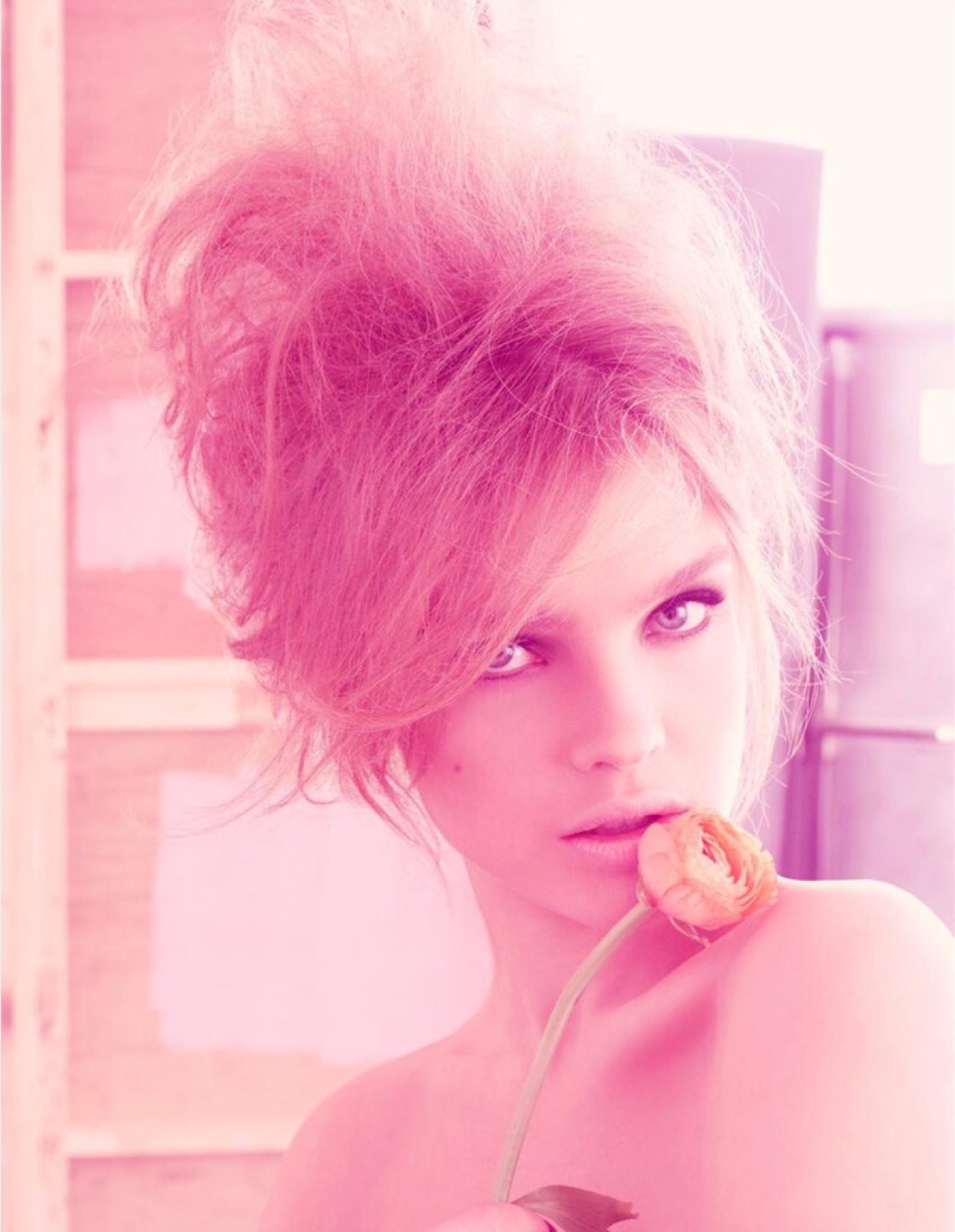

Pink is the one colour we are taught not to trust; it flatters, it sweetens, it asks to be dismissed. This photograph floods itself with pink and dares me to dismiss it. Everything is bathed in the same rose wash, the tousled tower of hair, the bare shoulder, the soft wall behind, until the picture seems to blush all over. Then, at the mouth, a single orange ranunculus, the one thing that refuses the tint, held up like a small correction to all that sweetness.
It is the flower that holds me, or rather the green stem descending from it across the bare shoulder, a thin diagonal the pink cannot quite absorb. The face is composed, the eyes level and darkly lined, a beauty mark set on the cheek like punctuation; the styling is grand, the hair teased into a storm. But the stem is ordinary, almost awkward, a real plant intruding on a confection, and it is there that the image comes alive for me, where artifice admits a little truth.
Meisel, who made every Vogue Italia cover for a quarter-century, understood that a beauty picture is a seduction, and that seduction is most persuasive when it lets one flaw show. He gives us the whole apparatus of glamour, then undercuts it with a single bloom and a candid gaze. Issued as an archival pigment print, the delicate pink monochrome holds together, the orange of the flower singing against it without breaking the spell. I keep coming back not to the beauty but to that stem, where the picture stops performing and begins, quietly, to mean.