Two nude youths asleep in flattened grass: the image belongs to a lineage older than photography, the Arcadian idyll that runs from Eakins’ swimming hole to the Sicilian pastorals of von Gloeden. Here the tradition lies down in a New England hayfield. One boy is on his back, hair fanned across the stalks, a hand laid over his mouth; the other rests on his stomach beside him, cheek to the ground, watching. Nothing happens, and everything carries the weight of a myth remembered.
What holds me is not the two beautiful bodies but a single hand, the fingers pressed lightly across the sleeping boy’s lips, hushing a mouth that was not going to speak anyway. That small, tender censorship undoes the whole pastoral calm for me. Around it the grass is described stalk by stalk, dry and bright, while the skin stays soft and faintly out of focus, as if the field were more awake than the sleepers. I keep returning to the hand; there the picture turns private.
The photographer spent a career pulling American masculinity back toward tenderness, and this is one of his purest instances: no glamour, no product, only two friends and a mown field. The lineage he draws on is homoerotic and pastoral at once, and he neither hides nor insists on it. The gelatin silver print gives the scene its hush, a wide grey scale in which the hay glitters and the flesh goes to velvet, lit like the memory of an afternoon that never quite ends.
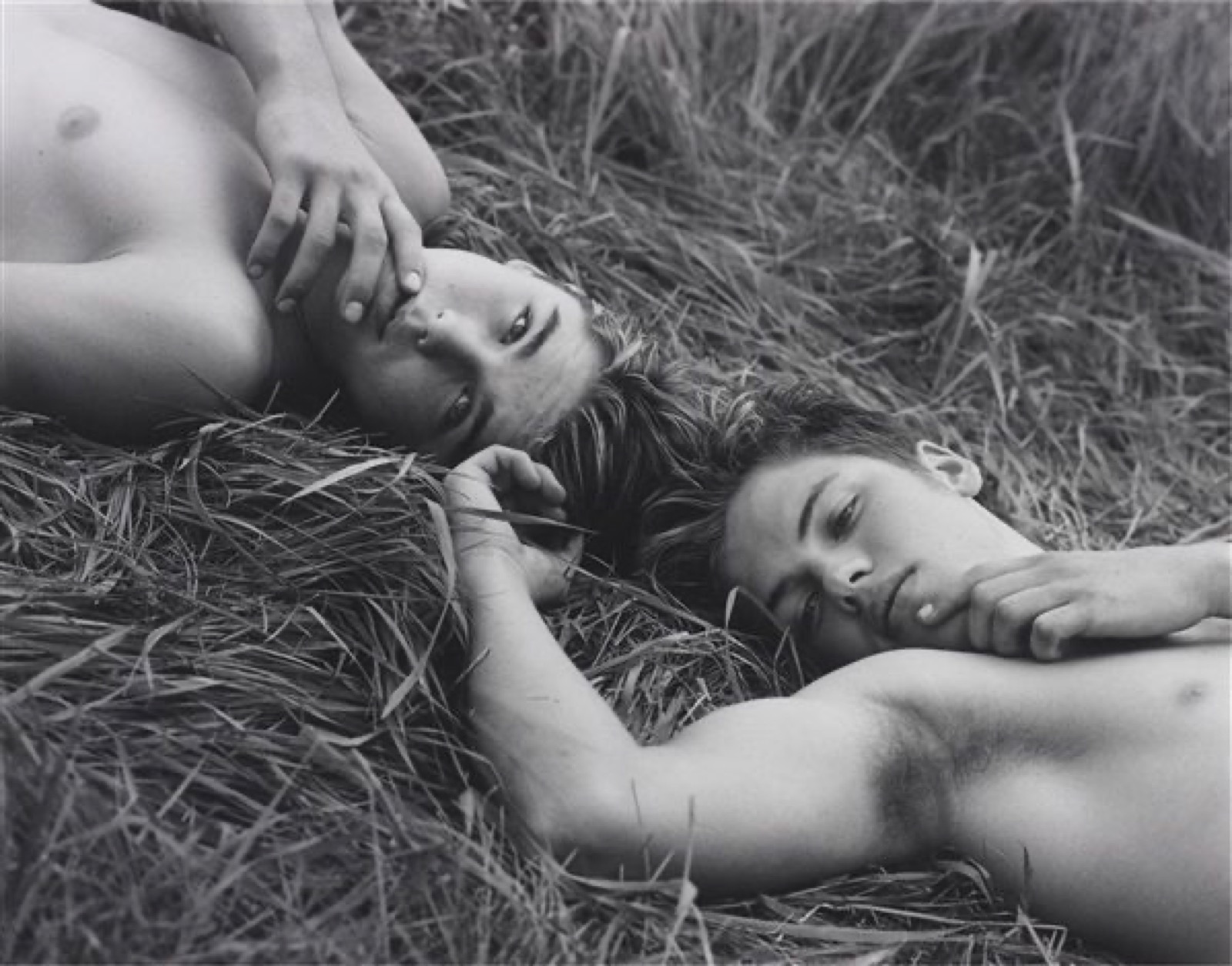

Two nude youths asleep in flattened grass: the image belongs to a lineage older than photography, the Arcadian idyll that runs from Eakins’ swimming hole to the Sicilian pastorals of von Gloeden. Here the tradition lies down in a New England hayfield. One boy is on his back, hair fanned across the stalks, a hand laid over his mouth; the other rests on his stomach beside him, cheek to the ground, watching. Nothing happens, and everything carries the weight of a myth remembered.
What holds me is not the two beautiful bodies but a single hand, the fingers pressed lightly across the sleeping boy’s lips, hushing a mouth that was not going to speak anyway. That small, tender censorship undoes the whole pastoral calm for me. Around it the grass is described stalk by stalk, dry and bright, while the skin stays soft and faintly out of focus, as if the field were more awake than the sleepers. I keep returning to the hand; there the picture turns private.
The photographer spent a career pulling American masculinity back toward tenderness, and this is one of his purest instances: no glamour, no product, only two friends and a mown field. The lineage he draws on is homoerotic and pastoral at once, and he neither hides nor insists on it. The gelatin silver print gives the scene its hush, a wide grey scale in which the hay glitters and the flesh goes to velvet, lit like the memory of an afternoon that never quite ends.