Txema Yeste
Spanish, b. 1972Needles, 2019-24
Gelatin silver print mounted on aluminium Dibond.
Image: 63 x 45 cm / 24 3/4 x 17 3/4 in / Paper: 78 x 59 cm / 30 3/4 x 23 1/4 in
Image: 110 x 78.5 cm / 43 1/4 x 30 7/8 in / Paper: 127 x 94.5 cm / 50 x 37 1/4 in
Image: 126 x 90 cm / 49 5/8 x 35 3/8 in / Paper: 143 x 106 cm / 56 1/4 x 41 3/4 in
Hand-signed by the artist, titled, editioned, and dated in ink on a label affixed to the verso of the mount
Edition of 10 — Image: 63 x 45 cm / 24 3/4 x 17 3/4 in / Paper: 78 x 59 cm / 30 3/4 x 23 1/4 in
Edition of 5 — Image: 110 x 78.5 cm / 43 1/4 x 30 7/8 in / Paper: 127 x 94.5 cm / 50 x 37 1/4 in
Edition of 3 — Image: 126 x 90 cm / 49 5/8 x 35 3/8 in / Paper: 143 x 106 cm / 56 1/4 x 41 3/4 in
© The Artist
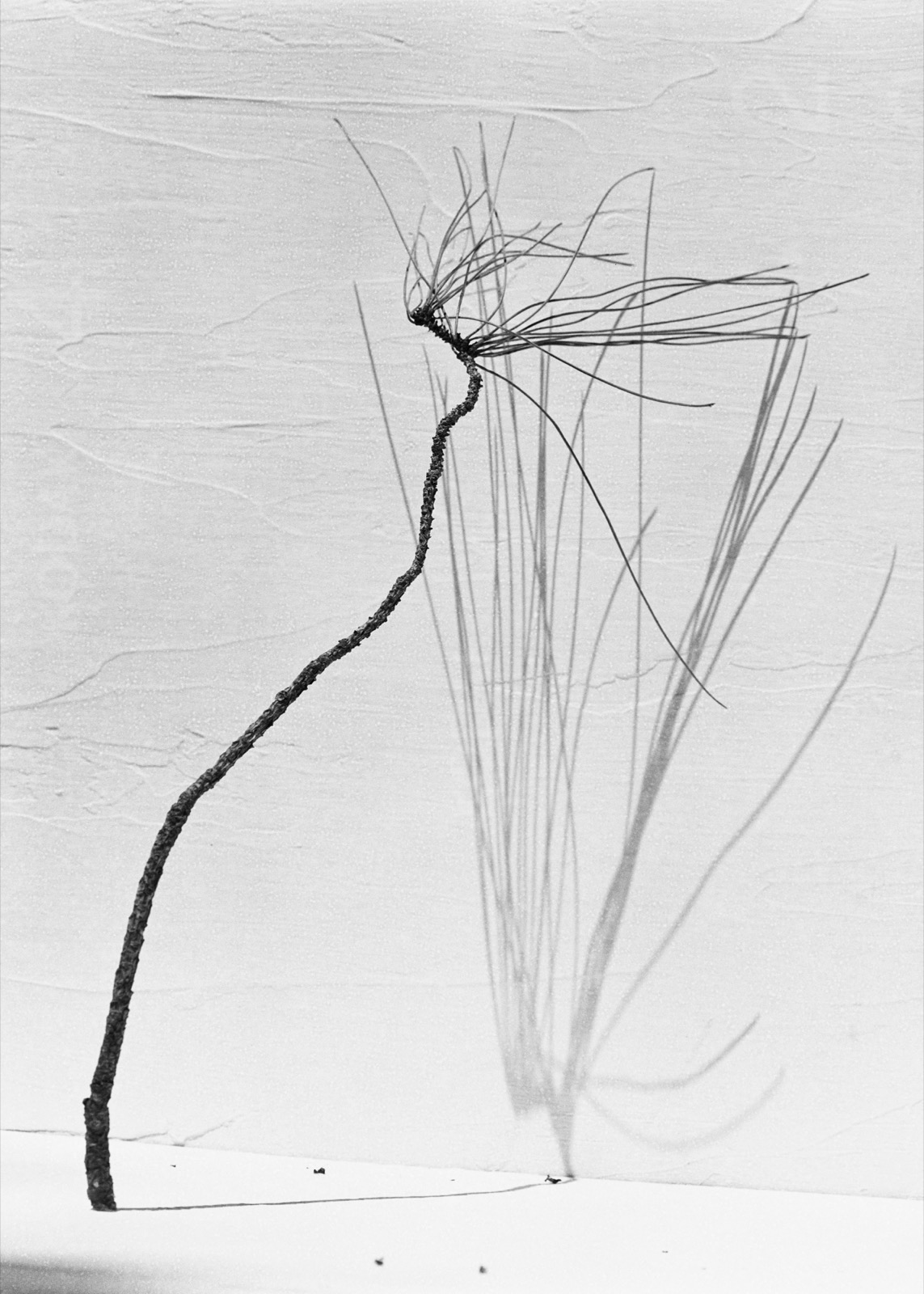
Read it as a character in an alphabet no one has taught us: a thick black stroke rising from the floor, bending twice like the neck of a bird, then exploding at the top into a fine spray of needles flung to the right. Yeste’s stalk is not writing, yet it insists on being read as a mark, a brushed ideogram, the flourish at the end of a signature. Its shadow repeats the phrase in grey, softer, downward, a second draft the wall keeps to itself.
What I love is the difference in hand between the two strokes. The stem is heavy, granular, encrusted, drawn slowly, pressed hard; the needles at its crown are quick, weightless, a dozen thin lines thrown off in a single gesture. Between them the whole plant becomes a sentence with a laboured beginning and a sudden, careless end. The pale plaster is the page, and it is not blank: faint ridges and a low ledge run under the writing, giving the letter a ground to stand on.
Yeste is one of the leading figures of Spanish fashion photography, published in Numéro, Harper’s Bazaar and Vogue, and the Needles series is where he lets that trained eye play across the calligraphy of dead plants. The pleasure is legibility without meaning: a form that behaves exactly like language and says nothing. The print is gelatin silver mounted on aluminium Dibond, its blacks deep enough to give the crusted stem real weight, its greys fine enough to hold the ghost-writing of the shadow. It is a letter from no alphabet, left open on the wall.