Staging is everything, and Todd Hido stages this motel room like a director who has sent everyone else home. A woman sits on a plain wooden chair set against a vast expanse of textured stucco wall, her arms lifted behind her head, her body partly undressed, her gaze levelled at the camera. To her right the frame admits the evidence of the location—an unmade bed, a nightstand, a cream telephone—but the composition gives most of its real estate to the empty, glowing wall.
That wall is the picture's genius. Hido lets a raking light gradate across it from warm ochre to a cold blue-green, turning ordinary plaster into something like a painted backdrop, while the single electrical outlet near the floor remains as a deadpan reminder that this is a real, rentable room. The figure is neither idealised nor exposed for spectacle; she is posed, self-possessed, aware of the apparatus. Nothing here pretends to be candid.
This is the constructed narrative mode that has shaped so much recent photography: a scene that looks like a still from a film that does not exist, proposing stories it will never confirm. Hido, better known for his exteriors, brings the same forensic patience indoors, treating the woman and the room as equal facts. Printed large on Dibond, the image keeps its cinematic composure and its ambiguity, refusing to say whether we have interrupted something or arrived far too late.
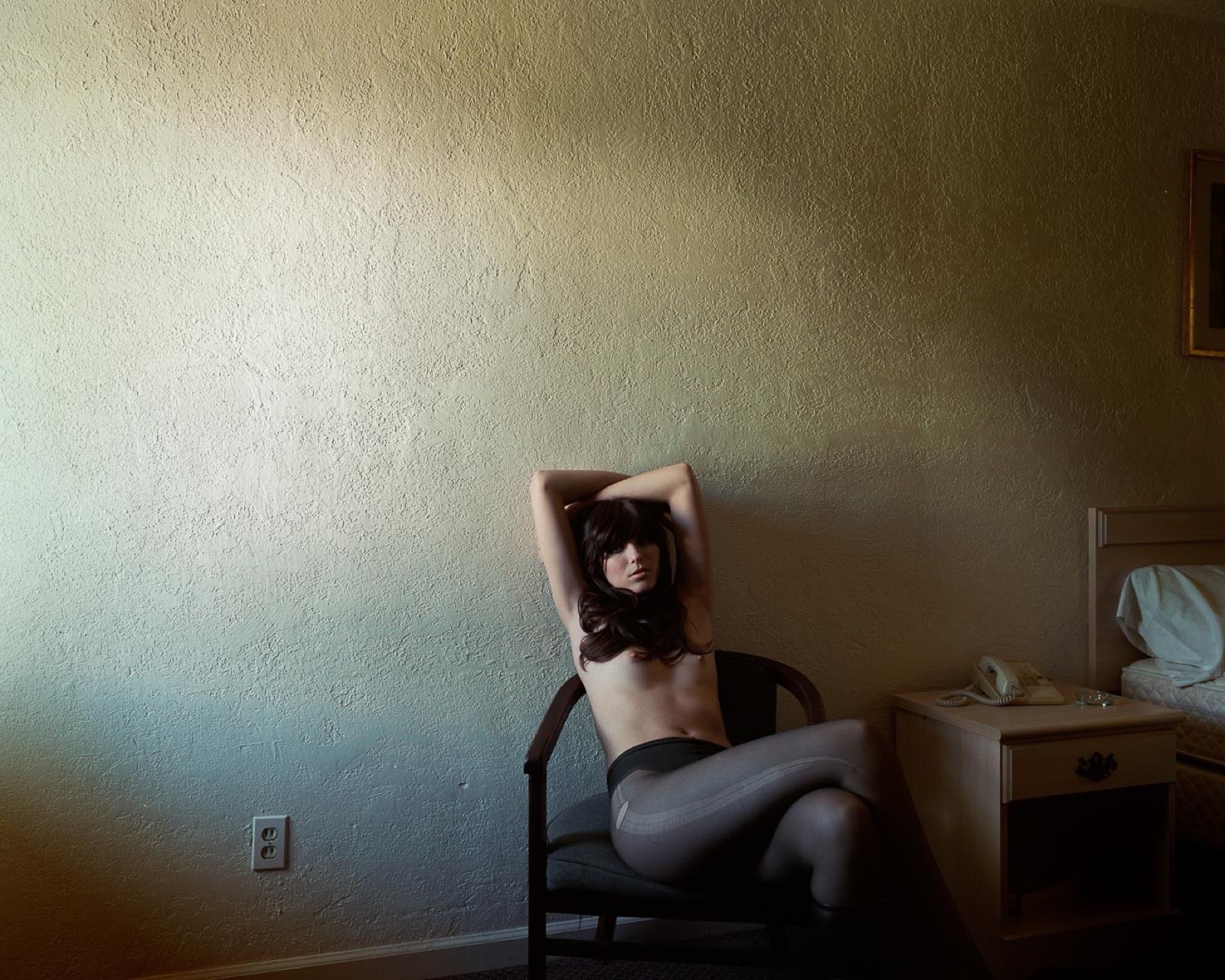

Staging is everything, and Todd Hido stages this motel room like a director who has sent everyone else home. A woman sits on a plain wooden chair set against a vast expanse of textured stucco wall, her arms lifted behind her head, her body partly undressed, her gaze levelled at the camera. To her right the frame admits the evidence of the location—an unmade bed, a nightstand, a cream telephone—but the composition gives most of its real estate to the empty, glowing wall.
That wall is the picture's genius. Hido lets a raking light gradate across it from warm ochre to a cold blue-green, turning ordinary plaster into something like a painted backdrop, while the single electrical outlet near the floor remains as a deadpan reminder that this is a real, rentable room. The figure is neither idealised nor exposed for spectacle; she is posed, self-possessed, aware of the apparatus. Nothing here pretends to be candid.
This is the constructed narrative mode that has shaped so much recent photography: a scene that looks like a still from a film that does not exist, proposing stories it will never confirm. Hido, better known for his exteriors, brings the same forensic patience indoors, treating the woman and the room as equal facts. Printed large on Dibond, the image keeps its cinematic composure and its ambiguity, refusing to say whether we have interrupted something or arrived far too late.