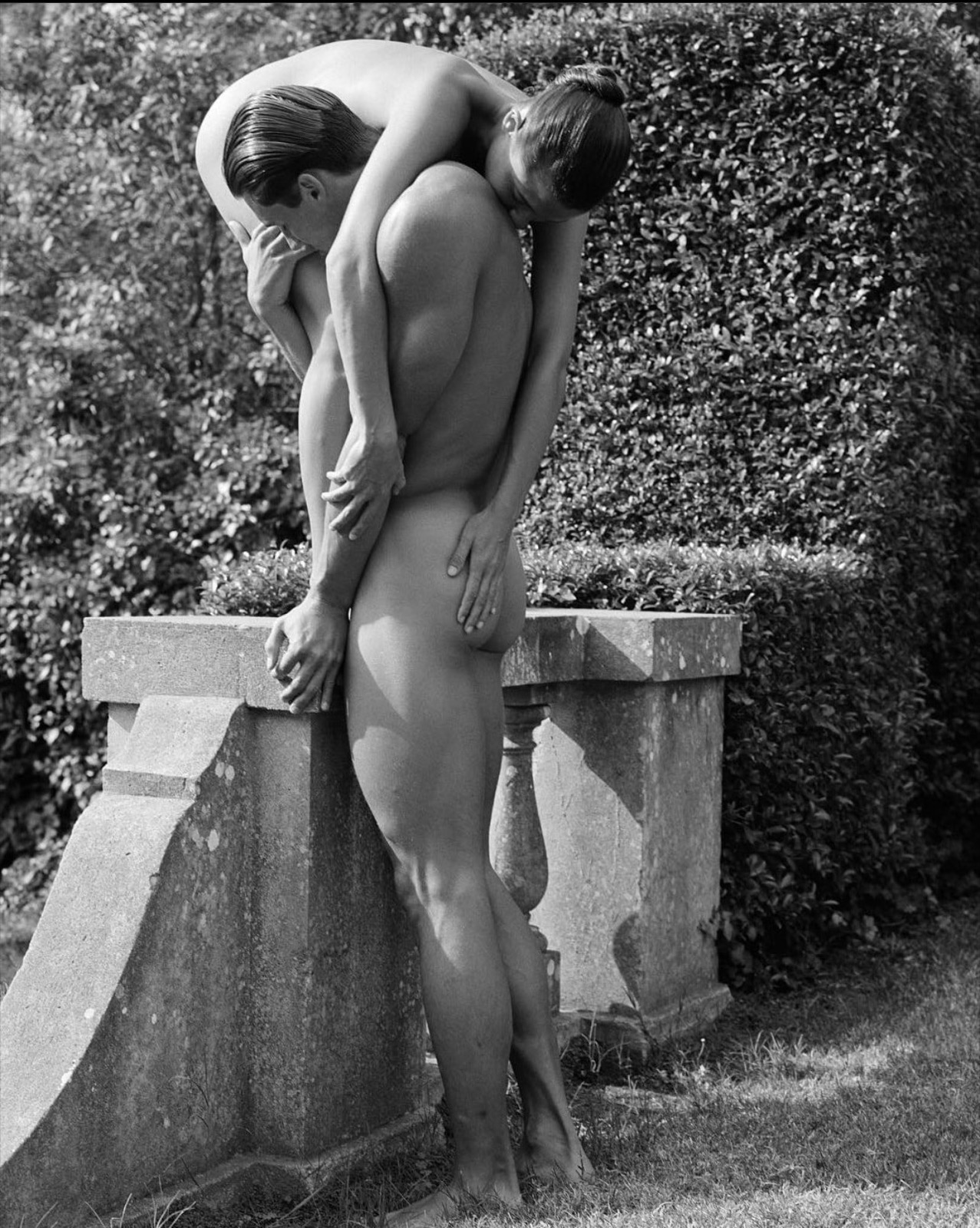
The sun here is the great leveler: it lies with the same even generosity on bare skin, on the lichen-spotted stone of the balustrade, and on the dense clipped hedge that closes the frame like a dark wall. Black-and-white was the right instrument for this light. What color would have made merely pleasant, the print makes sculptural — a scale of greys running from the near-black foliage to the pale ledge of stone, with the two bodies suspended, luminously, in between.
The pose is the puzzle, and it rewards patience. A man stands braced against the balustrade, hands flat on the stone behind him, while a second figure — hair drawn into a tight knot — folds over his shoulders like a garment being carried indoors, her arms wrapped down across his chest, one hand closed gently over his eyes. Nobody's face is given to us. He bears her weight; she takes his sight; and the exchange reads, depending on one's mood, as tenderness or as burden or as some private game whose rules were settled before the camera arrived. Garden statuary behaves this way — bodies locked in an attitude that outlasts explanation — and the photograph is happy to let its couple pass for marble that has warmed.
Made in 1988 in the gardens of a Montecito villa, the picture belongs to the years when this photographer reshaped how America imagined the body — for Calvin Klein, Ralph Lauren, and the great magazines — while producing prints of a classical gravity that museums took seriously then and collect still. The gelatin silver print keeps that afternoon's sun at hand: patient, physical, unrepeatable.
The sun here is the great leveler: it lies with the same even generosity on bare skin, on the lichen-spotted stone of the balustrade, and on the dense clipped hedge that closes the frame like a dark wall. Black-and-white was the right instrument for this light. What color would have made merely pleasant, the print makes sculptural — a scale of greys running from the near-black foliage to the pale ledge of stone, with the two bodies suspended, luminously, in between.
The pose is the puzzle, and it rewards patience. A man stands braced against the balustrade, hands flat on the stone behind him, while a second figure — hair drawn into a tight knot — folds over his shoulders like a garment being carried indoors, her arms wrapped down across his chest, one hand closed gently over his eyes. Nobody's face is given to us. He bears her weight; she takes his sight; and the exchange reads, depending on one's mood, as tenderness or as burden or as some private game whose rules were settled before the camera arrived. Garden statuary behaves this way — bodies locked in an attitude that outlasts explanation — and the photograph is happy to let its couple pass for marble that has warmed.
Made in 1988 in the gardens of a Montecito villa, the picture belongs to the years when this photographer reshaped how America imagined the body — for Calvin Klein, Ralph Lauren, and the great magazines — while producing prints of a classical gravity that museums took seriously then and collect still. The gelatin silver print keeps that afternoon's sun at hand: patient, physical, unrepeatable.