Whose driveway is this, and why does it already feel like a memory? Two young men lean into a black American sedan, its round headlight and chrome grille catching the flat suburban light, and the picture behaves less like a lookbook than like a still lifted from a film nobody quite remembers making. One wears a double-breasted jacket buttoned close over a belted waist; the other, in a looser grey suit and dark turtleneck, tips his weight against the fender, hands sunk in his pockets.
The clothing is the ostensible subject, yet the direction does the real work. Nothing is pressed to attention. The tailoring reads as costume borrowed from an older decade, the poses casual to the point of insolence, and the whole arrangement stages a particular American myth of young men, a big car, a lawn, a clapboard house half-hidden in the trees, as if fashion were only the pretext for summoning it. The camera stands a little low, letting the two figures own the frame and refusing the polish that would turn them into mannequins.
This is the register that made the photographer the defining eye of 1980s American fashion, the Calvin Klein years: he sold garments by selling a feeling of place, physical ease and half-remembered nostalgia. Printed here in gelatin silver, the grey scale does what colour could not, flattening the men and the machine into one continuous tone, ambiguous in date, closer to reverie than advertisement. The pleasure of the object lies in exactly this refusal to declare its year.
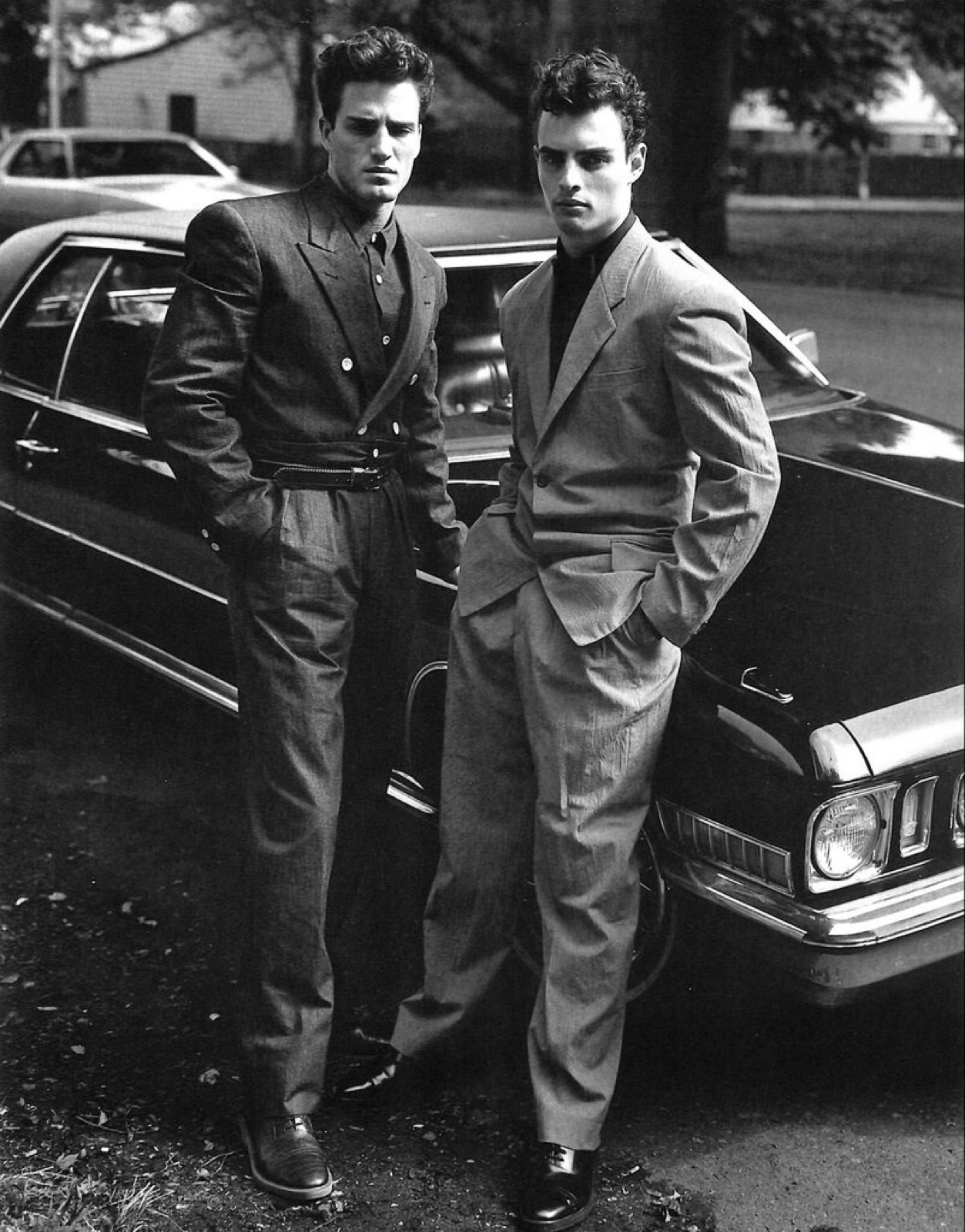

Whose driveway is this, and why does it already feel like a memory? Two young men lean into a black American sedan, its round headlight and chrome grille catching the flat suburban light, and the picture behaves less like a lookbook than like a still lifted from a film nobody quite remembers making. One wears a double-breasted jacket buttoned close over a belted waist; the other, in a looser grey suit and dark turtleneck, tips his weight against the fender, hands sunk in his pockets.
The clothing is the ostensible subject, yet the direction does the real work. Nothing is pressed to attention. The tailoring reads as costume borrowed from an older decade, the poses casual to the point of insolence, and the whole arrangement stages a particular American myth of young men, a big car, a lawn, a clapboard house half-hidden in the trees, as if fashion were only the pretext for summoning it. The camera stands a little low, letting the two figures own the frame and refusing the polish that would turn them into mannequins.
This is the register that made the photographer the defining eye of 1980s American fashion, the Calvin Klein years: he sold garments by selling a feeling of place, physical ease and half-remembered nostalgia. Printed here in gelatin silver, the grey scale does what colour could not, flattening the men and the machine into one continuous tone, ambiguous in date, closer to reverie than advertisement. The pleasure of the object lies in exactly this refusal to declare its year.