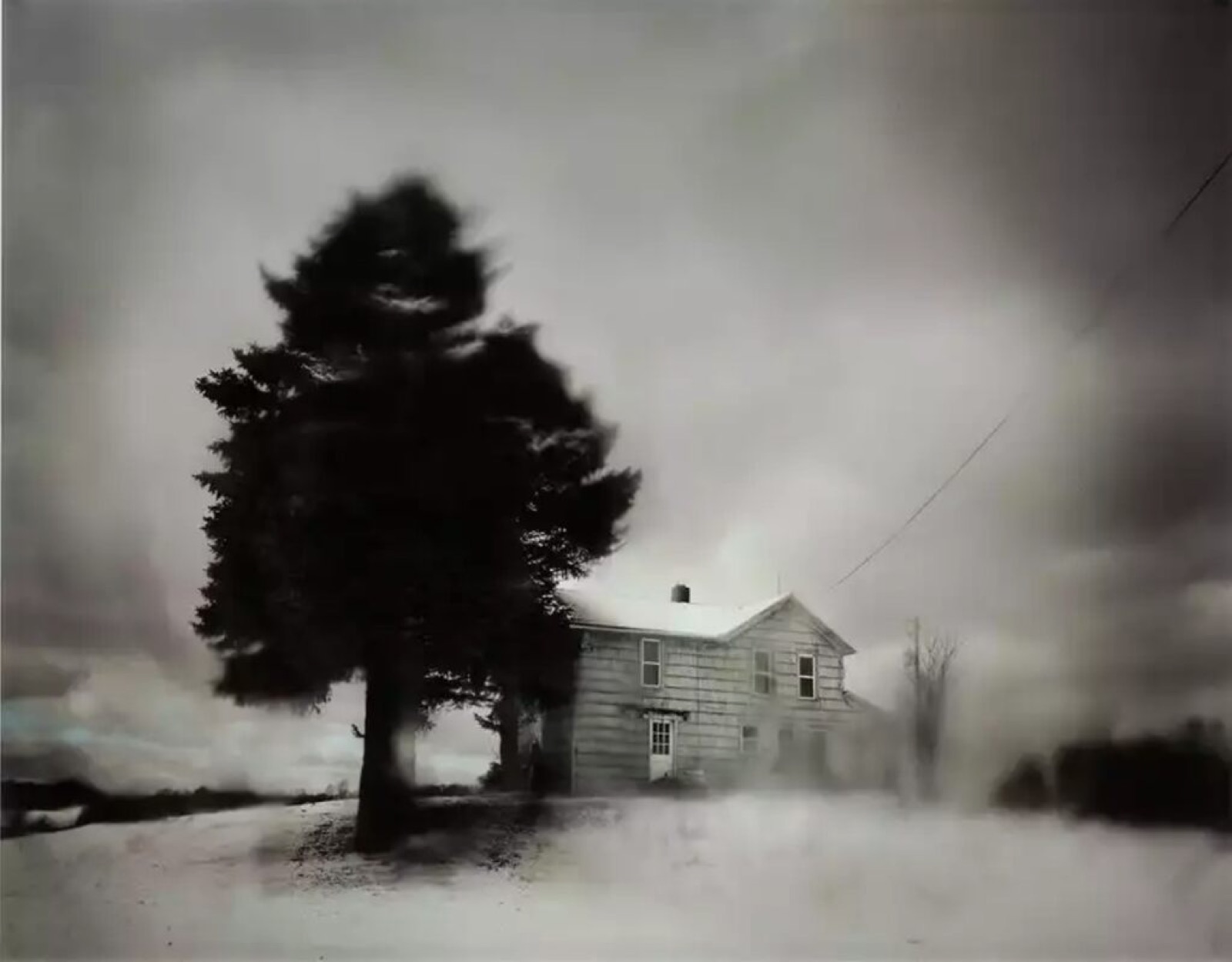
A minute from now, the fog will have reached the door. It is already at the foundations, unstitching the lower clapboards of the white farmhouse from the snow they stand on; the two dark pines, older than anyone who ever slept here, will be the last to go. The photograph holds the interval just before erasure: power lines still legible against a bruised sky, windows still dark and particular, the little chimney still insisting on warmth somewhere inside.
Hido was born in Kent, Ohio, and this feels like knowledge of a place rather than a visit to it: the way winter arrives in the interior of a country, not as spectacle but as slow subtraction. Wright Morris photographed such houses as monuments; here the house is closer to a memory in the act of fading. We are kept at the distance of a passerby, and the picture makes that distance an ethics. Whoever lived behind that pale door is not ours to know, only to consider, briefly, in the failing light.
The image belongs to the long project that has placed Hido’s prints at SFMOMA, the Getty and the Whitney: houses regarded from outside, weather doing the work of feeling. He photographs buildings the way certain writers describe childhood, from a distance that protects what it loves. As an archival pigment print it keeps every gradation of this near-monochrome world, the pines almost black, the snow almost silver, the fog a substance rather than an absence. It is a winter one can live with, and keep looking into.

A minute from now, the fog will have reached the door. It is already at the foundations, unstitching the lower clapboards of the white farmhouse from the snow they stand on; the two dark pines, older than anyone who ever slept here, will be the last to go. The photograph holds the interval just before erasure: power lines still legible against a bruised sky, windows still dark and particular, the little chimney still insisting on warmth somewhere inside.
Hido was born in Kent, Ohio, and this feels like knowledge of a place rather than a visit to it: the way winter arrives in the interior of a country, not as spectacle but as slow subtraction. Wright Morris photographed such houses as monuments; here the house is closer to a memory in the act of fading. We are kept at the distance of a passerby, and the picture makes that distance an ethics. Whoever lived behind that pale door is not ours to know, only to consider, briefly, in the failing light.
The image belongs to the long project that has placed Hido’s prints at SFMOMA, the Getty and the Whitney: houses regarded from outside, weather doing the work of feeling. He photographs buildings the way certain writers describe childhood, from a distance that protects what it loves. As an archival pigment print it keeps every gradation of this near-monochrome world, the pines almost black, the snow almost silver, the fog a substance rather than an absence. It is a winter one can live with, and keep looking into.