A broken tree beside grey water: photography dreamed this picture long before anyone made it. The smoky tones, the darkened corners, the drift of blur across the trunk all belong to the medium’s Pictorialist childhood, when photographers coaxed fog into their lenses to prove a camera could mourn. And mourning is the right register: the trunk forks, and one limb ends mid-air in a jagged snap, the oldest emblem of a life interrupted.
Around that wound the scene stays quietly factual: small waves arriving at a pale shore, winter stalks stiff along the bank, a second tree reaching into the frame from the upper right as if to check on its neighbor. Smudges of fog cross the image like thumbprints on glass, reminders that a photograph is never just a view but a thing made through surfaces — glass, vapor, paper — each leaving its trace. What we inherit is not the lake but this sensitive skin that once faced it.
The photographer, born in Kent, Ohio, and working from the San Francisco Bay Area, has spent decades driving into weather like this and filing what he finds under plain numbers, a habit closer to the vernacular album than to fine-art rhetoric. SFMOMA, the Getty and the Whitney keep his prints. Here the object is an archival pigment print: particles of pigment settled into paper, modern chemistry doing the slow tonal work gum and platinum once did, holding ash, smoke and silver-grey in suspension. The lake has long since changed; the skin that faced it is here, patient, transferable, alive to the hand that hangs it.
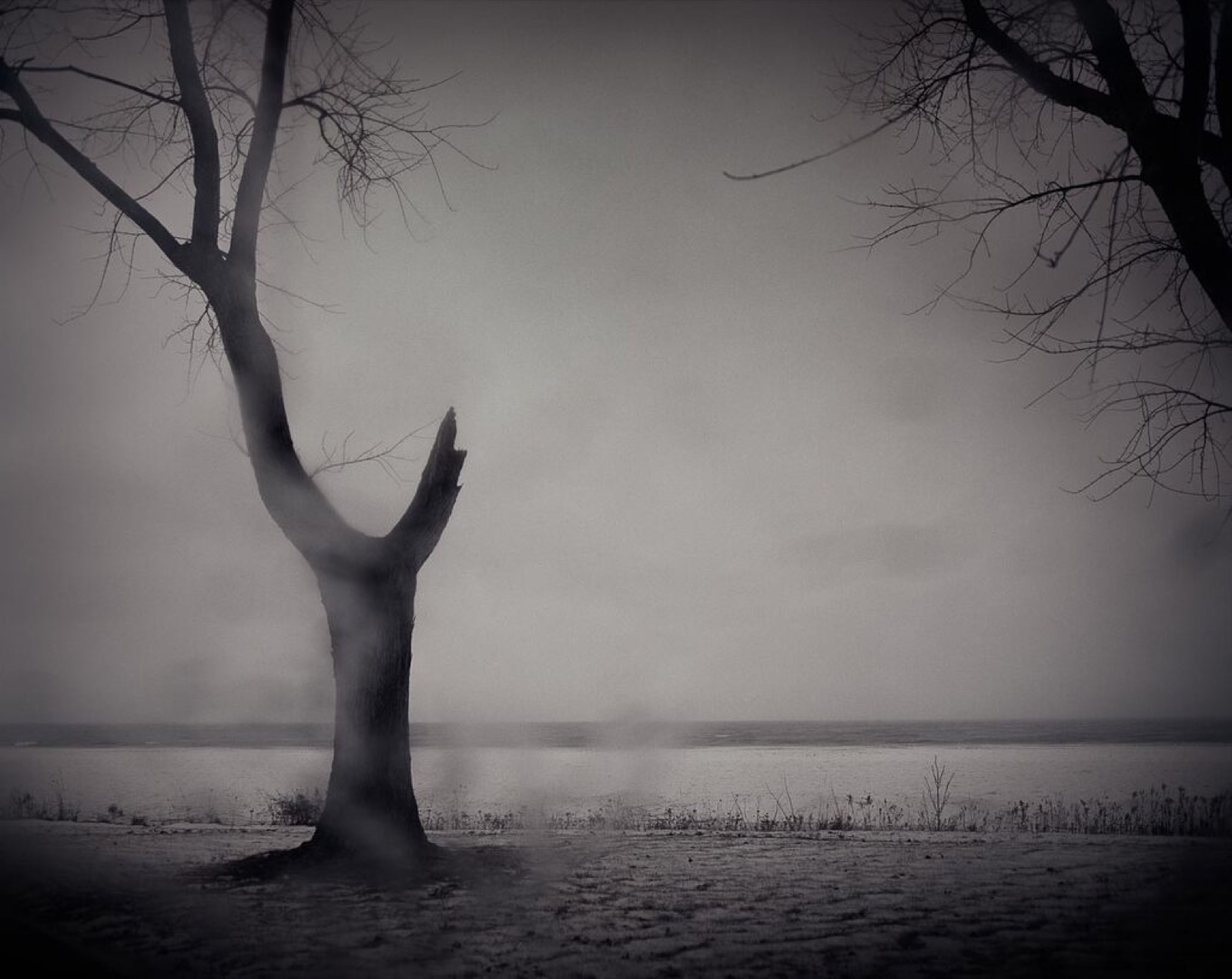

A broken tree beside grey water: photography dreamed this picture long before anyone made it. The smoky tones, the darkened corners, the drift of blur across the trunk all belong to the medium’s Pictorialist childhood, when photographers coaxed fog into their lenses to prove a camera could mourn. And mourning is the right register: the trunk forks, and one limb ends mid-air in a jagged snap, the oldest emblem of a life interrupted.
Around that wound the scene stays quietly factual: small waves arriving at a pale shore, winter stalks stiff along the bank, a second tree reaching into the frame from the upper right as if to check on its neighbor. Smudges of fog cross the image like thumbprints on glass, reminders that a photograph is never just a view but a thing made through surfaces — glass, vapor, paper — each leaving its trace. What we inherit is not the lake but this sensitive skin that once faced it.
The photographer, born in Kent, Ohio, and working from the San Francisco Bay Area, has spent decades driving into weather like this and filing what he finds under plain numbers, a habit closer to the vernacular album than to fine-art rhetoric. SFMOMA, the Getty and the Whitney keep his prints. Here the object is an archival pigment print: particles of pigment settled into paper, modern chemistry doing the slow tonal work gum and platinum once did, holding ash, smoke and silver-grey in suspension. The lake has long since changed; the skin that faced it is here, patient, transferable, alive to the hand that hangs it.